
Livraison le jour même ou le lendemain

Qualité garantie

Débloquez vos offres de bienvenue: Livraison GRATUITE | Jusqu'à -80 % | 30 jours d'essai gratuits à JoyPlus
Téléchargez l'application
A medication organiser can make taking medicines, vitamins or food supplements every day much easier. However, the wrong model can quickly become bulky, difficult to open or insufficiently protective when you are travelling.
Before buying a pill box, it is better to look at a few practical features rather than relying solely on marketing claims. Here are the main pitfalls to avoid, the criteria to compare and a selection of models suited to different needs.
A weekly pill organiser may look spacious enough, but some vitamin capsules, fish oil capsules or larger tablets take up considerable room. A compartment designed for small tablets can quickly become too narrow for a daily combination of several products.
Check the actual dimensions of the compartments and the stated capacity. If you need to store numerous tablets or larger capsules, a large-capacity pill organiser or a model with several compartments per day will be more practical.
Small push-button lids can be difficult to open for people with arthritis or limited grip strength. Conversely, a closure that is too loose may open inside a bag.
Compare push-button systems, individual lids and reinforced hinges according to your dexterity. Clear markings are also essential for distinguishing between days and different times of day.
Descriptions such as “sealed”, “waterproof” or “moisture-resistant” do not necessarily mean that the pill organiser can be submerged or kept in a damp bathroom. Check for a seal, an individual lid and the manufacturer’s care instructions.
Even with a sealed pill organiser or one described as moisture-resistant, store your medicines in a dry place and follow the storage conditions shown on their packaging. Some medicines must remain in their original packaging.
The right format depends on your medication schedule:
To reduce mistakes, choose clearly printed or engraved markings. Engraved lettering generally withstands wear better than simple printing, but always check that the model you receive is easy to read.
BPA-free plastic is commonly used for this type of accessory. This description provides information about the product’s composition, but does not in itself guarantee suitable storage for all medicines. Do not place tablets that are still damp in the compartments, and clean the case according to the manufacturer’s instructions.
A compact format is convenient when travelling, while a thicker case can accommodate larger capsules. Before ordering a portable medicine box, measure the space available in your bag or drawer.
An individual closure for each compartment helps prevent doses from mixing and reduces the risk of tablets spilling into your bag. If you need to split certain tablets, a tablet box with tablet cutter may be useful. However, not all tablets can be split. Check the information leaflet or ask your pharmacist for advice before making any changes.
A pill organiser does not replace the medicine’s packaging, label or storage instructions. It should also be kept out of the reach of children.
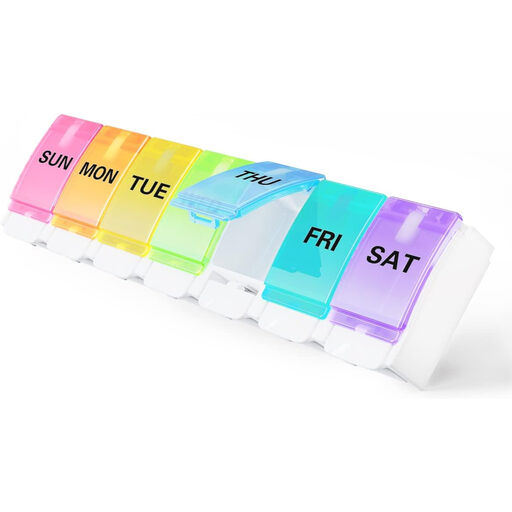
Why this choice suits this profile : This weekly morning-and-evening format is ideal for starting to organise your doses, both at home and when travelling. The push-button lids are designed to make opening easier.
The day and dose-time markings remove the need to rely on storage compartments that are difficult to identify. The button closure also helps prevent accidental opening inside a bag.
Seven-day organisation, two daily doses, compartments described as spacious and BPA-free polypropylene construction.
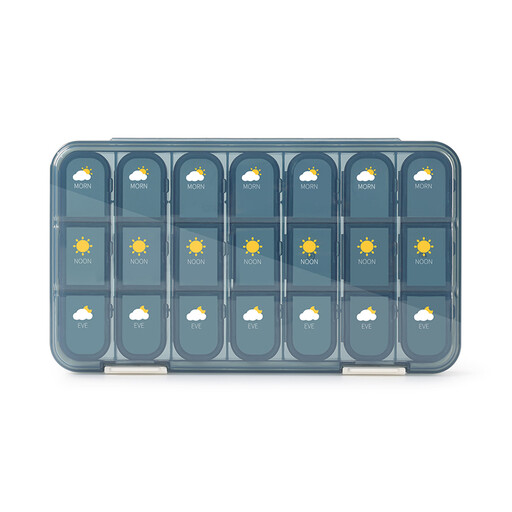
Why this choice suits this profile : Users who want to separate their doses precisely have 21 compartments, with dedicated storage for each day and time of day.
The double closure, consisting of an outer seal and independent inner lids, helps reduce the risk of doses mixing or the organiser opening during transport.
21 compartments, silicone seal and individual lids. The manufacturer describes a design intended to limit exposure to moisture.
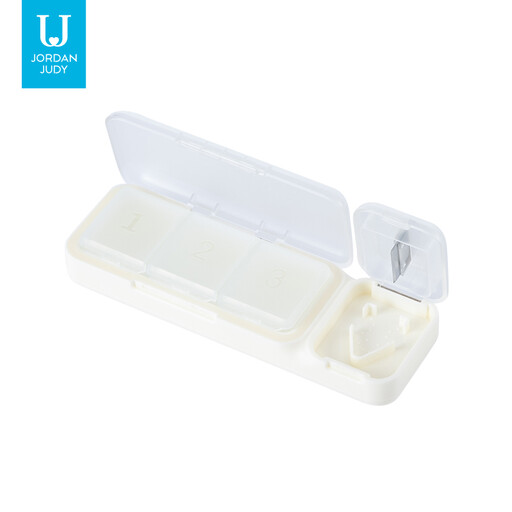
Why this choice suits this profile : Measuring 13,8 × 4,5 × 2,4 cm, this model slips easily into a handbag or pocket for everyday journeys. Its integrated tablet cutter meets a specific need, subject to the medicine being suitable for splitting.
There is no need to carry a separate accessory for splitting certain tablets. The snap-shut lid helps prevent tablets from spilling during transport.
Integrated tablet cutter, compact format and ABS, PP, PC and SUS301 stainless steel materials. Handle the blade with care.
We have put together a complete, real-time updated list of products that fully meet these strict selection criteria and European safety regulations.
Prepare the compartments in a clean, dry place, then check each one against the prescription or information leaflet. When helping someone close to you prepare their medicines, a second check by a carer can help reduce storage errors.
Clean the pill organiser with a damp cloth or slightly soapy water, following the manufacturer’s instructions. Dry each compartment thoroughly before filling it. Avoid using a dishwasher unless the manufacturer permits it, particularly for models fitted with a blade or seal.
When travelling, keep the essential treatment information with you and, where recommended, keep medicines in their original packaging. A travel pill organiser is designed to organise and carry doses, but it does not alter the prescribed storage conditions in any way.
There is no universal recommended lifespan. Replace it if the lids no longer close properly, the markings become difficult to read, a hinge cracks or the seal no longer works correctly. Regular cleaning and storing it away from heat will help keep it in good condition.
Not always. Some medicines are sensitive to moisture, light or contact with air. Check the information leaflet and ask your pharmacist for advice before removing a product from its original packaging. Tablets should not be mixed if this could make them difficult to identify.
For a few daily doses, a compact box with three or four compartments may be sufficient. If you need to store several capsules, choose a model with large compartments or a vitamin and supplement organiser arranged by day. Above all, compare the internal capacity, the clarity of the markings and how easy it is to open.