
Livraison le jour même ou le lendemain

Qualité garantie

Débloquez vos offres de bienvenue: Livraison GRATUITE | Jusqu'à -80 % | 30 jours d'essai gratuits à JoyPlus
Téléchargez l'application
For a new mum returning to work, travelling often, or simply wanting to express milk from time to time, a portable electric breast pump can really make daily life easier. But you need to know how to separate genuinely useful features from marketing claims that are harder to verify.
With its compact design, built-in battery and relatively discreet operation, the Medela Swing Solo portable electric breast pump seems purpose-built for life on the go. Before you place your order, though, it’s worth examining a few key points to avoid ending up with a pump that’s impractical, uncomfortable or fiddly to maintain.
The phrase “USB rechargeable” doesn’t guarantee that a device will last several days without needing a top-up. Before you buy, make sure you check:
The Medela Swing Solo Redesign claims up to six expression sessions per full charge, according to the manufacturer’s data. This figure is only a guide: the suction level, session length and battery wear can all affect the actual battery life you experience.
A discreet breast pump is especially welcome at the office, in a shared bedroom or in a public space. But the claimed noise level needs to be backed up by a concrete measurement. The Swing Solo product page states a maximum level of 45 dB. In practice, the noise you hear can vary depending on the surface the pump is placed on, the motor position and the setting you choose.
However, quietness shouldn’t come at the expense of ergonomics. The shape of the breast shield, the stability of the bottle and the simplicity of the controls will often have a much bigger impact on your day-to-day comfort.
An ill-fitting breast shield can make expressing milk uncomfortable, even painful. So check the size supplied and whether other sizes are available before you confirm your purchase.
This model comes with a PersonalFit Flex 24 mm breast shield. Its shape is designed to fit the breast better, but this technology doesn’t remove the need to choose a size that suits your own anatomy. If discomfort persists, consult the instructions and, if necessary, ask a healthcare professional for advice.
Cleaning is another aspect that’s often overlooked. Parts that come into contact with milk need to be easy to take apart, wash and dry. For the Swing Solo, the relevant parts are said to be dishwasher-safe on the top rack. It’s still essential to follow the manufacturer’s instructions and to check the condition of the parts regularly.
A single electric breast pump that recharges via USB can suit mums who want to cut down on cables and lighten their bag. While charging, though, make sure you keep the motor away from water and don’t use a damaged cable.
The Medela Swing Solo has a built-in battery. Lightweight and compact, it’s best suited to occasional use at the office or on the go. For very frequent sessions, plan a reliable charging solution and take note of the manufacturer’s guidance on battery lifespan.
The 2-Phase Expression technology alternates between a stimulation phase and an expression phase, according to the product description. The idea is to mimic a natural sequence, while still letting you adjust the settings to suit your preferences and comfort.
The PersonalFit Flex breast shield and its 24 mm diameter are features worth comparing with those of competing models. A soft, correctly positioned breast shield can make fitting easier and save you from having to adjust things repeatedly during a session.
For a breast pump intended for breastfeeding, check the composition of every part that comes into contact with milk. The Medela Swing Solo product page states that these parts are BPA-free and phthalate-free. The breast shield is made of silicone, while the bottle and lid are polypropylene.
This information reflects the declared material composition and is not a medical guarantee. Follow the washing, drying and steam sterilisation instructions, and replace parts as recommended in the manual.
The cards below compare the product with real-life situations. The other two references that may appear in a search containing the word “swing” are not breast pumps: they are a children’s item and a bed rail. A useful detail to help you avoid picking the wrong category when you buy.
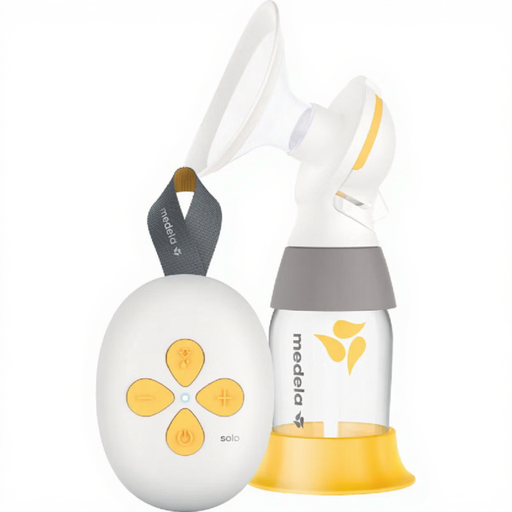
Why this choice suits this profile: its electric operation, built-in battery and compact design mean you don’t have to carry extra accessories for occasional sessions at home or on the move.
The product page mentions a rechargeable battery and up to six sessions per charge – a real advantage over a simple mains-powered pump with no stated battery life.
Built-in USB battery, 150 ml bottle, dishwasher-safe parts and milk-contact materials stated to be BPA-free.
Why this choice suits this profile: the combination of the PersonalFit Flex breast shield, 2-Phase Expression technology and a stated noise level of 45 dB is aimed at mums who value comfort and discretion.
The main features are identifiable and quantifiable: stated maximum noise level, 24 mm diameter and alternation between stimulation and expression.
PersonalFit Flex 24 mm breast shield, lightweight design and motor stated at 45 dB at maximum level.
Why this choice suits this profile: it can accompany you on journeys, during work breaks and for regular sessions where mobility matters more than a double pump or one designed for hospital use.
Its portable design and removable parts reduce bulk. For heavy use, however, plan for frequent maintenance and check the parts before each session.
Up to six sessions claimed per charge, dishwasher-safe parts and 150 ml bottle.
We’ve put together a full, real-time selection of products that meet these demanding criteria as well as European safety regulations.
Start by fully charging the battery, then assemble the clean parts. Position the breast shield and begin the stimulation phase at a low intensity. Then gradually increase the level to suit your comfort, referring to the instruction manual. The motor must never be immersed or placed under water.
There is no universal lifespan. It depends on how often you use it, how well you maintain it, and the condition of the valves and battery. Inspect the parts before each session and replace any that are cracked, warped or worn, in line with Medela’s recommendations.
The power consumption of a small rechargeable motor is generally modest. The ongoing cost mainly depends on replacing membranes, valves, breast shields and cables when needed. Washing also takes time and water. To estimate the long-term cost, check the availability and price of spare parts.