
Livraison le jour même ou le lendemain

Qualité garantie

Débloquez vos offres de bienvenue: Livraison GRATUITE | Jusqu'à -80 % | 30 jours d'essai gratuits à JoyPlus
Téléchargez l'application
Whether you're maintaining a car, a motorbike, a household installation or a workshop, a mechanics tool set can quickly become cumbersome if its contents don't match your needs. The number of pieces printed on the box isn't always enough to judge the suitability of a mechanics tool kit.
Here are the criteria to examine to avoid nasty surprises and choose equipment that's right for your garage, your vehicle or your DIY projects.
A 450-piece set might look extremely comprehensive. Yet some of the contents can sometimes boil down to bits in several variations or accessories you'll almost never use. For routine car maintenance, check above all for metric sockets, ratchets in several sizes, extension bars, hex keys and suitable bits.
In the UK, metric sizes should remain the priority. SAE sockets can nevertheless prove useful on certain vehicles, imported equipment or older machinery.
The mention chrome-vanadium steel, often abbreviated to Cr-V, refers to a family of steels commonly used for hand tools. On its own, it doesn't guarantee the tightening capacity or the service life of the equipment. Also examine the heat treatment, corrosion protection, fit precision and the quality of the ratchet mechanism.
For sockets used with an impact wrench, choose models designed for impact use, generally made from chrome-molybdenum steel, or Cr-Mo. A standard socket intended for manual tightening should not be used with a power tool.
A poorly compartmentalised case encourages losses, mixed-up sizes and tools that shift during transport. Clearly identified slots or a marked pouch let you quickly check the inventory after each job. A real advantage in a car boot, on a worksite or in a shared workshop.
The 1/4″, 3/8″ and 1/2″ drives aren't suited to the same tasks:
A 72-tooth mechanism offers a re-set angle of 5°, according to the specifications stated for certain models. It reduces the movement needed in awkward spots, but doesn't replace a torque wrench when the tightening torque must be precisely observed.
For a versatile DIY tool kit, check for the following items:
An adjustable spanner usefully completes a set, especially for fittings, plumbing nuts and general maintenance tasks. However, it shouldn't replace a correctly sized spanner when the tightening requires a precise grip.
A torque wrench is particularly useful for wheels, certain engine parts, bicycle components and assemblies where the torque is specified by the vehicle or machine manufacturer. Always respect the tool's measurement range as well as the recommendations for the part being assembled.
After each use, wipe the tools clean, store them in a dry place and lightly lubricate the ratchet mechanism when the instructions recommend it. Don't add an improvised extension to increase torque, and inspect sockets before each job.
The models below have been selected based on their composition, dimensions and the features stated in their product listings. They do not on their own guarantee the success of any particular repair.
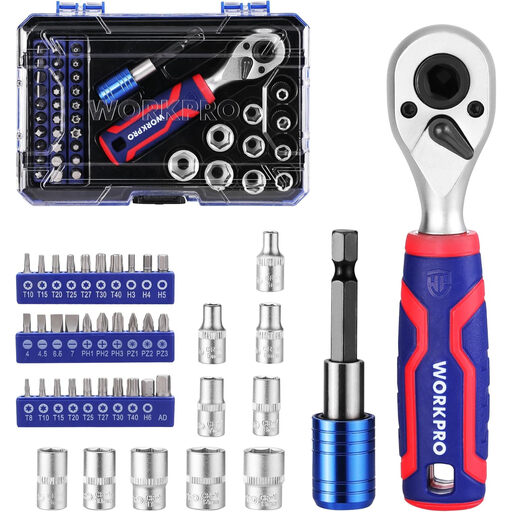
Why this choice suits this profile: Its compact format is ideal for small household repairs, routine maintenance and storage in a vehicle.
The 42 pieces are grouped in one box: 10 metric sockets, 30 bits and a 72-tooth ratchet stated with a 5° re-set angle.
1/4″ format, magnetic bit holder and chrome-vanadium steel for everyday tasks.
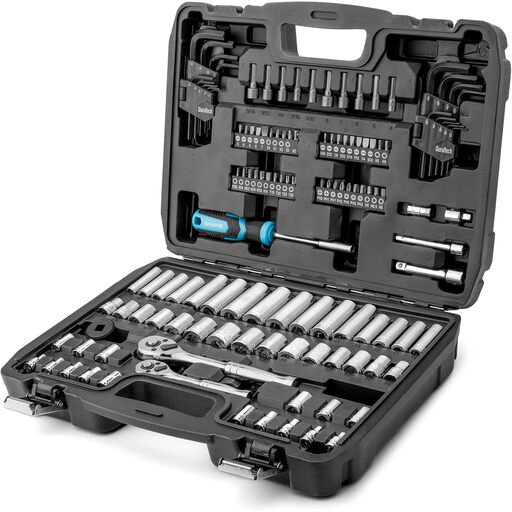
Why this choice suits this profile: This set brings together several tool families in a single case, enough to gradually equip a personal garage.
The detailed composition avoids confusing quantity with content: metric and SAE sockets, two ratchets, bits, hex keys and extension bars are all clearly listed.
121 pieces, treated Cr-V steel and storage case with clearly marked sizes.
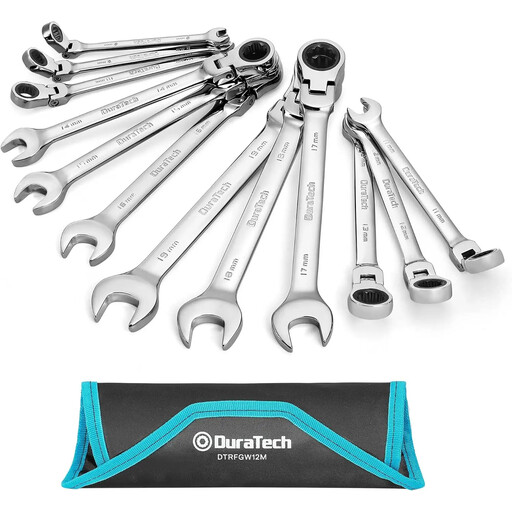
Why this choice suits this profile: Ratchet combination spanners are designed for repeated work in tight spaces, especially around an engine or a metal structure.
The 180° flex head and the stated 5° re-set angle address access problems, rather than simply adding sizes you won't use.
12 sizes from 8 to 19 mm, Cr-V steel and a roll-up pouch for transport.
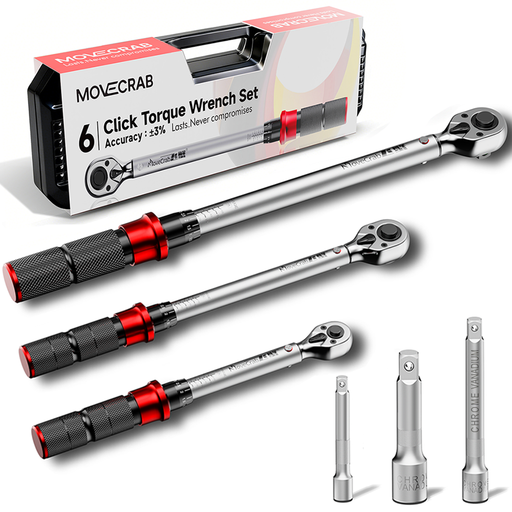
Why this choice suits this profile: People working on bicycles, motorbikes, cars or mechanical assemblies may need an extended torque range.
The listing states three ranges covering 5 to 220 N·m as well as three extension bars. The stated accuracy values should be checked in the supplied documentation before use.
We've put together a comprehensive, real-time updated selection of products that meet these demanding selection criteria and European safety standards.
For household tasks and routine car maintenance, a set of 40 to 120 pieces can cover the essentials, provided the sizes and accessories are well chosen. A larger set is mainly aimed at those who want to group several tool families together in a single case.
It allows you to carry out many simple operations, but not every job. Depending on the vehicle, you may need to add a torque wrench, spark plug sockets, deep sockets, a suitable jack or specialist tools. Always consult the manufacturer's documentation and use the appropriate protective equipment.
Clean the tools after each job, dry them before storing and put each piece back in its place. Avoid improvised extensions, tightening with the wrong size and using a ratchet as a striking tool. For a reversible mechanism, light lubrication in line with the instructions helps preserve smooth operation.