If you prepare meals in advance and regularly freeze portions, start by looking at a fridge-freezer with fridge and freezer capacities that suit the amount you usually store. If you freeze very little or are short on space, a single-door or table-top fridge may be a better fit. However, avoid choosing the largest capacity just in case: ADEME points out that a larger size and extra features can increase the energy consumption of an appliance that runs continuously.
Which households is each format suited to?
Households that prepare several meals in advance
If you store fresh ingredients, cooked meals and frozen portions, compare the two compartments of a fridge-freezer separately. Check that the storage space can accommodate your containers without filling the fridge completely.
Households that shop less often
Larger containers and regular stock-ups may call for more capacity. Even so, measure your kitchen and every route to the appliance’s location before choosing a larger model.
Smaller homes and lighter stocks
If you often buy fresh food and freeze very little, consider a table-top or single-door fridge. You still need enough room to store food without restricting air circulation, as recommended by ANSES.
What should you check before choosing?
Start with what you usually store and the space available, then compare the energy labels of appliances with a similar format and capacity.
| Criteria | What to check | My needs |
|---|
| Usable capacity |
Compare the fridge and freezer capacities in litres separately. Check there’s room for your containers, dishes and fresh food. |
I prepare portions to freeze: a large total capacity isn’t enough if the freezer compartment is too small. |
| Space and access |
Measure the height, width and depth. Check the delivery route, how the doors open and the clearances specified in the manual. |
My kitchen or access routes are narrow: I need to be able to install and open the appliance, not just get it into position. |
| Energy consumption |
The European energy label shows the class from A to G and consumption in kWh/year. Compare these alongside the capacity and features of similar models; ADEME highlights how size and extra features can affect consumption. |
If I don’t store much, I’d rather check the actual energy use of a larger appliance before opting for its extra capacity. |
| Food storage |
Check the shelves and drawers suit your containers. ANSES recommends keeping the coldest part of the fridge at 4 °C and avoiding overfilling it. |
I store cooked meals and fresh ingredients: I need enough room to put them away without blocking air circulation. |
| Noise and maintenance |
The European energy label gives the noise emissions. Check the exact model’s defrosting system and which features you’ll actually use. |
Noise matters to me in an open-plan kitchen; if I freeze food often, I also want to know what maintenance the freezer compartment needs. |
Which mistakes should you avoid?
-
Choosing the biggest capacity ‘just in case’
A fridge runs continuously. According to ADEME, its size and additional features can increase its energy consumption.
Estimate how much fresh and frozen food you usually store, then compare the capacity of each compartment and the kWh/year figures for similar-sized models.
-
Looking only at the energy rating letter
The energy class alone won’t tell you how much space is available for freezing or how noisy the appliance is.
Also check the kWh/year figures, the capacity of each compartment and the noise data on the European energy label.
-
Filling the fridge after every big shop
ANSES recommends not overfilling the appliance, so air can circulate, and keeping the coldest part at 4 °C.
Check that your shopping and meal containers fit on the shelves, leaving space between the food items.
-
Measuring the kitchen but not the route to it
An appliance may fit in its space but still be too wide to get through a doorway or allow its own doors to open fully.
Measure the route to the kitchen, then check the appliance dimensions and the clearances specified in its manual.
Some brands and models to compare
These details apply to the specific models listed, not to every appliance from each brand.
Bosch
The freestanding KGN39AIAU fridge-freezer is a useful model to consider when comparing compartment capacities and the footprint of a tall appliance.
- Bosch lists the KGN39AIAU as having 260 L of fridge space, 103 L of freezer space, an A energy rating and a noise level of 29 dB.
- Its stated dimensions are 2030 × 600 × 665 mm: check the available height and access routes.
Beko
The B3RCNE565HXB fridge-freezer is an example of a model whose fridge and freezer capacities should be considered separately.
- Beko lists this model as having 340 L of fridge space and 150 L of freezer space.
- Its specification gives it a D energy rating and consumption of 237 kWh/year. Compare these figures with those of appliances of a similar size and format.
Samsung
The RB38C7B6AS9/EF is worth considering if its connected features suit the way you plan to use it.
- Samsung lists this model as having a capacity of 387 L and dimensions of 595 × 2030 × 658 mm.
- According to Samsung, SmartThings features require Wi-Fi, a Samsung account and a compatible device.
Haier
The HCW99F18DHMB multi-door fridge-freezer is a useful reference when checking whether a larger format is right for your household’s food stocks and kitchen.
- Haier lists the dimensions of this model as 905 × 738 × 1825 mm.
- Check how the capacity is divided between compartments, the energy consumption of the exact model and whether you can get the appliance into your kitchen.
Fridges available on Joybuy
These models are mainly fridge-freezers and multi-door appliances for prepared meals and less frequent shopping, as well as a single-door model to consider if you freeze very little. Compare their dimensions and compartment layouts with your kitchen and the amount you usually store.
 Image unavailable
Candy CFQQ5T817EPS, 467 L multi-door fridge-freezer
If you store a lot of food, check that the stated capacity of 467 L suits your needs and that all four doors can open in your kitchen. The product title lists an E energy rating and Total No Frost.
View on Joybuy
 Image unavailable
Haier HTW5618ENMG, 360 L three-door fridge-freezer
If you store fresh meals and frozen portions, check how much space each compartment offers. The product title lists a capacity of 360 L, an E energy rating, Total No Frost, Wi-Fi and My Zone. Also check the dimensions and clearance required.
View on Joybuy
 Image unavailable
Samsung RF50C530EB1, 495 L multi-door fridge
Before choosing a larger model, consider whether the stated capacity of 495 L matches the amount you actually store. The product title lists an E energy rating; check the dimensions, clearances and installation requirements for any features you plan to use.
View on Joybuy
 Image unavailable
CHiQ JR227LSE, 227 L fridge-freezer
For a narrow kitchen where you still need freezer space, the product title lists 153 L of fridge space, 74 L of freezer space and a width of 54 cm. It also mentions Low Frost, a reversible door and an E energy rating. Check the height, depth and kWh/year for this model before comparing it with others.
View on Joybuy
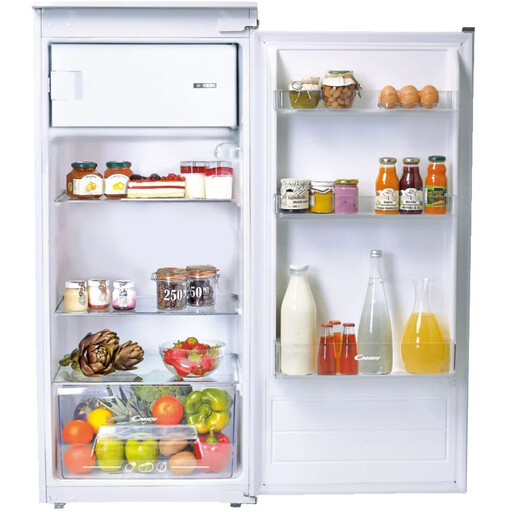 Image unavailable
Candy CIO 225 EE/N, 179 L single-door fridge
This 179 L single-door fridge is worth considering if you mainly store fresh food. Check the freezer compartment capacity before planning to use it for prepared portions. Also confirm the installation type for this model before buying.
View on Joybuy
Frequently asked questions
What capacity do you need for meals prepared several days in advance?
There’s no one-size-fits-all capacity: consider the size of your household, how often you shop and how much room your meals take up. Gifam recommends choosing a capacity to suit your household. If you freeze portions, compare the fridge and freezer capacities in litres separately.
What temperature should you check for foods that need extra care?
ANSES recommends keeping the coldest part of the fridge at 4 °C. This is where you should store foods such as meat, fish and cooked meals. Avoid overfilling the appliance too, so air can circulate.
Is the energy class enough to compare two models?
No. The European energy label for fridges and freezers also shows annual energy consumption, storage capacity and noise levels. Compare these details across appliances of a similar format and capacity, taking into account how much space you actually need.


