Choosing criteria
Start by separating your fresh-food and freezing needs, then check that the chosen format remains accessible and suitable for its location.
| Priority |
What to check |
Your needs |
| Fresh and frozen food split |
Compare the usable litres of the fridge and freezer separately. Check whether you need a combined or separate appliance, along with drawers, baskets and storage areas suited to your containers. |
I want to keep fresh food without running out of room for prepared portions. A simple internal freezer compartment is not suitable when you have a lot of frozen food, according to UFC-Que Choisir. |
| Footprint and access |
Measure the external dimensions, door or lid clearance and access to the drawers. Compare the floor space required by an upright freezer with that of a chest freezer. |
I need to be able to open the appliance, load the portions and find them easily within the available space. |
| Continuous running costs |
Compare the A to G energy label and annual consumption between appliances with similar formats and capacities. Size the capacity according to your actual needs. |
I want useful storage without continuously maintaining unused capacity. The energy label helps compare stated consumption, but it does not on its own show whether the appliance suits my needs. |
| Installation |
Check the climate class, especially outside the kitchen, as well as the ventilation clearances specified in the instructions. Also check that the appliance is level and that the doors close properly. |
My appliance must remain suitable for use in a kitchen, utility room, cellar or garage compatible with its installation requirements. |
Joybuy products
Joybuy options for organising fresh food and frozen portions, including fridge-freezers and dedicated freezers suited to different storage requirements.
 Image unavailable
CHiQ JR263LGE 262 L Low Frost 70/30
This fridge-freezer is suitable for managing fresh food and a moderate supply of frozen portions at the same time.
187 L fridge and 75 L freezer capacity, three freezer drawers, 54 cm width, class E and stated consumption of 215 kWh/year.
The N-ST climate class is stated for a range of 16 to 38 °C; the 75 L freezer may be limiting for a large supply. Also check the ventilation and door clearance.
Joybuy
 Image unavailable
CHiQ JR227LSE 227 L Low Frost
This compact fridge-freezer helps separate fresh meals from prepared portions in a small kitchen.
153 L fridge capacity, 74 L freezer capacity, 54 cm width, 4-star freezing, reversible door, adjustable feet and class E.
74 L of freezer capacity may not be enough for family-sized batches stored over a long period. Check the climate class, annual consumption and ventilation clearances.
Joybuy
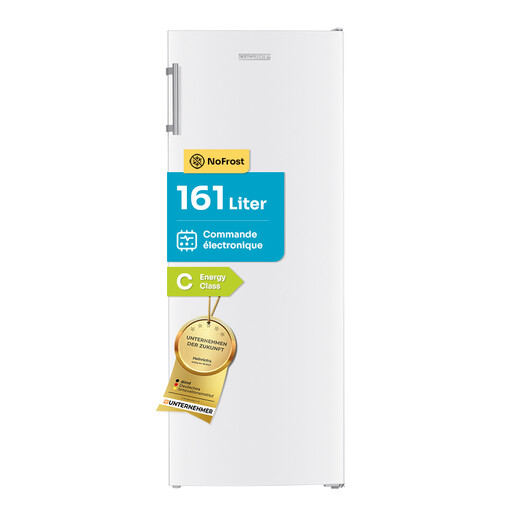 Image unavailable
Heinrich´s 161 L No Frost upright freezer
This upright freezer adds dedicated storage for frozen portions when a fridge already takes care of your fresh food.
161 L freezer capacity, No Frost protection, three drawers, two shelves, LED display, alarm and class C.
It provides no fridge space. Check the dimensions, climate class, noise level, annual consumption and whether the drawers are suitable for your containers.
Joybuy
 Image unavailable
CHiQ JR99DWE 99 L chest freezer
This chest freezer provides additional storage for frozen portions in a format designed for smaller storage areas.
99 L freezer capacity, removable wire basket, adjustable thermostat, dimensions of 54.5 × 47.6 × 83.5 cm, 4-star freezing and class E.
Chest-freezer storage requires an organised approach. Check the climate class if you plan to use it in a cellar, garage or utility room; manual defrosting is indicated when frost exceeds 5 mm.
Joybuy
 Image unavailable
Sonlu CC-520WE 444 L Total No Frost
This large-capacity model may suit less frequent shopping if the actual split between fresh and frozen food matches the way you organise your supplies.
Stated total capacity of 444 L, Total No Frost, class E, stated consumption of 289 kWh/year, stated noise level of 40 dB and SN-T climate class.
Check the usable litres of each zone, the external dimensions, door clearance, internal storage and ventilation clearances before installation.
Joybuy
Frequently asked questions
How can I estimate the fridge capacity I need before choosing a freezer?
As a starting point, UFC-Que Choisir recommends 100 to 150 litres for one person, followed by around 50 additional litres per person. This guideline applies to the fridge: check the freezer compartment capacity separately and don’t rely on the total capacity alone.
Is a simple freezer compartment enough for preparing meals in advance?
Not if you regularly store a lot of frozen food or prepared portions. UFC-Que Choisir states that a simple freezer compartment is not sufficient in this situation: instead, compare a fridge-freezer with a proper freezer compartment and a separate freezer.
Should I choose an upright freezer or a chest freezer?
Choose an upright freezer if you prioritise drawers, sorting portions and a smaller footprint. A chest freezer is suitable for a large open storage area for bulky supplies, provided you have enough space and check the climate class.
What should I check before delivery and installation?
Measure the delivery route, installation location, door or lid clearance and access to the drawers. Also check the ventilation required by the instructions; Bosch states in its FAQ that at least 200 cm² of free space is needed behind and beneath the fridge, but the instructions for the model you purchase take priority.
Is an energy label compulsory for a new fridge or freezer sold in France?
Yes. Refrigeration appliances, including fridges and freezers, are among the categories subject to energy labelling in France, according to the ministries responsible for the ecological transition. The scale runs from A to G: also compare annual consumption between appliances with similar uses and capacities.


