Households preparing portions every week
If you open your freezer often, drawers make it easier to separate meals, ingredients and leftovers. Look at how they’re arranged, and check whether the model has a door or temperature alarm.


If you often need to find prepared portions, an upright freezer with drawers makes them easier to access. For larger stocks and enough floor space, consider a chest freezer instead. A fridge freezer or under-counter freezer may suit a smaller amount. Whichever you choose, check the freezer compartment’s capacity, the space needed for installation and the model details on its energy label. The format alone won’t tell you its energy consumption or how long it will keep food frozen during a power cut.
The amount you need to store matters, but how often you look for a portion also affects which format is right for you.
If you open your freezer often, drawers make it easier to separate meals, ingredients and leftovers. Look at how they’re arranged, and check whether the model has a door or temperature alarm.
For bulk buys or seasonal produce, compare the capacity of a chest freezer with that of a large upright. A chest freezer needs enough room for the appliance and to open its lid. If it’s going in a pantry or garage, also check the ambient temperatures the model can operate in.
If you’re replacing your fridge anyway, check the fridge freezer’s frozen-food compartment capacity rather than its total capacity. An under-counter freezer may also be an option if its dimensions and the required clearances suit your kitchen.
Start with the portions you plan to store and the space available, then compare the features of models that meet both requirements.
| Consideration | What to check | How it affects your needs |
|---|---|---|
| Capacity and access | Compare the freezer compartment capacity, the layout of the drawers or baskets, and the size of your usual packaging. Also measure the space needed to open the door or lid. | I prepare several portions each week, so I want to organise them and reach the ones at the back, not just have lots of capacity. A chest freezer could work for stockpiling if I organise its open space. |
| Freezing meals | If you plan to freeze prepared food, check for a 4-star freezer compartment and the stated freezing capacity in kg/24 h. The French Ministry of Agriculture recommends setting it to -18 °C. | If I regularly put freshly prepared meals in the appliance, I need to distinguish a proper freezer compartment from an ice box intended for temporarily storing already-frozen food. |
| Energy use and noise | According to the European Commission, the energy label shows details including kWh/year, capacity and noise. Compare the kWh/year of appliances with similar capacities and layouts, rather than looking only at the A to G rating. | An extra appliance will run continuously in my home, so I want to know its stated annual energy use and check that its capacity suits the amount I actually plan to store. |
| Power cuts | Check the stated storage time in hours and whether the appliance has a temperature alarm. UFC-Que Choisir’s tests also assess how quickly the temperature rises during a simulated power cut; results apply to the models tested. | If I’m storing a large amount of food, I’d rather compare how long each model can keep it frozen and know whether a rise in temperature can trigger an alert. |
| Where to put it | Measure the height, width and depth, and check the clearances specified in the manual. For an unheated room, check the climate class and the ambient temperature range allowed for the exact model. | In a small kitchen, an under-counter freezer or fridge freezer could save space. If I’m putting an appliance in a garage or pantry, I need to check that it’s suitable for the room conditions. |
Its open space can hold plenty of food, but items at the bottom are harder to find than in the drawers of an upright freezer.
If you often reach for your meals, compare the two formats. With a chest freezer, use baskets, label portions and organise them so you use the oldest first.
The French Ministry of Agriculture distinguishes between an ice box, used to store already-frozen food temporarily, and a 4-star freezer compartment, which can freeze food.
Before planning to store batches of homemade meals, check the compartment’s star rating and the model’s freezing capacity.
The rating alone doesn’t tell you how much energy a model uses in a year or how much freezer capacity it offers. The European Commission says these details are shown separately on the label.
Compare the kWh/year of models with similar capacities and layouts, then check the noise level if the appliance will be near a living area.
The permitted ambient temperatures depend on the model. A claim that one model is suitable for a cold room doesn’t mean the whole range is.
Check the room’s seasonal temperatures, the climate class, the installation instructions and the required ventilation clearances for the appliance you choose.
These ranges can help you identify formats and features to compare. Any stated figures apply to the specific model concerned.
Bosch offers upright and built-in freezers, as well as larger vertical models.
Beko’s French range includes upright and chest freezers, with features varying by model.
Liebherr offers freestanding NoFrost freezers, built-in models and table-top formats.
Whirlpool’s French range includes upright and chest freezers. Some upright models have drawers for separating food.
These models include fridge freezers for replacing your fridge while still having freezer space, a small upright freezer and a compact chest freezer. Before choosing a format for your portions, compare the freezer capacity, which is separate from the total capacity of a fridge freezer.
 Image unavailable
Worth considering if you’re replacing your fridge too and want to organise portions in the freezer compartment. The 467 L refers to the total capacity of the fridge freezer, so compare the freezer capacity separately. The product description lists Total No Frost and an E energy rating. Check the dimensions and clearances before installation.
 Image unavailable
This fridge freezer is suited to households replacing their fridge and wanting to organise frozen portions. The 360 L is the total capacity, not the freezer capacity alone. The product description lists Total No Frost, Wi-Fi, My Zone and an E energy rating. Check the freezer capacity and the space required according to the manual.
 Image unavailable
Its 60 L capacity and three drawers could suit a small stock of separated portions. The product description lists a reversible door, adjustable thermostat and E energy rating. If you’re installing it under a worktop, check the dimensions, door clearance and required ventilation. Also compare the kWh/year on the energy label.
 Image unavailable
This 99 L chest freezer could hold a compact stock of food if you have enough floor space and clearance to open the lid. The product description lists a removable basket, adjustable thermostat, four stars and an E energy rating. The basket helps you separate smaller items; organise the food at the bottom too, and check the kWh/year and permitted ambient temperature range.
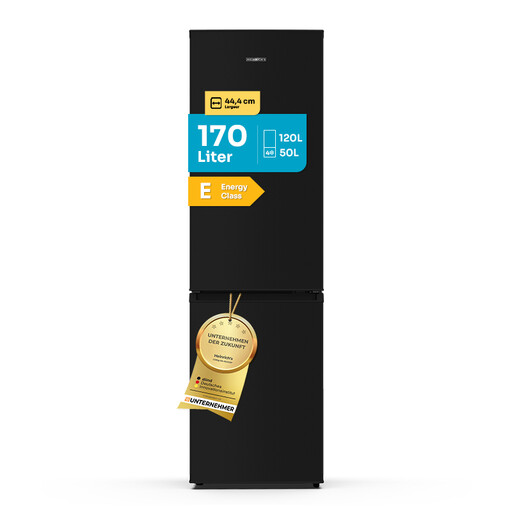 Image unavailable
If you’re replacing a fridge but still need a small amount of freezer space, this model’s product description lists 120 L of fridge capacity and 50 L of freezer capacity. It also lists a noise level of 40 dB and an E energy rating. Check that the freezer compartment is big enough for your portions, then check the dimensions and kWh/year before choosing.
The French Ministry of Agriculture recommends setting it to -18 °C. Also follow the storage instructions on food packaging and the appliance manual: freezing food doesn’t make it safe to eat indefinitely.
Not necessarily. The French Ministry of Agriculture distinguishes between an ice box, designed to store already-frozen food temporarily, and a 4-star freezer compartment that can bring the centre of food down to -18 °C quickly. Check the star rating and freezing capacity before putting prepared meals in it.
Don’t refreeze a defrosted meal as it is; the French Ministry of Agriculture advises against this. Anses recommends defrosting food in the fridge, in the microwave using the defrost setting, or quickly by cooking or reheating it, then eating it promptly.
For the household appliances covered in the European Union, the European Commission says the label shows details including the A to G rating, annual energy use in kWh, capacity and noise. Compare the kWh/year of models with similar capacities and layouts. The QR code links to their EPREL product information.
Yes, but only if the garage temperature falls within the range allowed for the model and you can follow its installation instructions. For example, Beko says some Freezer Guard models can operate in ambient temperatures as low as -15 °C, but this doesn’t apply to its whole range. Always check the exact model.