What should you look for first?
Start by considering the type and frequency of the food you store: portions you need to find regularly, large batches and the occasional meal all call for different amounts of freezer space. For each use, the checks below will help you compare appliances without confusing storage volume with freezing capacity.
| Feature |
What to check |
Who should consider it? |
| Access to portions |
Number and size of drawers or baskets; space for your usual containers. |
When you prepare several meals in advance, being able to find a portion without moving the whole stock makes a difference day to day. Around 36% of consumers put this kind of organisation first. |
| Storing batch-cooked meals |
Usable capacity in litres and freezing capacity in kg/24 h — two different measurements. |
To freeze large dishes or several batches on the same day, you need enough space and freezing capacity suited to the amount you’re adding. Capacity is the top priority for around 29% of consumers. |
| Continuous energy use |
kWh/year shown on the label, considered in relation to the capacity you actually need. |
Adding an appliance for just a few portions may not suit anyone looking to avoid having capacity that remains underused. For around 21% of consumers, the energy use of an appliance that runs continuously is the main consideration. |
| Location and temperature |
Dimensions, ventilation and the ambient temperatures allowed in the manual; whether the compartment can maintain −18 °C for domestic freezing. |
In a small room or an unheated garage, the appliance needs to fit the space and operate in the conditions specified for that model. Around 14% of consumers prioritise this compatibility with their installation and storage requirements. |
Appliances for different needs
These Joybuy appliances illustrate three different uses: storing portions in a chest freezer, organising them in an upright freezer, or combining refrigeration and freezing in one appliance. Compare the freezer space with the amount you usually prepare before choosing.
 Image unavailable
CHiQ JR99DWE, 99 L chest freezer
Worth considering if you want to store portions in a chest freezer and separate smaller items using the removable basket.
The product name specifies a 99 L capacity, a sliding lid and an E energy rating. Check the kWh/year figure and make sure you have enough space to access the chest.
View on Joybuy
 Image unavailable
Heinrich´s, 161 L No Frost upright freezer
Worth considering if you want to organise portions across several drawers and access your supplies from the front.
The product name specifies three freezer drawers, a temperature range of −14 °C to −22 °C and a C energy rating. Before planning large batches or installing it in a cold room, check the freezing capacity, kWh/year, dimensions and permitted ambient temperature.
View on Joybuy
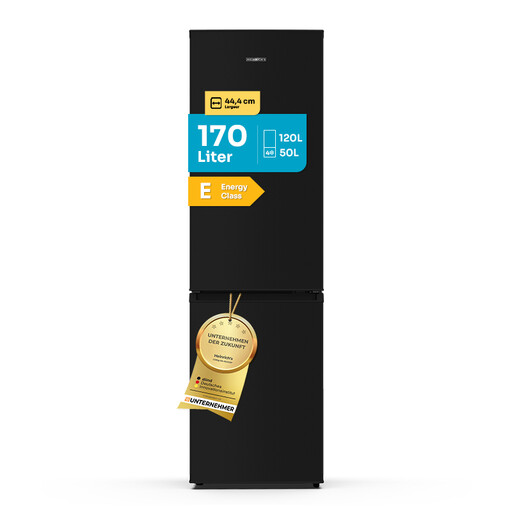 Image unavailable
Heinrich´s, 170 L fridge freezer (120 L + 50 L)
Compare it with a dedicated freezer if you also need fridge space and 50 L of freezer capacity is enough for your prepared meals.
The product name specifies 120 L for the fridge, 50 L for the freezer compartment, 40 dB and an E energy rating. Check the kWh/year figure, freezing capacity and dimensions before choosing this format.
View on Joybuy
Frequently asked questions
What temperature should you use to freeze home-cooked meals?
Check that the compartment can maintain −18 °C for domestic freezing. Anses says that bacterial growth stops at this temperature, but most micro-organisms survive freezing. Don’t assume that a basic freezer compartment offers the same features as a four-star freezer.
Can you wait until a meal is close to its use-by date before freezing it?
No. Anses recommends freezing food as soon as you buy or prepare it, rather than waiting until its use-by date is approaching. It recommends defrosting food in the fridge, in a microwave using the defrost setting, or quickly by cooking or reheating. Once defrosted, eat it promptly and don’t refreeze it.
How do you compare the energy use of a fridge freezer and a freezer?
Compare the kWh/year figures, then look at the usable freezer capacity and the features you need. ADEME points out that these appliances run continuously, and their size or excess capacity can affect energy use. The energy rating alone doesn’t reflect how you use an appliance.
Does a freezer sold in France need an energy label?
Yes. The French Ministry for Ecological Transition includes freezers and fridges among the appliances covered by energy labelling under European Regulation 2017/1369. When comparing two appliances, also check their stated energy use and take their respective capacities into account.
Can I install a freezer in a garage or cellar?
Only if the room’s temperature and installation conditions meet the requirements in the manual for your chosen model. Beko says that some models with Freezer Guard can operate at ambient temperatures as low as −15 °C; this feature doesn’t automatically apply to other appliances.


