People who freeze portions every week
If your freezer fills up after every batch-cooking session, check its usable capacity and how easy it will be to store and find your portions.


If you store both fresh ingredients and a few frozen portions, compare the usable capacity of each compartment in a fridge freezer. If the frozen portions regularly fill the existing compartment, consider adding a separate freezer instead: an upright model makes it easier to organise food in drawers, while a chest freezer means you’ll need to think about how to reach food at the bottom.
If your freezer fills up after every batch-cooking session, check its usable capacity and how easy it will be to store and find your portions.
When fresh ingredients and prepared meals share the fridge, chilled storage space and shelf dimensions matter more than the total capacity alone.
An additional upright or chest freezer can free up space in your main freezer. Measure the space you have in mind and check that the model’s climate class is suitable for the temperature in that room.
Start by separating the food you want to keep chilled from the portions you plan to freeze, then compare each appliance type with your available space and the way you like to find your meals.
| Priority | What to check | Based on my needs |
|---|---|---|
| Fresh and frozen capacity | Compare the usable capacity of each compartment separately, as shown on the energy label in line with European Commission guidance. Also check how much room your containers will take up. | I keep fresh ingredients and meals chilled, as well as a few frozen portions: a fridge freezer needs enough room in both compartments. If I mainly need more space for fresh food, I’ll first look at a larger model with more fridge capacity. |
| Extra freezer space | Compare the overall size and internal layout. UFC-Que Choisir distinguishes chest freezers, which can offer generous capacity, from upright models, which are generally arranged in compartments. | My frozen portions already fill the fridge freezer: an upright model with drawers would make it easier to organise them. I’d also consider a chest freezer for larger containers, as long as I can easily reach anything stored at the bottom. |
| Temperature | Plan to check the actual temperature, especially after filling the appliance. For a household fridge, ANSES recommends aiming for between 0 °C and 4 °C in the coldest part. | When I fill the fridge with prepared meals, I want to check that it’s maintaining the right temperature. A large capacity or NoFrost function is no substitute for doing this. |
| Installation and use | Check the dimensions, clearance needed and climate class. When comparing appliances of a similar size and capacity, also check their energy consumption and noise levels on the European energy label. | If I add an appliance to a utility room, I need to make sure it will fit through the doorway, that the door or lid can open fully, and that I’ve considered its ongoing energy use. Noise is also a factor if it’s going in a living space. |
A spacious appliance may still have a freezer compartment that’s too small for the portions you want to store. The European energy label shows the capacity of each compartment separately.
Estimate how many containers you’ll store at once, then compare the fridge and freezer space separately.
Capacity alone won’t tell you whether the freezer will fit in the room or whether the lid can open fully. The temperature where you plan to install it must also be suitable for the model’s climate class.
Measure the space, the route into the room and the clearance needed to open the lid before you choose.
NoFrost helps prevent frost; it doesn’t, by itself, guarantee that food in the fridge is kept at the right temperature. ANSES recommends between 0 °C and 4 °C in the coldest part of the fridge.
Compare maintenance features if they matter to you, but also plan to check the fridge’s actual temperature.
An additional freezer runs continuously and needs its own space, separate from your existing fridge.
Compare its energy consumption, noise, dimensions and usable capacity with similar-sized appliances; the European Commission lists this information on the energy label.
These product ranges illustrate different formats and layouts. The features mentioned relate to the specific models named and don’t necessarily reflect products available on Joybuy.
Bosch offers fridge freezers that combine chilled and frozen storage in one appliance.
Liebherr also offers dedicated freezers with NoFrost.
Haier offers upright and chest freezers. The right format for you will depend on how you want to access your portions and how much space you have.
The Beko RFNM200T40WN upright freezer is one example of a model with compartmented storage.
Whirlpool offers fridge freezers, including No Frost models.
This selection includes fridge freezers for storing chilled meals and frozen portions, as well as an upright freezer to consider if you already have enough fridge space.
 Image unavailable
To keep fresh and frozen meals in one appliance, compare the space in each compartment with the size of your containers.
Advertised total capacity of 360 L; Total No Frost and energy class E listed in the product name. Check the dimensions and clearance needed for installation.
 Image unavailable
This four-door model is worth considering if you store batches of fresh and frozen meals; check how much space is available in each compartment.
Advertised total capacity of 467 L, Total No Frost and energy class E. Measure the space needed in your kitchen and along the delivery route.
 Image unavailable
If you’re looking for a single appliance for fresh ingredients and portions to freeze, make sure the bottom freezer compartment can hold everything you plan to store.
Advertised total capacity of 282 L and energy class E. Follow the manufacturer’s instructions for transport and installation.
 Image unavailable
This freezer can supplement a fridge that already has enough chilled space when you need more room for frozen portions; it isn’t for meals that need to stay chilled.
Advertised capacity of 161 L, No Frost and energy class C. The product name lists three freezer drawers, two other drawers and an alarm. Check the dimensions and annual energy consumption to make sure it suits your space.
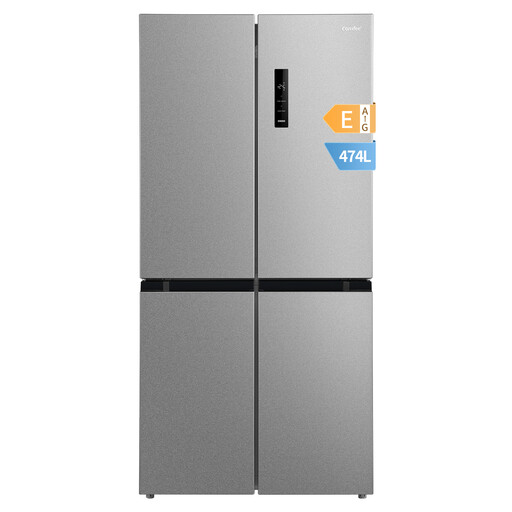 Image unavailable
If you’re looking for plenty of overall capacity for your prepared meals, check how the space is split between the fridge and freezer before deciding how many portions to store.
The product name lists a total capacity of 474 L, four doors and energy class E. Also check the dimensions, annual energy consumption and defrosting method.
ANSES recommends between 0 °C and 4 °C in the coldest part of a household fridge. Check the actual temperature, particularly when you’ve filled the appliance with several meals.
Not if your main priority is storing more frozen portions: a larger fridge compartment doesn’t tell you how much room there is for frozen food. Compare the usable capacity of each compartment separately before choosing between a fridge freezer and an additional freezer.
Choose based on your containers and how often you need to access them. An upright freezer with compartments makes it easier to organise portions you use often; a chest freezer offers open storage worth considering for larger batches, but you’ll need to plan how to reach food at the bottom. UFC-Que Choisir also distinguishes between these two formats by their capacity and layout.
For household refrigeration appliances covered by the European energy label, compare the storage capacity, energy consumption and noise emissions listed in line with European Commission guidance. Ideally, compare models of a similar size and capacity, then check their dimensions against the space you have available.