For a tea break with biscuits
You want to make a single cup without whisking powder. A green tea bag containing matcha fits the bill, provided you’re happy with the other ingredients and the blend’s flavour.


For a cup of tea to enjoy with biscuits, choose a tea bag blend if its green tea profile appeals to you. Check the ingredients: the Pukka and Jardin Bio Étic products featured by Auchan contain 2% and 3% matcha respectively. If you want to whisk matcha or add it to biscuits, look instead for matcha powder or plain matcha sticks, which are prepared differently. In either case, check explicitly what shape the tea bags are before assuming they’re pyramid-shaped.
You want to make a single cup without whisking powder. A green tea bag containing matcha fits the bill, provided you’re happy with the other ingredients and the blend’s flavour.
You’re looking for powder to mix, either on its own or with milk added by you. A green tea bag containing a small amount of matcha is prepared differently and won’t meet the same need.
You want to measure matcha into a dough or filling. Matcha powder or a plain matcha stick is worth considering. Check the ingredients before using a latte blend in a recipe.
Choose this if : you want to brew a cup of green tea to enjoy with biscuits.
Bear in mind : containing matcha doesn’t make the blend plain matcha powder; you’ll need to check separately whether the tea bags are pyramid-shaped.
Choose this if : you want to make a matcha drink or measure matcha into biscuits.
Bear in mind : powder needs to be mixed or whisked; a stick of powder isn’t brewed like a tea bag.
To choose between the formats, start with what you want to make, then check the ingredients and instructions for the exact product variant.
| Factor | What to check | Who is it for? |
|---|---|---|
| How much matcha it contains | The ingredients list, the stated proportion of matcha and the difference between a green tea blend and matcha powder. | If I want to whisk matcha or measure it into a recipe, a simple cup of green tea with matcha won’t be enough. Around 31% of consumers would put this distinction first. |
| Flavour with biscuits | The blend’s other ingredients, particularly mint, lemongrass, liquorice or lemon if listed on the label. | I’d rather choose an infusion flavour to go with the biscuits I’m serving than rely on the word “matcha” alone. This would be the priority for around 31% of consumers. |
| Preparation | The exact format — tea bag, powder stick or another type of product — and its instructions. | For a quick break, I want to make a cup without getting out a whisk. Around 23% of consumers would prioritise this convenience. |
| Ingredients you want | The ingredients in the exact variant, especially milk and sugar in a latte blend; check for certification details if they matter to you. | If I want to decide for myself whether to add milk or sugar, the ingredients matter more than how the drink is presented. Around 15% of consumers would make this their top priority. |
Auchan’s listings for Pukka Thé Vert Suprême et Matcha and Jardin Bio Étic Thé vert Matcha au citron state that they contain 2% and 3% matcha respectively. These tea bags are for making infusions, not for measuring matcha powder into biscuits.
Read the ingredients list and choose a product described as matcha powder if you want to whisk it or add it to a recipe.
The number of tea bags and their ingredients don’t tell you whether they’re pyramid-shaped. This distinction matters if the shape of the tea bag is one of your buying criteria.
Look for an explicit description or a sufficiently clear image on the packaging or listing for the variant you plan to buy.
Dammann Frères says its Matcha Latte sticks combine matcha with ingredients including skimmed milk powder and sugar. They therefore have a different composition from plain matcha powder.
If you want to measure these ingredients separately into your cup or biscuits, compare the ingredients lists before choosing a stick.
Thé Vert Suprême et Matcha is a green tea blend sold in tea bags.
Its Thé vert Matcha au citron is a tea bag infusion combining several plant-based ingredients.
The brand offers Matcha Tradition in pre-portioned sticks, which are different from its Matcha Latte sticks.
Its matcha powder products are for people who want to make a drink using a whisk.
The brand offers several Japanese matcha powder products, including Cérémonie and Originel.
These two products suit different purposes: brewing mint green tea containing matcha to enjoy with biscuits, or considering a 30 g matcha product for cooking. If you specifically want a pyramid tea bag, check its shape before buying.
 Image unavailable
For brewing a cup of mint green tea to enjoy with biscuits during a break. The ingredients listed by Joybuy include 60% sencha green tea, 20% spearmint, 18% peppermint and 2% matcha, so this isn’t plain matcha. Check the shape of the tea bags if you want a pyramid format.
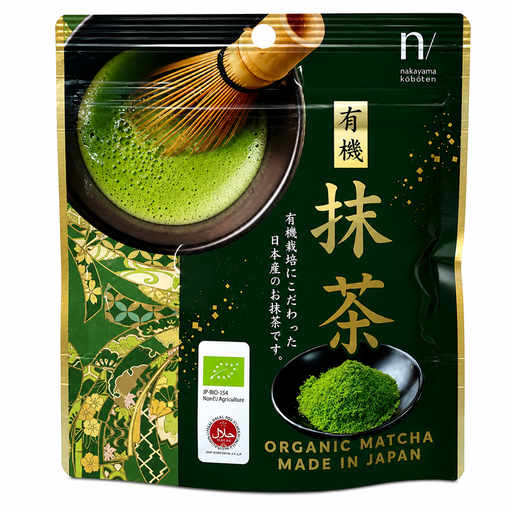 Image unavailable
Worth considering if you’re thinking of using matcha in biscuits. This product is listed in a 30 g size; check its physical format, ingredients and preparation instructions to make sure they’ll work for your recipe. Don’t choose it as a tea bag for infusing without checking first.
No, not when matcha is just one ingredient in the blend. Auchan’s listings state that Pukka Thé Vert Suprême et Matcha contains 2% matcha and Jardin Bio Étic Thé vert Matcha au citron contains 3%. If you want to use matcha on its own, read the ingredients list for the product you choose.
For whisked matcha, Palais des Thés recommends sifting one teaspoon or two matcha scoops, then adding 5 cL of water at 70 °C and whisking. Always follow the instructions for the product you’re using: powder and a tea bag for infusing aren’t prepared in the same way.
Check that the pyramid shape is stated or clearly shown for the exact product variant. The word “matcha”, a detailed ingredients list or the number of tea bags isn’t enough to confirm their shape.
No. According to the European Commission, the organic logo relates to product certification and requires at least 95% organic ingredients; it doesn’t specify how much matcha a blend contains or the shape of its tea bag. Check the ingredients and product description for those details.
Yes, particularly if you belong to a group advised by Anses to limit caffeine, including pregnant or breastfeeding women, children and teenagers. When choosing a drink, check the information for the exact product rather than assuming its caffeine content from the word “matcha” alone.