If you want matcha to be the star ingredient in your cup, choose a powder labelled 100% matcha green tea rather than a blend that contains only a small amount. Carrefour and Auchan product listings make it possible to compare these ingredients, but they don’t provide a like-for-like measure of flavour strength or caffeine content. The format, quantity used and your sensitivity to caffeine also matter.
Who are these formats for?
People who want matcha to be the star of their cup
You’re happy to measure and mix a powder so that the product you use is entirely matcha. Carrefour Bio’s product listing says it contains 100% matcha green tea, while the Pukka and Yogi Tea blends listed by Auchan and Carrefour each contain 2% matcha.
People who prefer teabags
You want to make or share a drink without measuring out powder. A green tea teabag or a flavoured herbal infusion could suit you, as long as you’re happy for matcha to make up only part of the blend.
People who keep an eye on their caffeine intake
You take account of other caffeinated drinks you have during the day and check what else is in your matcha. The Anses notes that caffeine affects people differently and can disrupt sleep.
What should you check before buying?
When shopping in retirement, first decide whether your priority is the amount of matcha in your drink, ease of preparation or keeping an eye on caffeinated ingredients. The word ‘strong’ is no substitute for checking the ingredients list and preparation instructions.
| Criterion |
What to check |
Who it’s for |
| Amount of matcha |
Check the ingredients list and the stated proportion of matcha: either powder made from 100% matcha green tea or a blend containing only a small amount. |
I want to make a cup in which matcha isn’t a minor ingredient. Around 42% of consumers would make this their priority. |
| Ease of preparation |
Choose between teabags and powder that needs measuring. Check the number of teabags or the net weight, as well as the preparation instructions. |
For everyday drinks, I’d rather not measure and mix powder. Simplicity would be the main priority for around 33% of consumers. |
| Other caffeinated ingredients |
Read the ingredients list, paying particular attention to green tea, mate or guarana, and consider any other caffeinated products you consume. |
If caffeine disrupts my sleep or I need to monitor my intake, the ingredients matter more than finding a bold-tasting cup. This would be the priority for around 25% of consumers. |
Common misconceptions to avoid
-
Assuming that ‘matcha’ in the name means ‘mostly matcha’
Auchan’s listings for Pukka and Jardin Bio Étic state that they contain 2% and 3% matcha respectively; Carrefour’s listing for Yogi Tea infusion says it contains 2%. In terms of ingredients, these blends are not equivalent to a powder labelled 100% matcha green tea.
If the amount of matcha is your main priority, compare the percentages and ingredients lists before choosing a format.
-
Confusing an ‘energy’ infusion with matcha powder
The Yogi Tea infusion described by Carrefour combines green tea, mate, guarana and matcha, among other ingredients. Its name doesn’t mean that matcha alone determines the character of the drink. The Anses also notes that caffeine can disrupt sleep.
Check all the ingredients and consider how much coffee, tea and other caffeinated products you consume.
-
Planning a purchase based on an old product listing
Carrefour’s page for Kusmi Tea matcha says that this product is unavailable. So you can’t use it to plan a purchase at your chosen store.
Before travelling to a store or placing an order, check the store’s current listing to confirm the product, its format and its ingredients.
Brands to know when comparing formats
These products show how ingredients and formats can differ. Their inclusion here doesn’t guarantee that they’re available at your local store.
Carrefour Bio
A product listing for Carrefour’s organic matcha powder describes it as a 55 g tin.
- The ingredients list states that it contains 100% matcha green tea.
- This ingredient information doesn’t quantify the flavour strength or caffeine content of the drink.
110 Graines
An Auchan product listing describes this as 100 g of organic matcha tea powder.
- The listing suggests mixing around 2 to 4 g of powder with 50 ml of hot water at 70 °C. This is a starting point for following the instructions for this product.
- This quantity doesn’t let you compare its flavour strength or caffeine content with another powder.
Pukka
Organic green tea in teabags containing matcha, rather than pure matcha powder.
- Auchan’s listing states that it contains 98% green tea blend and 2% matcha, making the proportion of matcha clear.
- This format won’t meet the same needs as powder made entirely from matcha.
Yogi Tea
A flavoured organic infusion combining green tea, mint, mate, guarana and matcha, among other ingredients.
- Carrefour’s published ingredients list states that it contains 2% matcha, making it easy to distinguish from pure powder.
- The other ingredients also matter when choosing a drink, particularly if you’re monitoring your caffeine intake.
Kusmi Tea
A Carrefour page for a Japanese organic matcha powder product says it is unavailable.
- The description identifies the format as powder for this discontinued listing.
- If you’re planning to buy it, check a current listing from your chosen store rather than relying on this page.
Matcha powder available on Joybuy
This selection is for people who want to prepare a drink using matcha powder and are happy to measure and mix it. It isn’t a measure of how strong the finished drink will taste.
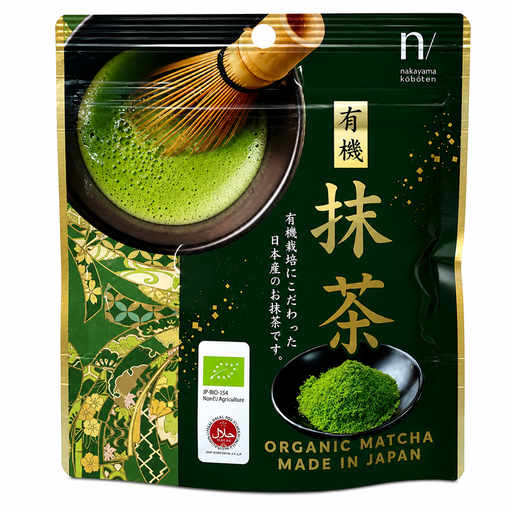 Image unavailable
JP Nakayama Organic Matcha 30 g
This powder is a good choice if you want to measure out your own drink, with matcha as its main ingredient.
Format: 30 g. The product description says it contains 100% matcha green tea, with no flavourings or added ingredients.
The description mentions a subtle bitterness. Check whether this suits the bold-tasting cup you’re after. The ingredients alone don’t tell you how intense it will taste or how much caffeine it contains.
View on Joybuy
Frequently asked questions
How do I choose a product if I mainly want to enjoy the taste of matcha?
Start by choosing a powder whose ingredients list says it contains 100% matcha green tea, rather than a blend with only a small amount. Carrefour Bio’s listing states that it has this composition, while the Pukka and Yogi Tea products described by Auchan and Carrefour each contain 2% matcha. However, this difference in ingredients doesn’t guarantee a particular flavour strength.
How can I prepare matcha powder without making an overly concentrated cup to start with?
Follow the instructions for the powder you’ve bought and adjust the amount to suit your taste. For its product, Auchan’s listing for 110 Graines recommends around 2 to 4 g of powder in 50 ml of hot water at 70 °C. Starting at the lower end of this range lets you try the amount before increasing it.
What should I check if I’m sensitive to caffeine?
Check the full ingredients list and take account of any other caffeinated products you consume, rather than relying on the word ‘matcha’ alone. The Anses says that caffeine can disrupt sleep and that its effects vary from person to person. If you’re taking medication or have a health-related concern, seek advice tailored to your situation.


