Those who enjoy a pronounced tea flavour
You want the tea to take centre stage at breakfast and prefer to measure out the matcha powder and liquid yourself.


For a cup with a pronounced tea flavour, choose a matcha powder whose ingredient list suits your preferences, then adjust the amount and dilution in line with the product instructions. A matcha latte or flavoured mix is better suited to when you fancy a milder or more convenient drink: its name alone doesn’t tell you how its tea flavour compares with that of pure powder. Also bear in mind any other caffeinated drinks you have with breakfast.
You want the tea to take centre stage at breakfast and prefer to measure out the matcha powder and liquid yourself.
You’re looking for a milder, milky or flavoured drink, without treating a latte mix as though it were made from matcha alone.
You’d rather start with a small pack of matcha powder before choosing a larger size.
If you’re after a pronounced tea flavour, first distinguish matcha powder from latte mixes, then check the recommended amount and dilution for the product you choose.
| Criteria | What to check | Who it suits |
|---|---|---|
| Tea flavour and ingredients | Read the ingredients to distinguish matcha powder from a blend. Check the recommended amount and volume of liquid. | I want the tea to take centre stage in my cup and to control the dilution myself; around 40% of consumers are thought to prioritise this pronounced tea flavour. |
| Sweetness and convenience | For a latte or flavoured mix, check the ingredients, serving size and preparation instructions rather than relying on the pack weight alone. | If I make a milky drink in the morning, I prefer a mild recipe that’s easy to serve; this is thought to be a priority for around 30% of consumers. |
| Trial size and cooking | Compare the weight and suggested uses on the packaging. Lidl and ALDI each list a 40 g matcha powder on their French websites. | I’d rather try matcha in a small pack, which I might also use in cooking; for around 30% of consumers, this trial size and its versatility are thought to be priorities. |
On its own, this word doesn’t let you compare the intensity of two cups. The ingredients, amount and dilution all matter too.
If you’re mainly after the taste of tea, check the ingredients and follow the preparation advice for each powder.
Carrefour France lists products described as “100% green tea powder” separately from matcha latte and flavoured mixes.
Check the ingredients, serving size and preparation instructions before choosing between a drink you measure out yourself and a milky recipe.
The European Food Safety Authority (EFSA) notes that tea naturally contains caffeine. So if you have matcha alongside coffee, it adds to the other caffeinated drinks you consume during the day.
If caffeine is an important consideration for you, take account of all the drinks you plan to have, not just the matcha.
The warning published by Anses concerns Matcha Slim, a drink marketed for weight loss; it doesn’t describe all food-grade matcha powders.
For breakfast, check the product category and ingredients. Don’t attribute the claims of a weight-loss drink to a tea powder.
Carrefour France lists matcha powders, including one described as “100% green tea powder”, as well as latte and flavoured mixes.
E.Leclerc lists a 100 g pack of organic matcha powder online.
Auchan lists a 100 g pack of 110 Graines organic matcha powder, with preparation instructions recommending 2 to 4 g in 50 ml of water at 70 °C.
Lidl lists 40 g of LOYD Japanese matcha powder in its online range, which includes tea.
ALDI lists 40 g of ASIA GREEN GARDEN matcha powder on its French hot drinks page.
This selection features a matcha powder to consider if you’d like to make your own weekend cup rather than buy a latte mix.
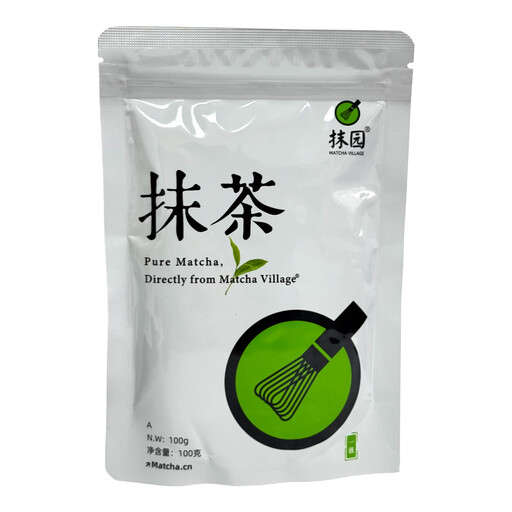 Image unavailable
This powder is a good choice if you want to measure out your own drink and enjoy a cup where the tea flavour takes centre stage.
Pack size: 100 g. Check the dosage and preparation instructions on the packaging before adjusting the dilution to suit your taste.
Start with matcha powder and adjust the amount and dilution to suit your taste, following the product instructions. For the 110 Graines powder listed by Auchan France, the recommended amount is 2 to 4 g in 50 ml of water at 70 °C. These instructions don’t automatically apply to other products.
It’s best to follow the temperature recommended for your powder. Auchan France advises using water at 70 °C for its 110 Graines product, while a Carrefour France listing recommends 70 to 80 °C for a different powder.
No. Carrefour France lists a product described as “100% green tea powder” separately from products called “Matcha Latte” or described as flavoured. Before comparing two products, read their ingredients and serving sizes.
Take account of the caffeine in all your drinks. EFSA notes that tea naturally contains caffeine; the amount in a cup of matcha depends, among other things, on the product and serving size.
No, these descriptions aren’t interchangeable. The warning published by Anses concerns Matcha Slim, a drink marketed for weight loss. When choosing a food-grade powder, check the category and ingredients of the product in question rather than applying this warning to all matcha powders.