Families who value fair trade certification
You want to check that the fair trade requirement applies to the matcha you’re buying, and not just to the brand or another product.


If fair trade is a priority when you shop for your family, choose matcha only if the Fairtrade / Max Havelaar label, or proof of certification, applies to the exact powder you’re buying. An organic claim or Japanese origin alone isn’t enough to confirm this. If you regularly make lattes and recipes, check the recommended use too, and choose a pack size that suits how much your family will use.
You want to check that the fair trade requirement applies to the matcha you’re buying, and not just to the brand or another product.
You use matcha in a variety of recipes and want a pack size that suits how often you use it.
You’d rather try a small pack first before deciding whether to use this powder in your drinks or recipes.
When shopping for your family, first check whether the matcha is certified, then choose a pack size and product for the way you usually prepare it.
| What to consider | What to check | Who is it for? |
|---|---|---|
| Fair trade certification | A Fairtrade / Max Havelaar label or proof of certification that applies to the exact powder, not just the brand. | If fair trade guides my purchase, I want to be able to link the label to the matcha I’ve chosen, rather than rely on a general claim; around 42% of consumers would put this proof at the top of their list of criteria. |
| Family-sized pack | The net weight and storage instructions, based on how often you expect to use it. | If I often make lattes for my family, I want a pack size we can use without waste; around 33% of consumers would prioritise this first. |
| Use in cooking | The ingredients and whether it’s intended for drinks or recipes. | I want to use the same powder in drinks and bakes, rather than choose a product at random that’s marketed for drinking on its own; around 25% of consumers would make this versatility their priority. |
The EU organic logo relates to organic farming. On its own, it doesn’t show that the powder has fair trade certification.
If this matters to you, check that the Fairtrade / Max Havelaar label or proof of certification applies to the specific product you’re buying.
A product marketed for drinking on its own may not be right if you’re looking for an ingredient to use regularly in lattes and bakes.
If you’re cooking with it, check that the product page or packaging mentions the recipes or drinks you plan to make.
Carrefour offers a 50 g SIPSTA pouch for drinks and baking.
Aromandise offers its organic Matcha Jade Culinary powder in a 100 g pack for drinks and recipes.
Kusmi Tea offers organic matcha from Japan in 30 g and 100 g packs.
This 100 g powder may be worth considering for family recipes. Check that its ingredients and recommended uses suit your needs, and that it has fair trade certification if this is important to you.
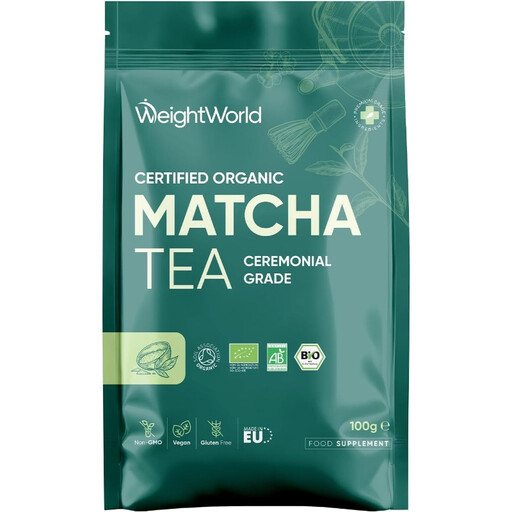 Image unavailable
If you’re considering this powder for family lattes or recipes, check that its recommended uses suit what you plan to make.
Pack size: 100 g. If fair trade is essential to you, check that the label or proof of certification applies to this specific product.
No. As Agence Bio explains, the EU organic logo shows that organic farming rules have been followed. For fair trade, check separately that a Fairtrade / Max Havelaar label or proof of certification applies to the matcha you’re buying.
Check the packaging or product listing for the exact product to identify the label and the product or ingredient it covers. The product name and ingredients list can help you tell matcha powder from a blend, but they don’t replace checking its fair trade certification.
Choose an amount your family will actually use, and a powder that’s intended for cooking. Aromandise offers its Matcha Jade Culinary in a 100 g pack for recipes; Carrefour also describes its 50 g SIPSTA pouch as suitable for baking. Check the storage instructions for the product you choose.
No. Matcha is a powder that you mix into a drink. For its own product, Kusmi Tea recommends mixing it with water at 80 °C; follow the instructions for the product you’ve chosen.