
Livraison le jour même ou le lendemain

Qualité garantie

Débloquez vos offres de bienvenue: Livraison GRATUITE | Jusqu'à -80 % | 30 jours d'essai gratuits à JoyPlus
Téléchargez l'application
Protecting your jewellery, cash, documents or keys at home isn’t just about choosing the model with the largest capacity. A combination-lock wall safe should first and foremost suit the way you plan to use it, the space available and the level of protection you need.
However, some product listings can be confusing. Here are the main pitfalls to avoid before you place an order.
An electronic lock or a customisable combination makes access easier, but that alone doesn’t make a safe genuinely secure. You should also check:
A poorly secured combination-lock safe can be carried away in seconds. To reduce the risk of theft, fixing it to a wall or floor is just as important as the lock.
Claims such as ‘fireproof’, ‘burglar-resistant’ or ‘fire-resistant’ should be treated with caution. A statement on a product page is no substitute for certification to a recognised standard.
To compare models on a sound basis, check whether a clearly identified standard is listed, such as EN 14450 for certain security cabinets or EN 1143-1 for safes that meet more stringent requirements. If no documented rating is provided, treat these claims as statements made by the manufacturer, not as a regulatory guarantee.
The external dimensions don’t give you an accurate picture of the usable space inside. The reinforced door, bolts and thick walls all reduce the internal capacity. A compact 4 to 9-litre safe can hold a few pieces of jewellery, passports or envelopes, but it will soon feel too small for A4 documents or several devices.
For a safe intended for jewellery and documents, compare the internal dimensions, check whether it has a shelf and make sure you can store your items without folding them.
A steel safe has a sturdier structure than a lightweight box made from plastic or fabric. However, the stated thickness alone isn’t enough to assess the whole product: the door, hinges and fixing points also play a crucial role.
To install a wall safe:
Fixing a safe to a simple plasterboard wall without suitable reinforcement greatly reduces the benefits of a wall-mounted model.
Electronic models generally use a multi-digit code and either AA batteries or a button cell, depending on the design. In particular, check:
A mechanical combination lock avoids the need to replace batteries, but may take longer to set. For a combination-lock key box used by several people, mechanical dials are practical, provided they’re easy to read and can withstand the weather.
Velvet padding or a felt lining helps prevent scratches on watches, jewellery and metal items. Removable dividers make it easier to organise documents, cash and small devices.
For outdoor installation, look for a cover that protects against rain and dust. A portable secure key box with a shackle may suit a rental property or temporary access, while a wall-mounted model is better for permanent installation. No home safe should be described as completely burglar-proof: it’s secure storage for valuables and should form part of a wider approach to keeping them safe.
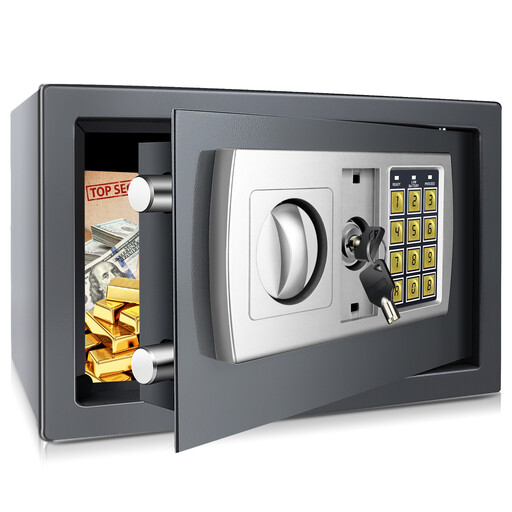
Why it suits this type of user: Measuring 31 × 20 × 20 cm, it’s a good fit for a flat or office where you need to protect paperwork, jewellery or cash without taking up too much space.
The product listing specifies a 3- to 8-digit combination, a lockout after three incorrect attempts and two emergency keys. You’ll need to supply 4 AA batteries, though.
Advertised 2 mm steel, a reinforced 4 mm door, an interior cushion and pre-drilled holes for fixing to a wall, floor or inside a piece of furniture.
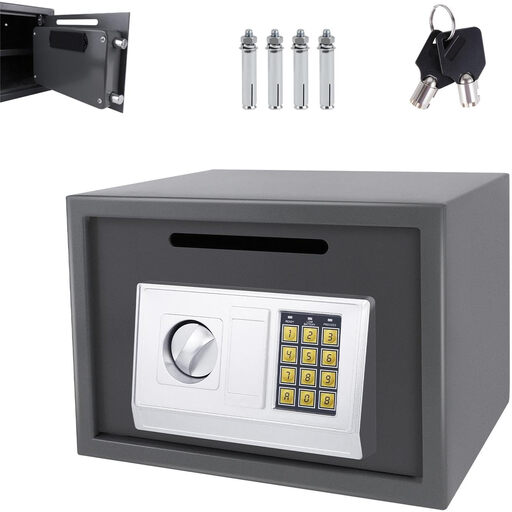
Why it suits this type of user: Its generous capacity makes it a good choice for households and small offices looking to store several files, pieces of jewellery and valuables together.
The two compartments make it easier to keep things organised and avoid ending up with a safe that’s too cramped. Permanent fixing is still essential to reduce the risk of it being moved or carried away.
16 L capacity, a customisable 3- to 8-digit code, two emergency keys and an interior cushion. The stated dimensions are 35 × 25 × 25 cm.
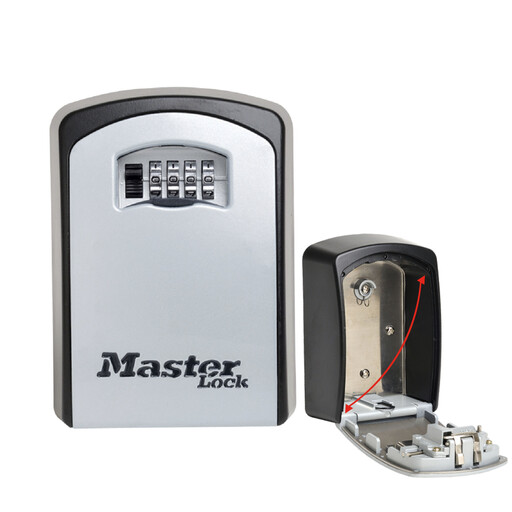
Why it suits this type of user: This combination-lock key safe is designed for homeowners, agencies, offices and holiday-let hosts who need to share access without handing over a key in person.
It’s designed to hold keys and cards, not to store cash or documents. This distinction helps you avoid paying for capacity you don’t need.
Advertised internal compartment dimensions of 11.5 × 7.7 × 4 cm, a resettable 4-digit combination, a protective cover and a mounting kit included.
We’ve put together a comprehensive selection, updated in real time, of products that meet these exacting criteria and the applicable European safety standards.
Choose a solid wall and use fixings suited to the material. For a hollow wall, add reinforcement or choose another location. The safe should remain completely stable when you pull on the door and when the bolts extend.
It depends on how often you use the safe, the type of lock and the quality of the batteries. Replace them as soon as the low-battery warning appears, and keep the emergency keys somewhere separate from the safe. Don’t hide them right next to it, as that would greatly reduce the point of having the safe.
Not necessarily. Check the internal dimensions rather than relying on the capacity in litres alone. To store documents without folding them, look for a width and depth that will accommodate A4 sheets, or choose a larger model with an internal divider.