
Livraison le jour même ou le lendemain

Qualité garantie

Débloquez vos offres de bienvenue: Livraison GRATUITE | Jusqu'à -80 % | 30 jours d'essai gratuits à JoyPlus
Téléchargez l'application
A Master Lock safe can protect passports, official documents, jewellery, cash, keys or even electronic devices. But relying solely on price or exterior appearance can lead to unpleasant surprises. A compact model isn't necessarily fire-resistant, a digital combination safe isn't always practical for everyday use, and a certification must be interpreted in its proper context.
Here are the criteria to examine before buying, along with a selection of models suited to different profiles in the UK.
A steel safe with an electronic lock can make a break-in attempt more difficult. That doesn't mean it will protect your papers against a fire or water damage. Some safes intended for home or office use are primarily designed to secure their contents, without any certification for heat or immersion resistance.
For deeds, passports or digital media, look for an explicit mention such as UL Classified or ETL Verified, checking the duration, temperature and type of content covered.
A portable safe or a small model placed in a cupboard can be carried away if it isn't fixed. The anchoring kit supplied with some products limits this risk, but its installation can affect certain stated performance levels. The instruction manual therefore deserves a careful read.
The specification sheet for some fire and water-resistant safes states, for example, that the water protection applies only before the fixing kit is installed. Conversely, a model equipped with a waterproof kit designed for floor fixing can retain this protection, in line with the manufacturer's instructions.
A biometric safe allows quick access to its contents, but its fingerprint reader requires clean, dry fingers and runs on batteries. A digital combination safe avoids searching for a key, but you need to remember the code and monitor the battery level. A key-operated safe remains the simplest solution, provided you keep the spare key in a separate place known only to authorised people.
Start by measuring the items you want to store rather than relying solely on the stated volume. For A4 sheets, check that the internal dimensions allow them to be laid flat. For a laptop, check the width, depth and especially the available height, particularly if shelves are fitted.
A foam lining, textile mat or removable tray can prove useful in a safe intended for jewellery and cash. These accessories minimise scratches and make organising easier.
The stated features should specify the temperature and duration of protection. In the selection below, some safes are described as UL Classified for 30 minutes at 843 °C, while others state 1 or 2 hours at 927 °C for documents. These figures don't automatically apply to all contents: digital media may have a separate indication.
Also examine the information regarding water: complete immersion, precise water depth or limited duration. Even a fireproof and waterproof safe doesn't remove the need to place it in an area with low flood risk.
To better resist forced removal, choose a model equipped with metal locking bolts, a protected or concealed hinge, and the ability to be fixed to the floor or a sturdy shelf. With an electronic lock, check the number of batteries required, the presence of an emergency key and the procedure provided when the batteries are nearly depleted.
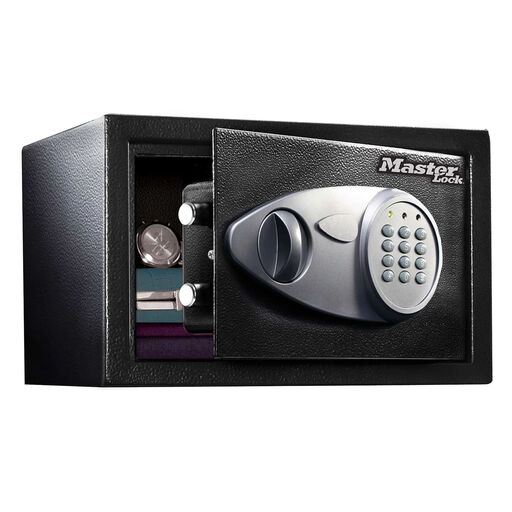
Why this choice suits this profile: With internal dimensions of 21.6 × 34.6 × 22 cm, it can accommodate A4 documents, jewellery, cash and small devices in a bedroom or home office.
The specification clearly states it is not designed to resist fire or water: you cannot attribute a function it doesn't have.
Programmable digital combination, two metal locking bolts and fixing kit included.
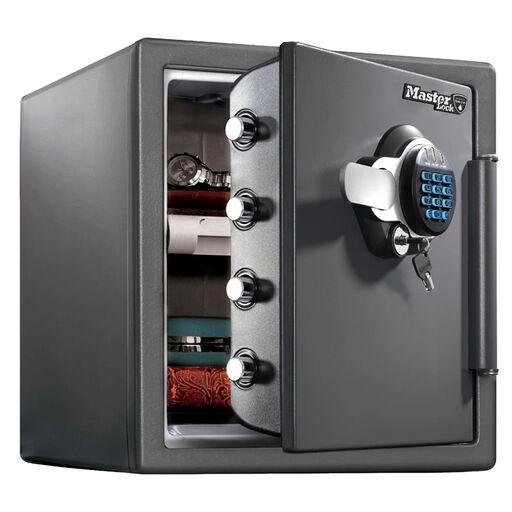
Why this choice suits this profile: With an internal volume of 34.9 × 31.9 × 30.2 cm and adjustable shelves, it suits families and professionals storing several files or sensitive items.
The stated performance distinguishes fire, drop and water resistance: UL indicates 2 hours at 927 °C, while ETL states protection under 20 cm of water for 24 hours.
Backlit keypad, additional key lock, four active locking bolts and interior light.
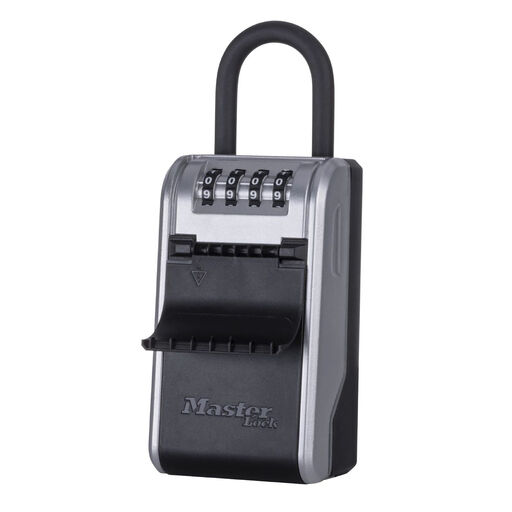
Why this choice suits this profile: Airbnb hosts, homeowners and small businesses can share access without handing over a physical key, thanks to the removable shackle and resettable code.
This is a key safe, not a document safe: its use has nothing to do with the fire or burglary protection offered by a heavy safe.
Stated capacity for up to ten keys, weatherproof cover and large, well-spaced dials.
We've put together a comprehensive, real-time updated selection of products that meet these strict criteria, as well as European safety requirements.
Place it on a stable surface, then use the anchoring kit if the model includes one. Check the type of floor or the sturdiness of the shelf and follow the instructions in the manual. For a fireproof and waterproof safe, make sure the fixing doesn't compromise the stated certification.
It depends on the frequency of use, the type of batteries and the model. Replace them as soon as the low battery indicator lights up. Keep the emergency keys or recovery code in a separate place: definitely not inside the safe.
It primarily protects its contents when closed, but its portability also makes it easy to take with you. For documents or cash, a model that can be fixed to the floor is generally more suitable. A portable safe with a cable is better suited for travel, hotel rooms or temporary situations.