
Livraison le jour même ou le lendemain

Qualité garantie

Débloquez vos offres de bienvenue: Livraison GRATUITE | Jusqu'à -80 % | 30 jours d'essai gratuits à JoyPlus
Téléchargez l'application
Passports, jewellery, cash, contracts, USB drives and digital media all deserve protection that matches how you use them. Yet choosing a Master Lock safe based solely on its appearance or price can lead to a few nasty surprises. A compact model isn’t necessarily fire-resistant, while a fireproof safe isn’t always designed to stop the whole unit from being stolen.
Before you decide, start by identifying your needs: frequent access, protection against fire and water damage, enough capacity for A4 documents, ease of transport, or resistance to forced removal.
A key-operated safe is simple to use, but its spare keys must be kept in a separate, secure place. A digital model saves you from carrying a key, but it relies on batteries that are sufficiently charged and a combination you’ve correctly memorised.
The biometric safe offers quick access via fingerprint recognition. That doesn’t guarantee instant opening in every situation, though: your finger needs to be clean and dry, and it’s best to register several fingerprints. Having a digital code or backup keys as a fallback is therefore something to check.
Portability is handy for moving the safe between home and the office. However, it can also work in a thief’s favour, as they only need to take the whole unit. For a fixed installation, check for a fixing kit or anchor points. Where the manufacturer provides for it, fixing the safe to a shelf, a sturdy piece of furniture or the floor is strongly recommended.
Not all commercial promises about fire resistance are equal. Look for a clearly stated duration, temperature, and standard or certification. Protection claimed for paper documents doesn’t automatically apply to CDs, DVDs, USB drives or external hard drives. A fireproof and waterproof safe should also specify the conditions under which its resistance to immersion or water exposure has been tested.
For everyday access, compare these three options:
A silent keypad can be invaluable in a bedroom, study or shared office. With a biometric safe, registering several fingers reduces access problems if one is damp, cold or marked.
The stated volume isn’t everything. Check the internal dimensions and the width of the opening. For a document safe, a width wide enough to lay A4 sheets flat avoids having to fold them. For jewellery and cash, a removable tray or soft lining makes organising easier and reduces scratches.
Also consider the external dimensions: they need to match your chosen location, whether that’s the depth of a cupboard, the height of a shelf, or the space available under a desk.
The models shown below have features stated with precise references:
These details reflect the characteristics provided for the products. They don’t mean you should open a safe during or immediately after a fire, nor that it can remain submerged indefinitely. The lid must be completely closed and locked.
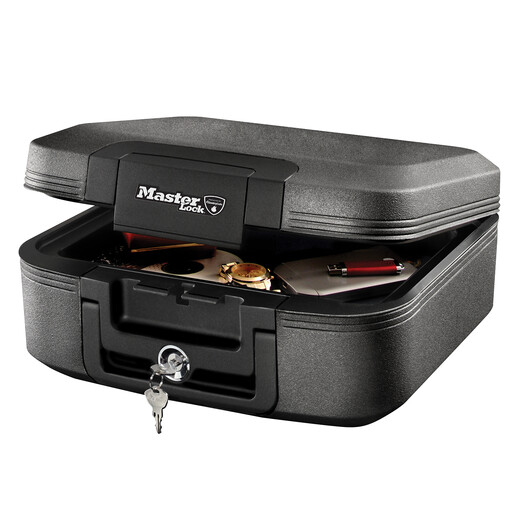
Why this choice suits this profile: This key-operated model is ideal for a first installation at home or in a small office, with no programming or batteries to worry about.
Its features mention a UL classification of 30 minutes at 843 °C for documents, as well as ETL verification for water and certain digital media.
7.8 L capacity, folding handle, tubular lock and interior space wide enough to hold A4 sheets flat.
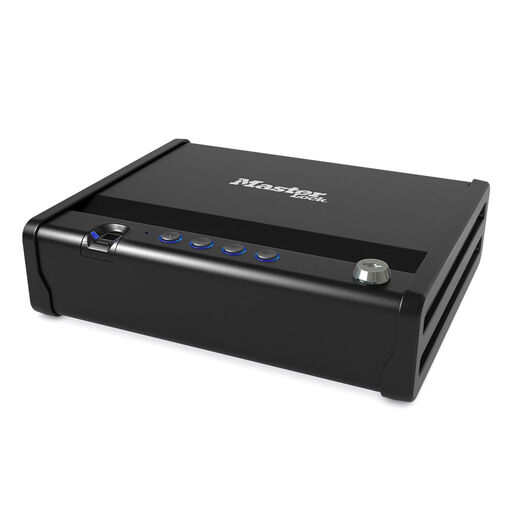
Why this choice suits this profile: Its fingerprint opening is designed for those who regularly access their jewellery, cash, passports or other sensitive items.
The biometric reader is backed up by a resettable digital combination and two backup keys. So you’re never reliant on just one method of access.
Steel construction, concealed hinges, silent automatic opening and a removable fabric-lined tray.
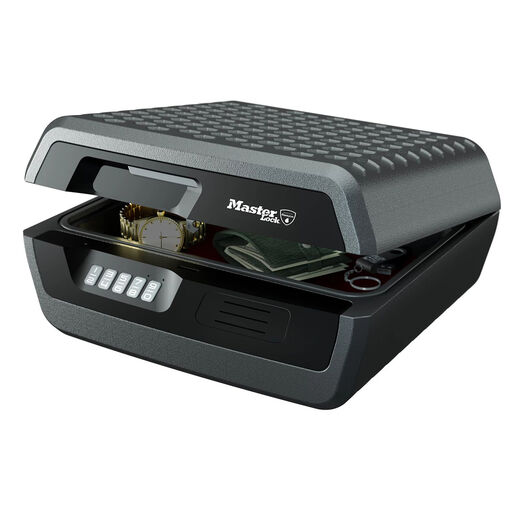
Why this choice suits this profile: Its larger capacity and digital keypad make it suitable for professional or family use, as well as for regularly storing files and digital media.
The product page mentions a UL classification for documents and ETL verifications for digital media and submersion, rather than just a vague promise of resistance.
10 L volume, resettable user combination, master code, silent mode and storage for A4 documents flat.
We’ve put together a comprehensive, real-time updated list of products that fully meet these strict selection criteria and European safety regulations.
Even a safe that suits your needs must be installed carefully:
This depends on how often you use it, the type of batteries and the model. It’s best to check the battery indicator regularly and keep compatible spare batteries to hand. The master code or backup keys should remain accessible to authorised people, but never stored right next to the safe.
The relevant models display precise features: UL classification for 30 minutes at 843 °C for documents, and ETL verifications for certain digital media and for submersion. This protection is conditional on following the instructions on the product page: the safe must be closed and locked, and the duration of water exposure is not unlimited.
For a permanent installation, fixing is recommended where the manufacturer provides for it. Without anchoring, a portable safe can be carried away with all its contents. Before installing it, check its dimensions, the strength of the mounting surface and the contents of the kit supplied.