
Livraison le jour même ou le lendemain

Qualité garantie

Débloquez vos offres de bienvenue: Livraison GRATUITE | Jusqu'à -80 % | 30 jours d'essai gratuits à JoyPlus
Téléchargez l'application
A Master Lock safe can protect paperwork, cash, digital media or small electronic devices. However, not every model meets the same needs. A travel safe serves a different purpose from a fireproof model designed to stay in an office.
Before buying, three mistakes come up time and again: confusing water resistance with permanent watertight protection, choosing a volume that is too small for A4 documents, or opting for a locking system without checking the emergency access options. Here are the criteria to consider when comparing the models available in France.
Claims such as “waterproof” or “water-resistant” deserve close attention. Some safes are designed to withstand submersion under a specific testing protocol, while a portable model that is simply water-repellent mainly protects against splashes and everyday moisture.
For a watertight safe intended to hold your documents, check the stated standard or certification, along with the immersion time and conditions. The storage location also matters: a damp cellar or a garage exposed to major temperature changes is not suitable for every model.
Fire-resistant walls and locking mechanisms reduce the internal space. A safe advertised as having a capacity of several litres may therefore prove too cramped for a thick document wallet, binders or several files.
Measure the items you want to protect and compare them with the internal dimensions. For A4 sheets, check that they can be placed flat without being folded. This precaution is particularly important for a document safe, especially when storing deeds, contracts, certificates and insurance files.
A combination safe means you do not have to manage a key, but it relies on the user’s memory and, when fitted with an electronic keypad, on the condition of its batteries. A key safe, meanwhile, requires you to keep the key somewhere separate but easily accessible.
A biometric safe can make everyday access simpler, but it also runs on batteries and must have an emergency key. Before buying, check how many users can be registered, the power requirements and the emergency opening procedure.
For a fireproof safe, examine the stated temperature and duration, as well as the type of contents protected. The protection offered for paper documents is not necessarily the same as that intended for USB drives, DVDs and other digital media.
In the range presented, some models are listed as UL classified for 30 minutes of fire resistance at 843°C, while others claim 1 hour at 927°C. For several products, the specifications also mention ETL certification for digital media and submersion. Compare this information according to your intended use and check it in the documentation supplied.
A small portable safe is suitable for passports, bank cards, cash or phones. For home or professional use, a capacity of 10 to 23 litres provides more flexibility for storing documents and larger items.
Fixing is another point that should not be overlooked. A lightweight safe placed on a shelf can easily be carried away. For a safe intended for the home or office, choose a model supplied with the appropriate fixing hardware, where the layout of the property or premises allows. Always follow the manufacturer’s instructions so that you do not compromise the stated level of resistance.
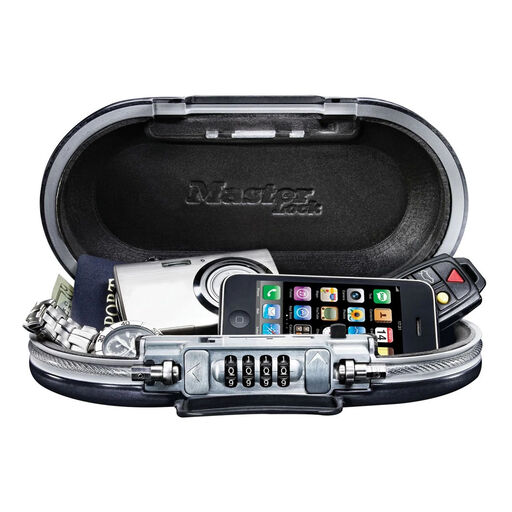
Why this choice suits this profile: With an internal capacity of 0.7 litres, this portable safe is suitable for students, travellers and anyone who wants to keep their phone, passport, cards or cash secure in a hotel room, dormitory or office.
Its internal dimensions are clearly specified: 3.5 × 21.5 × 8.9 cm. However, the integrated 50 cm cable must be attached to a fixed, sturdy object: it is a deterrent against opportunist theft, not an impenetrable anti-theft device.
Resettable four-dial combination, water-resistant coating, protective foam and a dedicated opening for a charging cable or earphones.
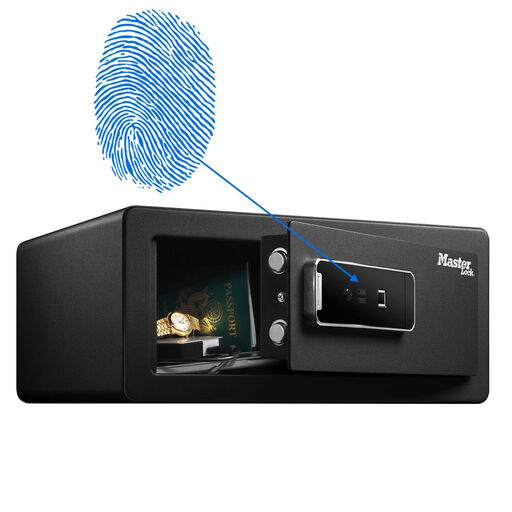
Why this choice suits this profile: Measuring 43 × 37 × 19.5 cm and made from steel, this safe is suitable for a home or office where frequent access to jewellery, cash, devices and A4 documents matters more than portability.
The reader can store up to 30 fingerprints, and an emergency key is supplied. The four AA batteries are not included, so plan for replacements and store the key separately.
Two motorised bolts, concealed hinge, interior lighting, carpeted base and fixing hardware included.
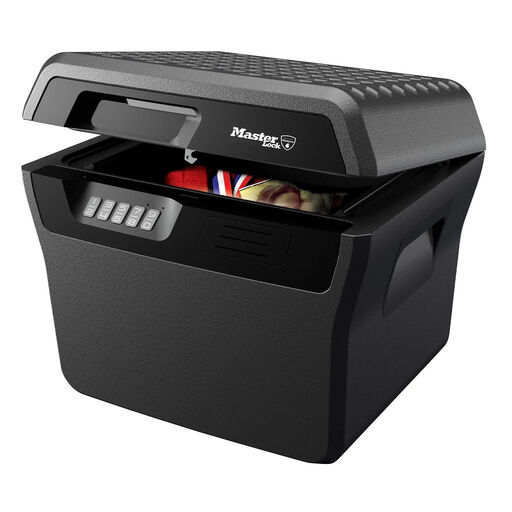
Why this choice suits this profile: Its capacity and flat A4 storage are suitable for families, self-employed professionals and small businesses that keep several paper files and digital media.
The stated protection levels distinguish between paper, digital media and immersion. The safe must remain closed and locked: it is not designed to withstand indefinite immersion.
18.5-litre capacity, stated UL classification at 843°C for 30 minutes for documents, ETL certification for water protection and programmable digital lock.
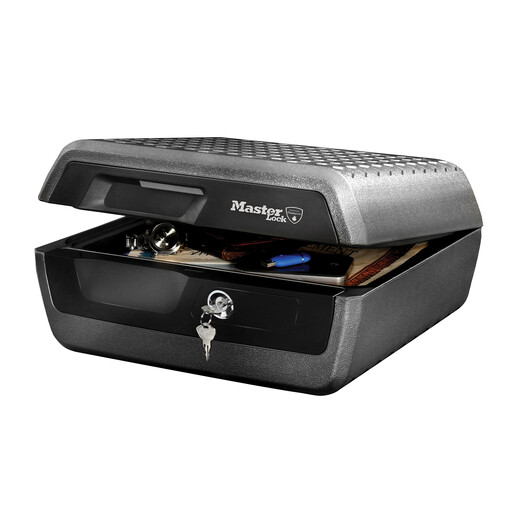
Why this choice suits this profile: This mid-sized format allows you to store A4 sheets flat without taking up as much space as a large office safe. It is suitable for moderate residential or professional use.
The 10-litre internal capacity is specified in detail, as are the tubular lock and two keys. The keys should be kept outside the safe, in a secure place.
Stated fire resistance for 1 hour at 927°C, ETL certification for submersion, portable format and a 2-year limited warranty according to the product specifications.
We have put together a complete, real-time updated list of products that fully meet these strict selection criteria and European safety regulations.
A compact model such as the 5900EURD is suitable for small items and temporary protection in a hotel room, campsite or student accommodation. Its 50 cm cable must be attached to a fixed support. For A4 documents or fire protection, it is better to choose a larger safe designed to remain in one place.
Some models have stated certification for submersion, while others are simply water-resistant. Check the specifications for your chosen model and verify the precise conditions: duration, depth and protected contents. Certified resistance does not mean that the safe can remain permanently submerged.
In everyday use, the only costs generally involve replacing the batteries. Digital and biometric models may run on alkaline batteries, which are sometimes not included. Keep a spare set in the specified format and store the key or emergency combination separately to avoid being locked out.