
Livraison le jour même ou le lendemain

Qualité garantie

Débloquez vos offres de bienvenue: Livraison GRATUITE | Jusqu'à -80 % | 30 jours d'essai gratuits à JoyPlus
Téléchargez l'application
A Master Lock key safe can make accessing a home, office or professional premises much easier. No more handing over a key in person every time someone arrives: this type of box is particularly handy for homeowners, concierge services, home care providers and rental managers.
However, not all models are created equal, and they don't all meet the same requirements. A poorly chosen outdoor key safe can become awkward to open, lack space for a full keyring, or show its limitations when faced with the elements. Here are the points to consider before buying, along with a selection of models suited to different uses.
A protective cover, a metal casing or a mechanism designed for outdoor use does not automatically make the product completely waterproof. If you plan to install it on a wall exposed to rain, check for a cover that shields the dials, a well-protected door and appropriate maintenance recommendations.
Even a secure key safe intended for outdoor use must be fixed to a stable surface and, where possible, sheltered from water run-off and splashes. Regularly cleaning the dials and cover also helps keep the mechanism working smoothly.
External dimensions don't reflect the space actually available. A small safe can easily hold a single flat key, but quickly becomes cramped with several keys, an access card or a remote fob.
Before choosing a key safe for a rental or an Airbnb key box, measure the complete keyring. Then compare the internal dimensions, rather than just looking at the height, width and depth of the casing.
A key safe with a code makes sharing access simple, provided you don't publish the code in a listing or keep it indefinitely. For a holiday let, it's best to have a procedure for changing it between guests, where the model and your setup allow.
Also keep the code in a secure place and test the mechanism before a tenant, contractor or family member arrives. That way you avoid nasty surprises when access becomes urgent.
A wall-mounted key box is well suited to a home or premises used regularly. It needs to be fixed to a solid surface, but has the advantage of staying in place and reducing the risk of it being moved or forgotten.
Conversely, a portable key safe with a shackle or cable can be moved from a door to a vehicle, gate or handrail. This is a good solution for temporary rentals, home visits and sites where drilling is not possible — or desirable.
Models with a four-digit combination avoid the need to manage an extra key. They offer several thousand combinations, but keeping the code discreet is essential. The dials need to be legible and spaced well enough to be used with gloves or in low light.
Some models feature illuminated dials powered by a CR2032 battery. This can be useful for arriving at night, but it means you need to check the battery level regularly.
For a few keys and access cards, a medium-capacity box may be enough. If you need to store several keyrings or large remote fobs, it's better to opt for a large model with a more generous internal compartment.
A key safe does not serve the same purpose as a fire-resistant safe, a biometric safe or a secure storage unit for keys and valuables. Safes are designed to hold documents, cash, devices or other sensitive items, with different requirements for fixing, fire resistance and access control.
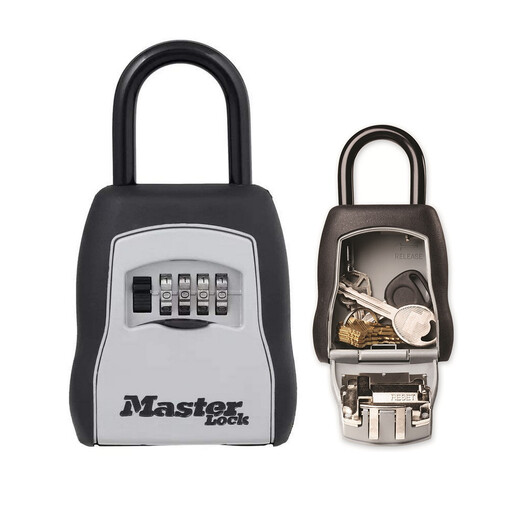
Why this choice suits this profile: With its portable size of 157 × 90 × 40 mm, it attaches to a handle, ring or barrier without needing permanent drilling.
Its internal dimensions of 74 × 68 × 30 mm let you quickly check whether it can hold your small keyring.
Metal body, resettable four-digit combination and protective cover for the dials.
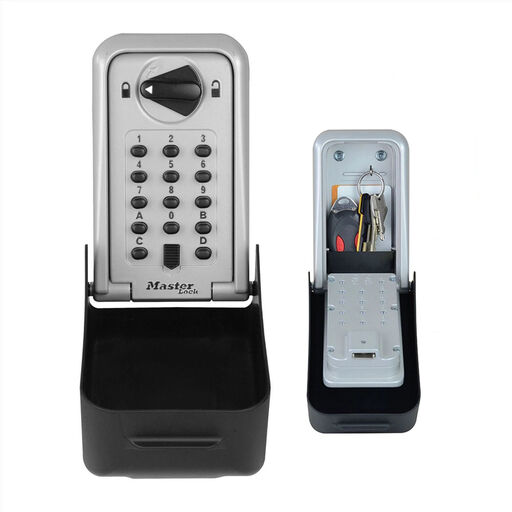
Why this choice suits this profile: This large wall-mounted safe is designed for repeated access at a house, agency or rental property.
Its stated internal volume of 140 cm³ reduces the risk of ending up with a box that's too narrow for several keys.
Zinc alloy, recessed door, removable ABS cover and wall-fixing kit included. The product listing mentions SBD, SS and CNPP certifications: check the associated documents before relying on them.
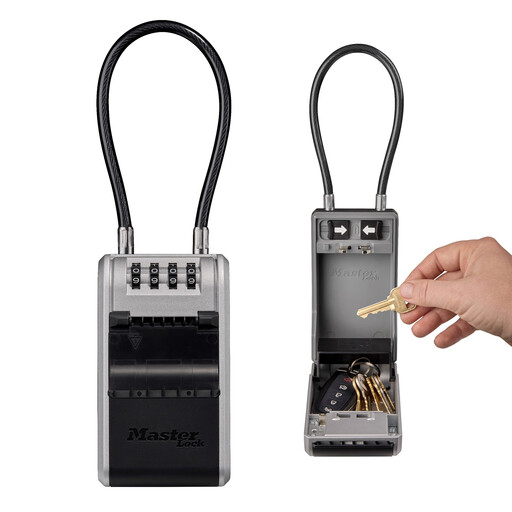
Why this choice suits this profile: Its removable flexible cable adapts to handrails, gates, pipes and industrial equipment that are difficult to fit with a rigid shackle.
Its internal compartment, stated to be 2.5 times larger than a standard safe, can hold several keys and access cards.
8 mm steel cable, aluminium body, inner tray and full cover against dust and moisture.
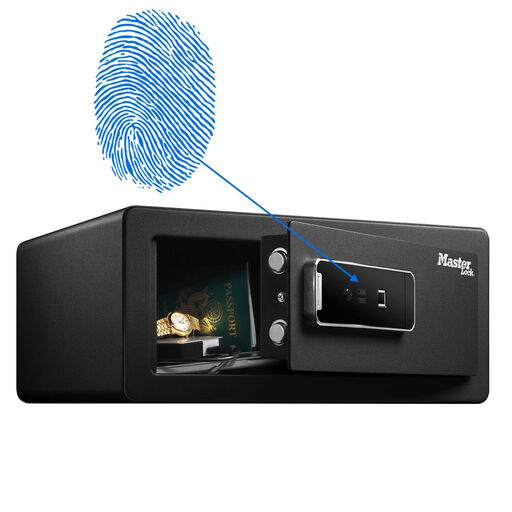
Why this choice suits this profile: This is not a standard key safe, but a biometric safe for home or office use.
It stops you from misusing a small key safe to store documents, cash or devices that need a more suitable space.
Scanner designed to recognise up to 30 fingerprints, two motorised locking bolts, interior light and fixing hardware included.
We've put together a complete, real-time updated list of products that meet these demanding criteria and European security standards.
For a wall-mounted model, choose a solid surface, use the kit provided and follow the fixing instructions. With a portable model, loop the shackle or cable around a sufficiently sturdy fixed point. Change the code before first use and check that the box is properly closed.
It depends on its exposure to rain, frost and dust, as well as how often it's used. Wipe the box down regularly, keep the cover closed and check the condition of the dials. If the model has a light, replace the CR2032 battery as soon as the brightness drops.
A wall-mounted key box is suitable for a fixed address with regular arrivals. A portable key safe is better when drilling is not allowed or when the device needs to be moveable. In both cases, choose a capacity that fits the keyring and put a clear procedure in place for changing the code between guests.