
Livraison le jour même ou le lendemain

Qualité garantie

Débloquez vos offres de bienvenue: Livraison GRATUITE | Jusqu'à -80 % | 30 jours d'essai gratuits à JoyPlus
Téléchargez l'application
A fire, a water leak or a burglary can damage passports, notarised deeds, contracts, USB drives, cash or jewellery in a matter of minutes. Yet choosing a Master Lock fireproof and waterproof safe isn't just about comparing capacity and lock type.
Some marketing claims deserve a closer look. A model described as "fire-resistant" may not offer the same level of protection as a certified fire-rated safe. Similarly, the term "waterproof" can simply mean splash-resistant, rather than protection against submersion. Finally, a portable safe is convenient, but it will be far easier to carry away if it isn't fixed or secured.
Here are the criteria to check before you buy, followed by a selection suited to different uses in the UK.
Temperature and exposure time play a decisive role. A safe rated to withstand 30 minutes at 843°C cannot be directly compared to a model designed to last one hour at 927°C. Also check the type of content covered by the certification: paper documents, digital media, or both.
External dimensions alone aren't enough to assess the actual usable capacity. A fireproof box intended for documents must be able to hold your papers without folding them. For contracts, property titles or administrative files, make sure you have enough space to store A4 paper flat.
A key-operated safe works without batteries and remains very simple to use, but the keys must be kept in a separate place. A digital combination model offers more convenient everyday access, at the cost of regular battery replacement. A biometric safe provides quick opening, but it requires a reliable power source and a backup solution.
Master Lock product sheets refer in particular to UL classifications and ETL verifications. For the models concerned, the UL classification specifies a duration and temperature of fire resistance according to a defined protocol. The ETL verification may, in turn, relate to protection against submersion or digital media.
These indications do not guarantee that the contents will remain protected in all circumstances. The lid must be completely closed and locked. Furthermore, a waterproof safe is not necessarily designed to remain submerged for a long period.
For a few passports, cards and USB drives, a mini travel safe of less than one litre may suffice. For a family, a capacity of 5 to 10 litres will be better suited to everyday documents. A safe intended for home or office use, with a capacity of 18 litres or more, will leave more room for files, electronic devices and other valuables.
Also think about measuring the intended location: shelf, drawer, cupboard or floor. A bulky safe must remain easily accessible. Depending on its weight and use, it may also require fixing.
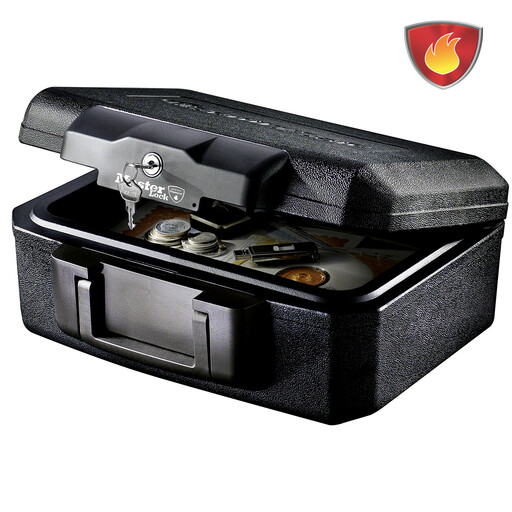
Why this choice suits this profile: This compact format is ideal for those who want to protect passports, deeds, insurance documents and digital media without installing a permanent safe.
The product sheet mentions a UL classification of 30 minutes at 843°C for documents, as well as an ETL verification for certain digital media. The stated performance is therefore based on clearly defined criteria.
5 L capacity, key lock, integrated handles and two keys supplied. The internal dimensions allow you to store documents and small items.
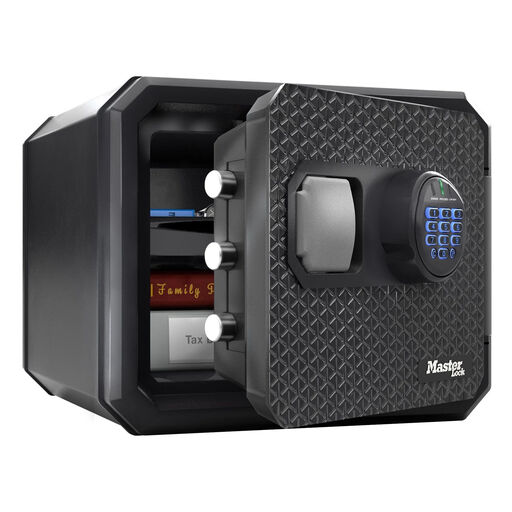
Why this choice suits this profile: Its capacity is suitable for a household or small office that wants to keep files, digital media and valuables together in one piece of equipment.
The stated levels distinguish the UL resistance of one hour at 927°C from the water protection verified by ETL. The fixing kit is designed to preserve this water resistance after floor anchoring.
Backlit keypad, three automatic locking bolts, interior light, adjustable shelf and stated water protection up to 12 cm for 24 hours.
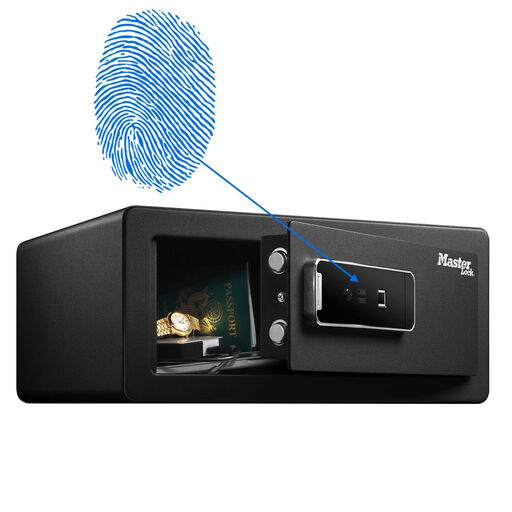
Why this choice suits this profile: This model is aimed at people who regularly access their cash, jewellery, devices or documents and who want quick access at home or in the office.
The biometric lock is not the only access option: a backup key is supplied. The included fixing hardware also reduces the risk associated with a safe that is simply placed down.
Steel construction, two motorised locking bolts, concealed hinge, interior light and the ability to store up to 30 fingerprints.
For occasional travel, the Master Lock Mini Travel Safe 5900EURD is another option: it offers an internal capacity of 0.7 L, shock-absorbing foam, an integrated 50 cm cable and a four-wheel combination lock. It can hold passports, cards, a phone or cash in a hotel room, student accommodation or a locker. Its water resistance is limited and its cable is primarily intended to deter opportunistic theft: it in no way replaces a fixed safe.
We have put together a comprehensive, real-time updated selection of products that meet these demanding selection criteria and European safety standards.
Not necessarily. Portable safes can be installed on a shelf or in a cabinet, while some models come with the hardware needed for anchoring. However, fixing reduces the risk of movement or theft. Carefully follow the manufacturer's instructions so as not to compromise the water or fire protection.
It depends on the condition of the seals, the lock, the batteries and the environment in which the safe is stored. Regularly inspect the lid, clean the surfaces with a soft cloth and replace the batteries of a digital or biometric model as soon as necessary. Avoid very damp places and direct exposure to a heat source.
In everyday use, costs are generally limited to battery replacement and light maintenance. A key-operated safe does not require this type of maintenance, but it does require keeping the keys in a separate place, accessible only to authorised people. For frequent use, compare above all the ease of access, the internal capacity and the presence of backup solutions.