
Livraison le jour même ou le lendemain

Qualité garantie

Débloquez vos offres de bienvenue: Livraison GRATUITE | Jusqu'à -80 % | 30 jours d'essai gratuits à JoyPlus
Téléchargez l'application
Passports, contracts, notarised deeds, digital media and jewellery are often impossible to replace after a fire, flood or burglary. Yet choosing a Master Lock fireproof and waterproof safe isn't just about comparing a price or an advertised capacity.
A seemingly minor detail can make all the difference between a practical product and a solution that ultimately doesn't suit you. Here are the criteria to consider before buying, along with a selection of models designed for different uses, at home and in the office.
A fireproof safe may be certified to protect paper documents for a given duration and up to a specific temperature. Digital media — USB sticks, CDs or external hard drives — may require a separate certification.
So check whether the classification applies only to paper documents or also covers digital media. The UL mark does not automatically mean that every item stored inside the safe will benefit from the same level of protection.
A water-resistant safe may be designed to withstand partial immersion for a set period when simply placed on the floor. Some models, however, do not retain this feature once bolted to the ground.
This distinction matters when choosing between better theft resistance and effective protection against water damage. Consult the manufacturer's instructions before drilling into the floor or altering the intended installation method.
A capacity of 5, 10 or 56 litres doesn't tell you whether your documents can be stored flat. The thickness of the walls, shelves, drawers and locking mechanism all reduce the actual usable space.
For a safe intended for documents, compare the internal dimensions with A4 paper size, your ring binders, folders and devices. Also leave a few centimetres of margin if your needs are likely to change.
The certifications advertised deserve careful reading. In this range, several safes are listed as UL Classified for a specific duration and temperature, while water and impact resistance are verified by ETL.
Some models claim protection for one hour at 927 °C, while a more compact safe boasts 30 minutes of resistance at 843 °C. These figures help you compare uses, but they don't guarantee protection against every disaster. It's still best to place documents in suitable pouches and follow the closing instructions.
A key-operated safe is simple to use: no batteries to monitor and no code to remember. However, you must keep the keys in a separate place that is still accessible to authorised people.
A digital safe, with a backlit keypad, is better suited to those who want to change their code easily or access the contents in a dimly lit room. The trade-off is that you need to keep an eye on the power supply and replace the batteries when they run low.
Some models combine a keypad with an emergency key. With dual locking, both access methods may even be needed at the same time. This is an important point to bear in mind before installing one in an office or business.
For a few passports, USB sticks and small items, a portable safe of 4.9 or 5 litres may be perfectly adequate. For contracts, administrative files and bulkier items, a capacity between 22.8 and 33 litres offers more flexibility.
The larger models, from 56 to 56.5 litres, suit large families, self-employed people and offices, provided you have a stable location. Check for adjustable shelves, a drawer, a door pocket or interior lighting.
Fixing the safe to the floor improves stability and reduces the risk of a thief carrying it away. However, it can affect the water resistance of some models. Never drill through a wall or floor without following the manufacturer's instructions to the letter.
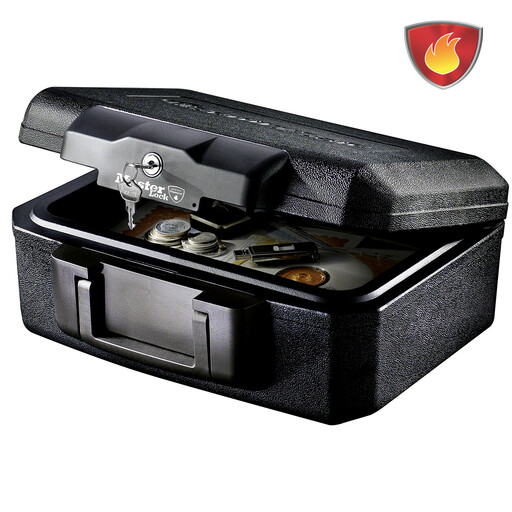
Why this choice suits this profile: Its compact size makes it a good first safe for passports, ID documents, USB sticks and small items. The built-in handle lets you move it easily from a shelf to a drawer or desk.
The product page distinguishes internal dimensions from external ones. The key lock, meanwhile, doesn't rely on any power supply.
5-litre capacity, UL classification stated for 30 minutes at 843 °C and ETL verification for digital media.
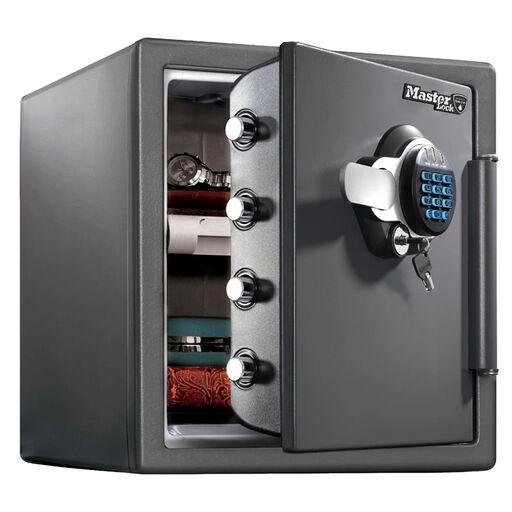
Why this choice suits this profile: This model combines a generous capacity, a dual-access locking system and several storage features. It's suitable for a home or office where files accumulate.
The product page states that both the digital code and the key are needed to open the safe. It also notes that fixing it may affect water resistance.
33 litres, UL protection stated for two hours at 927 °C, ETL resistance to 20 cm of water for 24 hours and adjustable shelves.
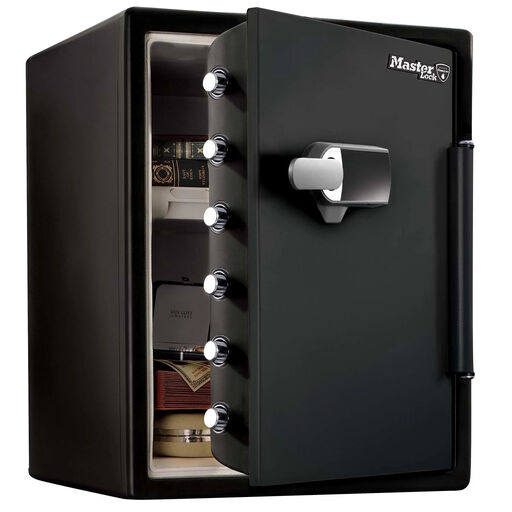
Why this choice suits this profile: Its volume meets the needs of businesses, professionals and families who want to store numerous files, digital media and valuables together.
The product page distinguishes between freestanding placement and floor anchoring, and states that water resistance applies to the safe before it is fixed.
56.5-litre capacity, six locking bolts, interior lighting, drawer and adjustable shelf, all complemented by a backlit keypad.
We've put together a comprehensive, real-time updated selection of products that meet these demanding criteria and European safety standards.
Not necessarily. Check that the product page explicitly mentions digital media and the corresponding classification. The performance stated for paper documents and electronic devices may differ.
It depends on the model. Some models retain their water protection after fixing thanks to a specific kit, while others state that anchoring compromises this feature. Read the instructions carefully before proceeding with installation.
Power consumption is generally limited to the keypad and locking mechanism. Maintenance mainly involves replacing the batteries when they run low. Always keep the emergency key or access information in a separate, secure place.