
Livraison le jour même ou le lendemain

Qualité garantie

Débloquez vos offres de bienvenue: Livraison GRATUITE | Jusqu'à -80 % | 30 jours d'essai gratuits à JoyPlus
Téléchargez l'application
Soreness after a workout, tension after a long day at the office... We've all experienced muscle pain. To combat it, the massage gun has quickly become the go-to tool for muscle recovery and at-home wellness. The problem? The market is flooded with models making enticing marketing claims, making it easy to get lost. The result is often an unsuitable device that ends up collecting dust in a closet.
As a product expert at Joybuy, my mission is to help you see clearly. Before you make a purchase, here are the common pitfalls to avoid so you don't regret your choice:
To make the right choice, ignore the marketing jargon and focus on the technical specs that truly matter. Here are the three criteria to scrutinise.
Amplitude refers to the distance the massage head travels back and forth with each pulse. This is THE number-one criterion that determines the true effectiveness of a percussive massage device.
Stall force is the maximum pressure you can apply to the massage head before the motor stalls. A low stall force indicates an underpowered motor. If the device stops the moment you apply firm pressure to a dense muscle (like the thigh or calf), it's practically useless. Sufficient stall force ensures the device maintains its speed even during a deep-tissue massage.
Often overlooked, these two aspects are crucial: they will determine whether you use your massage gun regularly or if it just gathers dust.
Instead of an endless list, here is a curated selection of products tailored to distinct user profiles, based on our criteria for performance and practicality.
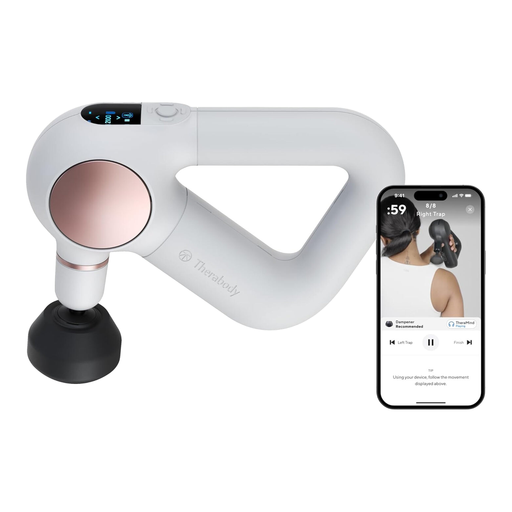
Who is it for? Those seeking more than just a massage: a true wellness experience. Ideal for relieving daily stress, releasing neck and back tension, and even improving sleep.
It avoids the trap of raw power. Instead, it focuses on a moderate but scientifically calibrated intensity, pairing it with guided breathing exercises via its app. Its famous patented triangular handle definitively solves the ergonomic challenge of reaching your back unassisted.
The combination of percussive therapy, guided routines, and a heart rate sensor provides an ultra-personalised approach to stress and pain relief.
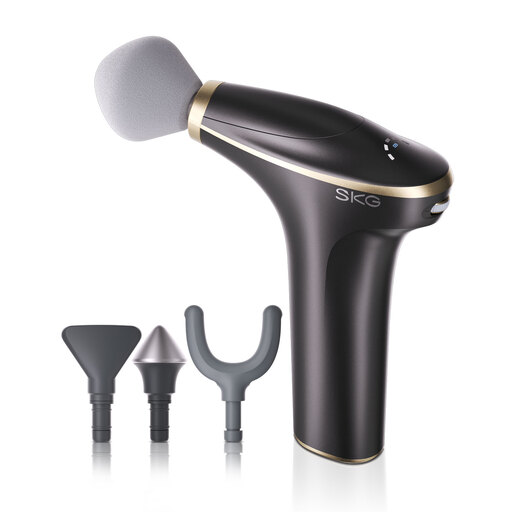
Who is it for? Dedicated athletes and sports enthusiasts who need a high-performance, portable tool to optimise their recovery. Its power and interchangeable heads allow for precise work on targeted muscle groups.
It's the king of the power-to-portability trade-off. Its 10 mm amplitude ensures an effective deep massage without being overly aggressive. Ultra-compact (350 g) and stylish, it makes heavy, bulky devices a thing of the past.
Its 5 speeds and 4 massage heads allow you to precisely tailor the treatment to every recovery need.
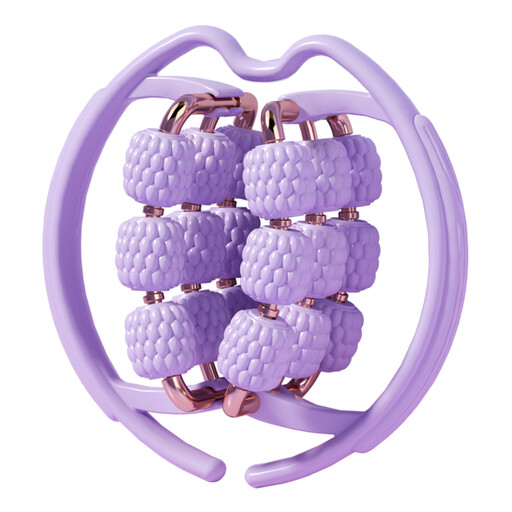
Who is it for? An excellent alternative for those who prefer a manual approach or are looking for a simple, cost-effective solution. Perfect for a targeted massage of the arms, thighs, and neck, while maintaining full control over the pressure.
Being 100% manual, it bypasses all the pitfalls of electric models: no battery, no noise, and no disappointing motor. The user has complete control over the intensity and depth of the massage, ensuring tailored effectiveness every time.
Simplicity, portability, and effectiveness at a great price. This type of massage roller is a perfect complement or a very smart alternative to electric massage guns.
We have curated a complete range of products that meet our performance criteria and safety standards.
The massage gun uses percussive therapy (rapid, vertical pulses) to penetrate deep into the tissues. It's incredibly effective for targeting very specific tension knots (known as trigger points). The massage roller (or foam roller), on the other hand, uses your body weight to apply broader, continuous pressure to the muscles (a technique called myofascial release). The two are highly complementary: the gun for deep, precise work, and the roller for a more general massage of large muscle groups.
As a general rule, one to two minutes per muscle group is more than enough. Massaging the same area for too long can cause irritation or even bruising. For recovery, use it right after your workout. To relieve tension, a session every day or every other day is a good frequency. Always follow the manufacturer's recommendations and, most importantly, avoid bony areas, joints, and the front of your neck.
The noise level varies greatly from one model to another. Entry-level devices can be very loud (over 70 dB), which is anything but relaxing. Modern models equipped with brushless motors are much quieter. Their noise levels often fall below 60 dB, with best-in-class models even reaching as low as 45 dB—the equivalent of a quiet conversation. This is an essential comfort factor that shouldn't be overlooked.