
Livraison le jour même ou le lendemain

Qualité garantie

Débloquez vos offres de bienvenue: Livraison GRATUITE | Jusqu'à -80 % | 30 jours d'essai gratuits à JoyPlus
Téléchargez l'application
Masking tape for painting can save you valuable time. However, you need to choose the right type: unsuitable adhesion can leave marks, pull away a finish or create uneven edges. Whether you are repainting a living room, a façade, a piece of furniture or a stairwell, your choice will mainly depend on the surface, how long the tape will be left in place and the level of precision you need.
Highly adhesive tape is not necessarily the most effective. On a painted wall, varnished parquet flooring or a piece of furniture, overly aggressive adhesive can remove a layer of paint or leave residue. Conversely, tape with insufficient adhesion may allow paint to seep beneath the edge.
Adhesion must therefore be suitable for the surface. Medium-adhesion masking tape is generally suitable for walls, wood, metal and glass in good condition. For delicate surfaces, it is better to choose a low-adhesion version.
Multi-surface masking tape may be suitable for several types of surface, but that does not mean it will work with every finish. Dusty, damp, porous or freshly painted surfaces reduce its adhesive power and increase the risk of paint bleeding.
You should also pay close attention to the removal time stated on the packaging. This can vary depending on the product, temperature, exposure to sunlight and the type of surface.
Narrow tape is particularly practical for mouldings and precise patterns. By contrast, a width of 36 to 48 mm provides broader protection for skirting boards, frames and adjacent areas. Choosing the wrong width can therefore lead to excessive tape usage or, conversely, insufficient protection.
UV-resistant masking tape is preferable for a surface exposed to direct sunlight or for a short outdoor project. However, it is still essential to follow the removal time stated on the packaging.
Start by identifying the surface carefully:
On recently applied paint, wait until it is completely dry, in accordance with the manufacturer’s instructions. Even tape designed for delicate surfaces may react differently depending on the quality and age of the coating.
The term residue-free painting tape is only meaningful when it is accompanied by a specific removal time. In the selection below, the stated timeframes range from a few days to several weeks, depending on the product and intended use.
Remove the tape when the paint is touch-dry, without leaving it in place for longer than necessary. Peel it off slowly at approximately 45°, without pulling sharply or stretching the tape.
To achieve crisp paint lines, the quality of the edge matters just as much as that of the adhesive. A 19 mm strip is suitable for details, furniture, borders and patterns. Widths of 24 to 36 mm offer better control on walls and door and window frames. Formats from 48 to 50 mm protect a larger area.
Remember to check the total length too. A 50 m roll may be enough for one room, while a multipack of rolls will be more practical for renovation work or professional use.
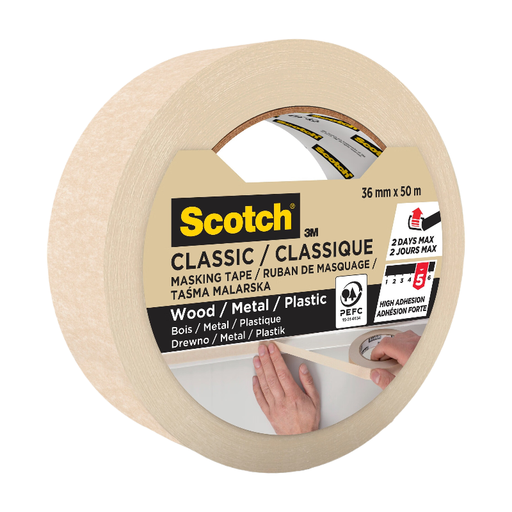
Why this product suits this profile: At 50 m long and 36 mm wide, this roll is suitable for occasional jobs on smooth surfaces in good condition.
The product details state that it is intended for short-term use and can be removed without residue within a limited timeframe. This helps you avoid leaving the tape in place for longer than recommended.
50 m long, 36 mm wide, crepe paper backing and adhesion suitable for smooth surfaces.
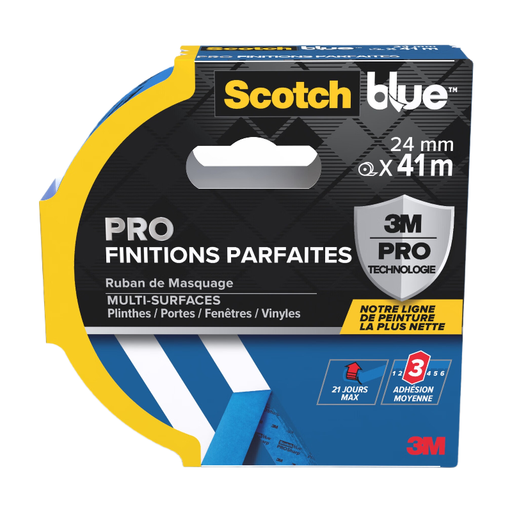
Why this product suits this profile: Its compact format is ideal for decorative finishes and projects where crisp edges are the top priority.
The manufacturer describes PRO Edge-Lock+ technology as helping to limit paint bleed. The product details also state that it can be removed after up to 21 days, both indoors and outdoors.
24 mm wide, advertised as suitable for metal, glass, wood and painted walls, with UV resistance.
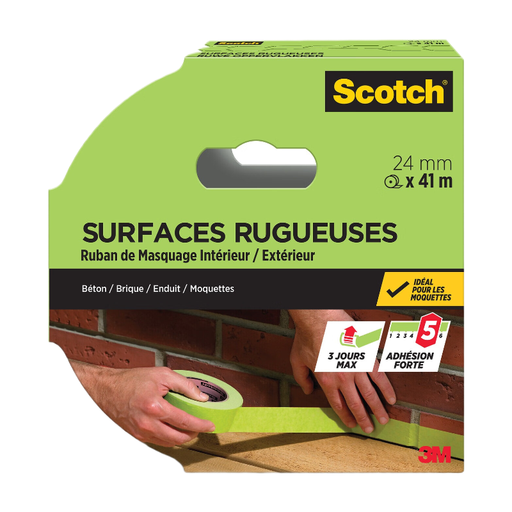
Why this product suits this profile: Its design is intended for difficult surfaces commonly found during renovation, such as brick, concrete, render, concrete blocks and bare wood.
This is not a universal tape sold without qualification: the product details specifically target rough surfaces and recommend removal within three days.
Enhanced adhesion, hand-tearable, suitable for indoor and outdoor use, measuring 41 m × 24 mm.
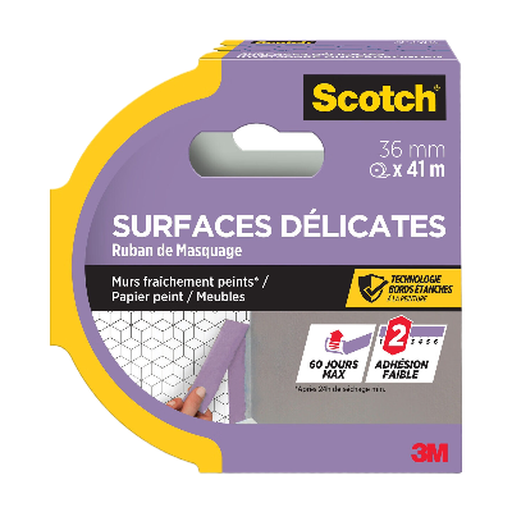
Why this product suits this profile: Its low adhesion is intended for parquet flooring, furniture, vinyl coverings and other indoor surfaces that require extra care.
The stated low adhesion reduces the risk associated with overly aggressive adhesive. Testing it on a less visible area is still recommended, particularly on wallpaper.
36 mm wide, advertised removal time of up to 60 days, hand-tearable and suitable for decorative work requiring crisp edges.
We have put together a complete, real-time updated list of products that meet these demanding selection criteria and European safety standards.
On a painted wall in good condition, medium-adhesion decorator’s tape that is compatible with several surfaces is suitable for everyday jobs. If the paint is recent, delicate or matt, choose masking tape for delicate surfaces and test it first in an inconspicuous area.
It depends entirely on the model. Standard tapes for short-term use may need to be removed within two to five days. Some multi-surface tapes state that they can be left for up to 14 days, while models for delicate surfaces may last up to 60 days. However, these timeframes still depend on the type of surface and the surrounding conditions.
For a project exposed to sunlight, choose exterior masking tape with UV resistance. Depending on the product, the details may state residue-free performance for 7, 14 or 21 days. Avoid exceeding this timeframe and remove the tape slowly to protect the paint.