
Livraison le jour même ou le lendemain

Qualité garantie

Débloquez vos offres de bienvenue: Livraison GRATUITE | Jusqu'à -80 % | 30 jours d'essai gratuits à JoyPlus
Téléchargez l'application
The vast and colourful world of markers can quickly become overwhelming. Between promises of "long-lasting" inks and supposedly indestructible tips, it's easy to end up with a disappointing product. A poor choice doesn't just ruin a craft project? it's also a waste of time and money.
Before you fill your basket, let's review the most common pitfalls to avoid:
To avoid these traps, you just need to master a few key concepts that make all the difference in a marker's quality and use.
Choosing the right marker is, above all, about finding the model that matches your project. Here are the three points to check before you head to the checkout.
The ink dictates how the marker can be used. They are generally classified into three main families:
The tip is what gives your line its personality.
There's a marker for every surface! Always check the manufacturer's recommendations. A glass marker has a special formula to grip a smooth surface, while a fabric marker is designed to withstand washing. This is the essential condition for a flawless, long-lasting result.
To help you see more clearly, we've selected products that meet specific needs, based on the criteria we've just covered.
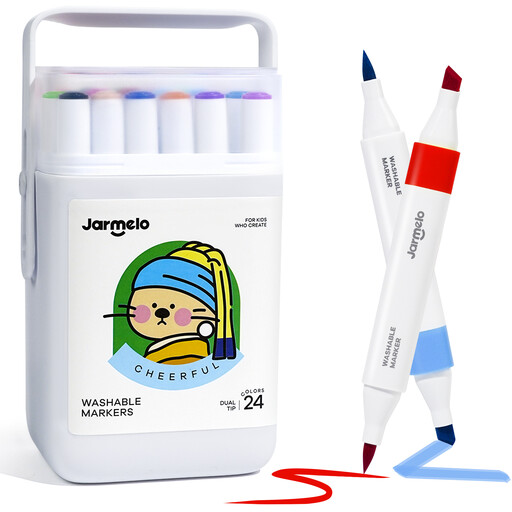
Why this choice? This set is designed entirely for children. Its dual tip (brush and chisel) offers great versatility for both colouring and first drawings. We appreciate its thick, oval barrel, which ensures a good grip, and its handy storage case to keep everything organised.
Its water-based ink is washable from skin and most fabrics: say goodbye to the stress of permanent stains! The ventilated caps are an essential safety feature, and the fibre tips are designed to withstand the enthusiasm of young artists, preventing the problem of crushed tips.
The combination of non-toxic, washable ink and a dual-tip design makes it a starter kit that is as comprehensive as it is safe for children.
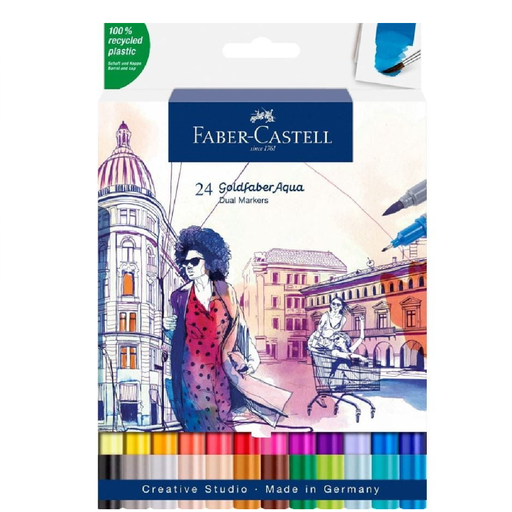
Why this choice? This set is aimed at artists and discerning hobbyists. Each dual-tip marker combines a flexible brush tip, perfect for colour blocking and gradients, with a fine tip (0.6 mm) for precise details. Its watercolour ink opens the door to highly sophisticated wash effects.
No more dilemma over which tip to choose: it offers two complementary options on each marker. Its high-quality ink is formulated not to bleed through most drawing papers, which prevents ruining the next pages of a sketchbook. The icing on the cake: the barrel and caps are made from 100% recycled plastic, a sign of thoughtful design.
The ink's perfect water solubility, combined with the flexibility of the brush tip, makes it an ultra-versatile creative tool, halfway between a marker and watercolour paint.
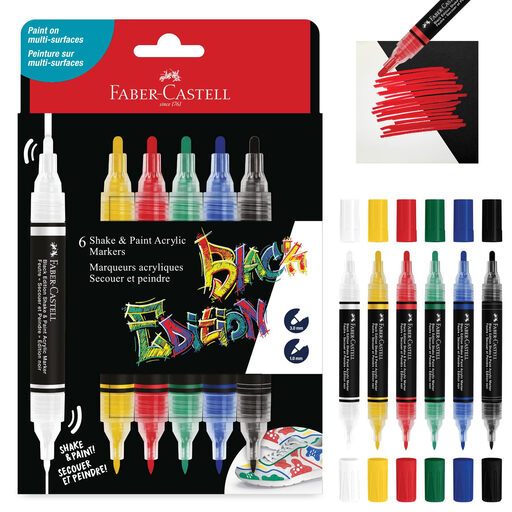
Why this choice? This set of acrylic markers is the secret weapon for customisation fans. Its opaque, water-resistant ink adheres durably to smooth or porous surfaces (stone, glass, metal, plastic) where classic markers fall short.
It tackles the myth of the misleading "multi-surface" marker head-on. Its acrylic formula is specifically designed for maximum adhesion and opacity on the most demanding surfaces. The "Shake & Paint" valve system ensures a consistent ink flow for a clean, uninterrupted line.
Its intense pigmentation and opacity allow you to draw on dark surfaces with a vibrant result, something impossible with classic water- or alcohol-based markers.
Explore our complete, up-to-date selection of products that meet our demanding selection criteria and current standards.
For a water-based marker, try soaking the tip in a little warm water for a few minutes. For an alcohol-based model, a quick dip in isopropyl alcohol might do the trick. In both cases, replace the cap securely and let the marker rest horizontally for several hours. Be aware, however: if the ink has completely evaporated, it is unfortunately beyond saving.
The difference is mainly in opacity and texture. The ink of an alcohol-based permanent marker is translucent and blends into the paper, which is perfect for gradients and colour mixing. Conversely, an acrylic marker lays down an opaque layer of paint on the surface. It can therefore cover other colours and remains perfectly visible on dark surfaces. Acrylic provides a matte or satin finish, whereas alcohol-based ink is more subtle.
Yes. Children's markers sold in the European Union must comply with very strict safety standards (like the EN 71 standard) that regulate the presence of chemical substances. The "non-toxic" label guarantees this compliance. As for the word "washable," it means the ink can be easily removed from skin with soap and water, and from most fabrics after a machine wash. A word of advice: act quickly on stains to ensure no trace is left behind.