To choose an individual cake for a marathon, check the carbohydrates per serving and the allergens, then try the recipe and portion size in training before taking it along for race day. The St Michel and Auchan product pages list 13 g and 16 g of carbohydrates respectively for the portions featured here. These cakes can contribute to your fuelling plan, but on their own they do not provide the 30 to 60 g per hour recommended by World Athletics for 1 to 2.5 hours of exercise. For efforts lasting longer than 2.5 hours, the World Athletics guideline can be as high as 90 g per hour, depending on the circumstances.
Who are these formats for?
Runners who want to take a small portion with them
An individually wrapped cake can make it easier to pack a training snack or an extra item you’ve already planned to take. The formats featured by St Michel, LU and Auchan make it easy to count how many you’re bringing. However, check the carbohydrates in your chosen portion and try it before using it during a race.
Marathon runners tracking their carbohydrate intake per hour
The number of packets doesn’t tell you how many carbohydrates they provide. World Athletics recommends 30 to 60 g per hour for 1 to 2.5 hours of exercise, and up to 90 g per hour for efforts lasting longer than 2.5 hours, depending on the circumstances. To include a cake in your plan, start with the grams listed for the portion you’ll be eating.
Runners who pay attention to ingredients and what they can tolerate
Before choosing a cake for race day, check its ingredients, allergens and any ‘may contain’ warnings on the packaging you buy. The St Michel, LU and Auchan recipes featured here contain different allergens. World Athletics also recommends practising your planned race-day fuelling strategy during training.
What should you look for?
To include an individual cake in your marathon fuelling strategy, start with the carbohydrates in the portion you’ll actually eat. Then check the ingredients, packaging and how well you tolerate it during training.
| What to consider |
What to check |
Who is this useful for? |
| How well you tolerate it in training |
Try the recipe and portion size you’re planning to use on a long run, alongside the drink you intend to have during the race. |
I prefer to use a product and portion size I’ve already tried, rather than discover a new recipe mid-run; around 37% of consumers would put tolerance at the top of their list. |
| Carbohydrates per portion |
Check the carbohydrates in the portion you’ll eat and add them to those in any drinks or other products you’ve planned. |
If I track my intake hour by hour, I need to know how each cake fits into my plan; around 27% of consumers would prioritise this. |
| Easy-to-carry format |
Check whether the cakes come in separate packets, and distinguish the weight of one portion from the weight of the whole pack. |
To plan my fuelling in advance, I want to be able to carry and count individual portions; this would be the main consideration for around 18% of consumers. |
| Allergens and ingredients |
Read the ingredients list and any ‘may contain’ warnings on the packaging of the product you’re buying. |
If certain ingredients don’t suit me, I need to choose a recipe that meets my requirements first; around 18% of consumers would prioritise this check. |
Mistakes to avoid
-
Confusing an individual portion with a full fuelling dose
An individually wrapped cake won’t necessarily provide the carbohydrates you need for an hour of exercise. The St Michel and Auchan product pages list 13 g of carbohydrates for a soft madeleine and 16 g for an organic chocolate sponge cake.
Check the carbohydrates per portion and count the cake alongside the drinks and other items in your plan, rather than relying on the number of packets.
-
Trying a chocolate cake for the first time on race day
Recipes vary in their ingredients and fat content, and everyone responds differently to food during exercise. World Athletics recommends trying your planned race-day fuelling strategy in training.
Try the product, portion size and accompanying drink on your long runs before deciding to take them along for the marathon.
-
Relying on the allergen information for a different product
Ingredients and ‘may contain’ warnings can vary between cakes, even within the same brand. An individual packet alone doesn’t tell you whether its recipe meets your requirements.
Check the packaging of the product you’ve bought whenever you switch recipe or format.
-
Assuming a large cake comes in ready-to-carry portions
The Carrefour Classic’ plain cake featured by Carrefour is sold in a 500 g pack. It isn’t individually wrapped, even though its nutritional information lets you check the composition per 100 g.
Check the packaging and serving size before comparing this cake with individually wrapped ones.
Brands to know when comparing formats
These products illustrate different formats and recipes. Information on one product page won’t automatically apply to other cakes from the same brand.
St Michel
The brand offers soft madeleines in individual packets, with one madeleine per serving.
- The St Michel product page lists 13 g of carbohydrates, 7 g of fat and 116 kcal per soft madeleine, making it easy to include this portion in a fuelling plan.
- This recipe contains gluten and egg; it also carries warnings for possible traces of nuts, milk and soya.
LU
The Carrefour product page for LU Napolitain Original shows a box of six individually wrapped portions.
- The separate packets make it easy to count the portions you’re taking with you.
- For this product, Carrefour lists 20 g of fat per 100 g, and states that it contains wheat, egg, milk and soya; nuts may also be present. This information doesn’t apply to every Napolitain variety.
Auchan
Auchan’s organic chocolate sponge cakes come in a pack of six individually wrapped portions.
- For one 33.3 g cake, the Auchan product page lists 16 g of carbohydrates, 8.1 g of fat and 148 kcal.
- The recipe contains ingredients including egg, milk, almonds, wheat and soya. Its individual format doesn’t mean you’ll necessarily tolerate it during a race.
Carrefour
Carrefour’s range includes a 500 g pack of Classic’ plain cake, a useful example of the difference between a large cake and an individual portion.
- The product page gives nutritional values per 100 g, including 25 g of fat and 436 kcal.
- The pack doesn’t contain individually wrapped portions. The recipe lists wheat, egg and milk, and may contain traces of nuts.
Individual cake available on Joybuy
The LU Napolitain Pocket featured here is a packet of two pieces. Treat it as a portion to count in your plan, after trying it in training. To assess its contribution, check the carbohydrates listed on the packaging of the product you buy.
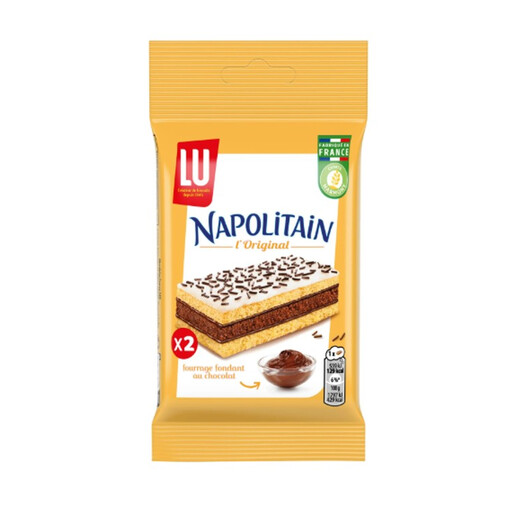 Image unavailable
LU Napolitain Pocket, 2 pieces, 60 g
You could take this packet of two pieces on a training run to try the recipe and portion size before deciding whether to use it during a race.
Format: 2 pieces, 60 g. Check the packaging for carbohydrates per portion, ingredients and allergens.
View on Joybuy
Frequently asked questions
Can an individual cake be part of your marathon fuelling plan?
Yes. It can contribute to the carbohydrates in your plan if you’ve already tried that product and portion size in training. One portion won’t necessarily provide a full hour’s fuelling: St Michel lists 13 g of carbohydrates for the madeleine featured here and Auchan lists 16 g for its sponge cake. World Athletics recommends 30 to 60 g per hour for 1 to 2.5 hours of exercise, and up to 90 g per hour for longer efforts, depending on the circumstances.
How do you compare two individual cakes for a long run?
First compare the carbohydrates in the portion you plan to eat, then check the fat, ingredients and allergens in each recipe. Remember to include the carbohydrates in your drinks and other products too: the pack weight or number of packets won’t tell you how much you’re planning to take in.
Should you try the cake before marathon day?
Yes. If you’re planning to eat it during the race, try the same product and portion size, along with the drink you’ll have with it, during training. World Athletics recommends practising your planned race-day fuelling strategy beforehand.
Where can you check the allergens in a packaged cake?
Check the ingredients list and any ‘may contain’ warnings on the packaging of the cake you’re buying. Recipes and formats can vary, even under the same brand, so don’t rely solely on the product page for a different item.


