
Livraison le jour même ou le lendemain

Qualité garantie

Débloquez vos offres de bienvenue: Livraison GRATUITE | Jusqu'à -80 % | 30 jours d'essai gratuits à JoyPlus
Téléchargez l'application
A manual stapler can be used to join sheets of paper, attach fabric to a seat or secure a flexible material to wood. However, not all models are interchangeable. Using an office stapler to renovate a chair, or a DIY staple gun to join documents, quickly leads to jams, poorly driven staples and unnecessary expense.
Before making your choice, pay particular attention to the type of staples accepted, the tool’s actual capacity and the effort required to operate the handle. Here are the main criteria to consider, followed by a selection suited to different uses.
The term ‘stapler’ covers several different mechanisms. An office stapler generally uses standard 26/6 staples, no. 10 staples or other formats designed for paper. An upholstery stapler, on the other hand, often uses strip staples such as type 53, 140 or equivalent formats, depending on the manufacturer.
These references are not automatically compatible. To attach fabric to wood, choose a model whose staple dimensions are clearly stated. For example, some tools accept type 53 staples in 6, 8 or 10 mm.
A high striking force does not guarantee that a tool will be comfortable to use. For a decorating project or furniture renovation, a handle that is difficult to press will quickly tire your hand and may result in staples being driven in unevenly.
Instead, examine the shape of the handle, its travel, the stability of the nose against the surface and whether a power adjustment is available. An adjustable-power manual staple gun may adapt better to different densities of flexible materials, but it will not replace a tool designed for hardwood.
A magazine that is difficult to open slows down every project. Similarly, without a staple remover, you may have to use a screwdriver or pliers, risking damage to the fabric or furniture surface.
For regular use, look for a quick-release magazine, an anti-jam mechanism and, if possible, a stapler supplied with a staple remover. These features do not make the tool universal, but they make touch-ups and material changes easier.
Compatibility should be clearly stated on the packaging or product page. Type 53 staples are available in 6, 8 and 10 mm, among other sizes. A shorter length is suitable for some fabrics and thin materials, while a longer staple may be necessary for securing several layers. The nature of the surface and the density of the fabric remain decisive factors.
For paper, check the exact reference: standard 26/6 staples, no. 10 or another format. An office stapler advertised for 15 sheets should not be used beyond this limit. Some models accept approximately 20 to 30 sheets of 80 g/m² paper, but this capacity depends on the paper used and the condition of the mechanism.
An all-metal mechanism can be a good choice for frequent office use. A PC+ABS body often offers an appealing balance between light weight and durability for creative hobbies. The right choice depends on how often you will use it and on the material to be secured.
For a DIY stapler, examine the following features in particular:
A stapler for furniture and fabrics is suitable for small furnishing, decorating or upholstery projects. It should not be confused with an electric or pneumatic stapler designed for a high professional workload. For hardwood, check the limits stated by the manufacturer: some models are designed for softwoods such as pine or spruce and are not recommended for dense timber.
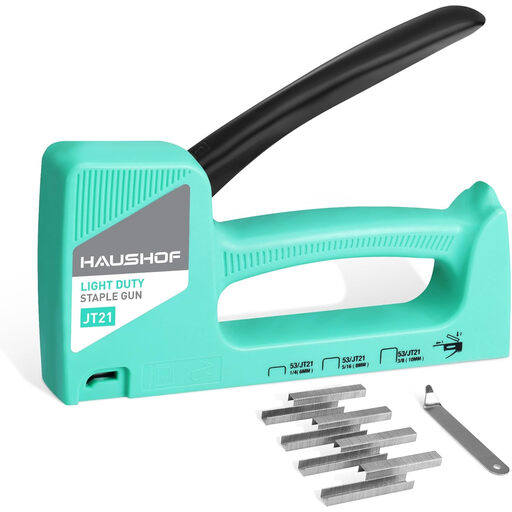
Why this choice suits this profile : This ready-to-use kit is ideal for a first fabric repair, a decorating project or renovating a small piece of furniture.
Compatibility with 6, 8 and 10 mm type 53 staples is clearly stated. The kit includes 800 8 mm staples and a staple remover.
Easy-press handle, anti-jam mechanism and quick-release magazine for small projects.
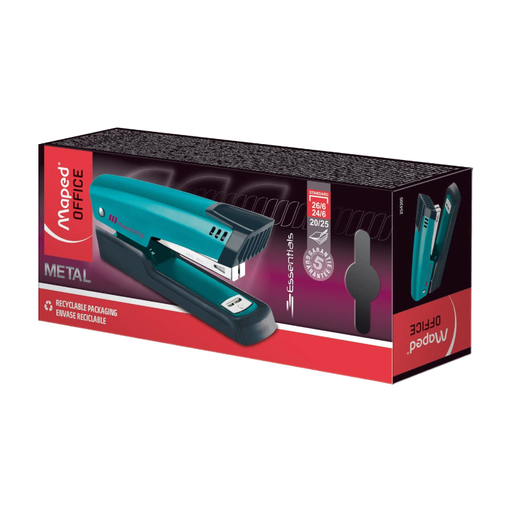
Why this choice suits this profile : Its compact design and refined finish will fit effortlessly on a personal desk, in a student bedroom or in a home office.
The standard 26/6 staple reference is clearly stated, helping to prevent reloading errors and incompatible purchases.
Metal mechanism, non-slip base, storage box and easy-to-store half-strip format.
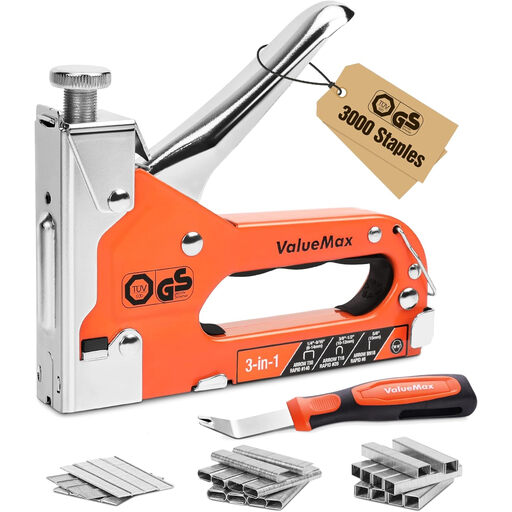
Why this choice suits this profile : This model is designed for those who switch between upholstery, decorating, securing materials and small woodworking projects involving softwood.
The three compatibility options are detailed : types 140/T50, 28/T18 and 8/BN18. The instructions also state that the tool is not recommended for hardwood.
Force adjustment, hinged magazine and a pack of 3 000 staples divided between D, U and T formats.
We have put together a complete, real-time updated list of products that meet these strict selection criteria and European safety regulations.
An upholstery stapler or staple gun compatible with type 53 staples is generally suitable for small projects involving softwood, fabric and decorative materials. Check the staple length and the tool’s capacity before buying.
An office stapler is designed to pierce and join sheets of paper using standard staples. A furniture stapler has a mechanism suited to driving staples into a surface, as well as a different handle and different staples. These two tools are therefore intended for different tasks.
Its lifespan depends on how often it is used, the type of material, the quality of the staples and how well it is maintained. Avoiding surfaces that are too hard, observing the stated capacity and promptly removing jammed staples will help preserve the mechanism.