
Livraison le jour même ou le lendemain

Qualité garantie

Débloquez vos offres de bienvenue: Livraison GRATUITE | Jusqu'à -80 % | 30 jours d'essai gratuits à JoyPlus
Téléchargez l'application
A manual stapler can be used to assemble documents, attach fabric to a seat or secure a lightweight material to wood. However, not all models are interchangeable. Using an office stapler to renovate a chair, or a DIY staple gun to join piles of documents, quickly leads to jams, poorly driven staples and uncomfortable handling.
Before comparing models, it is therefore better to focus on the features that really matter rather than on marketing claims.
An office stapler is designed for joining sheets of paper. Its capacity is generally expressed as a number of pages, for example 15 or 20 to 30 sheets of 80 g/m² paper. It is not designed to attach fabric, thick cardboard or a material to wood.
A staple gun, also known as a wall stapler or upholstery stapler, operates with a very different striking force. It is used against a stable surface for decorating, upholstery or furniture repair work.
The wording ‘compatible with standard staples’ is too vague to be genuinely useful. Depending on the model, this may refer to type 53 staples, sizes 140, 28 or 8, or 26/6 staples for an office stapler.
A stapler that only accepts type 53 staples will not necessarily work with 26/6 staples. Always check the compatible sizes and lengths before buying, especially if you already have a supply of staples to use.
A magazine that is difficult to open can quickly slow down your work. A mechanism without a release system may force you to interrupt your DIY session and remove a jammed staple with pliers.
For regular use, look for a quick-release magazine, an anti-jam mechanism and, where possible, a staple remover included with the product. These features do not remove the need to use the tool correctly, but they make everyday maintenance considerably easier.
For attaching fabric to softwood or completing small creative projects, a stapler that accepts several staple lengths offers greater flexibility. Models compatible with 6, 8 and 10 mm type 53 staples are suitable for many light decorating and upholstery jobs.
The length must nevertheless be suited to the material. A staple that is too long can pass through a thin support, while one that is too short may not hold securely enough. When working on furniture, always test the stapler on a scrap of material before tackling the visible section.
An ergonomic handle and progressive pressure help reduce fatigue when several dozen staples need to be inserted. A fabric stapler or manual stapler for wood still requires you to hold the workpiece firmly and keep the tool head flat against the surface.
Models with an adjustable force setting allow you to adapt the driving depth to the density of the support. This feature is particularly useful if you switch between fabric, cardboard, softwood and different craft projects.
A metal or metal-alloy body may be suitable for frequent use. A PC+ABS body offers a good balance between weight and durability for small household projects. For an office stapler, focus primarily on sheet capacity and the type of staples it accepts.
Also read the safety instructions: keep your fingers away from the staple outlet, stabilise the support, point the tool away from your body and do not use staples on material thicker than the stated capacity.
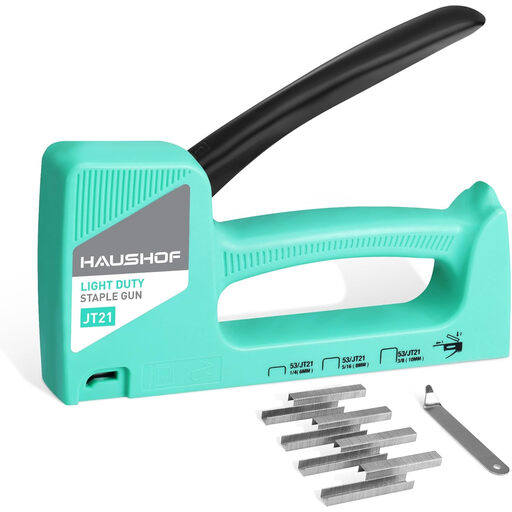
Why this choice suits this profile: This ready-to-use kit includes a manual stapler, 800 8 mm staples and a staple remover. It is suitable for small upholstery, wood DIY and home decorating projects.
Compatibility with 6, 8 and 10 mm type 53 staples is clearly stated, helping to prevent size-related mistakes. The quick-release magazine makes reloading easier.
Progressive-pressure handle, anti-jam mechanism and included accessories, so you can get started without buying anything else.
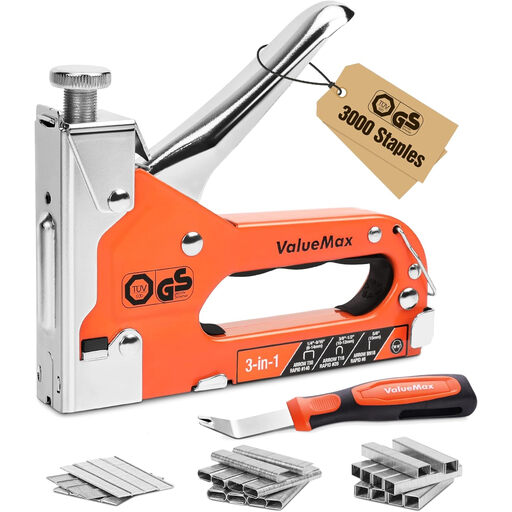
Why this choice suits this profile: Users looking for a versatile stapler get three compatible sizes and an adjustable force setting to suit different supports.
Compatibility with 140/T50, 28/T18 and 8/BN18 sizes means the tool is not limited to a single staple type. The top-mounted adjustment helps control the driving depth.
Steel-alloy body, ergonomic handle and a kit containing 3,000 staples. However, the manufacturer advises against using it on hardwood.
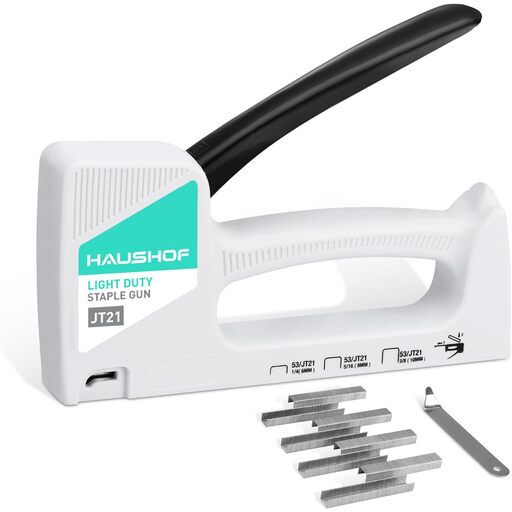
Why this choice suits this profile: This model is designed for repeated light upholstery, craft and furniture repair projects that require several reloads.
The anti-jam mechanism and quick-release magazine are well suited to jobs involving frequent reloading. The three type 53 staple lengths are clearly specified.
PC+ABS construction, advertised progressive pressure and a set containing 800 8 mm staples and a staple remover.
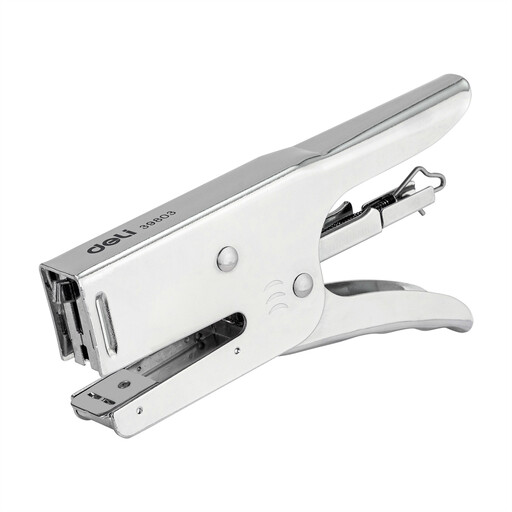
Why this choice suits this profile: Its desktop format is ideal for reports, schoolwork, administrative documents and filing tasks at home.
Its stated capacity of around 20 to 30 sheets of 80 g/m² paper clearly defines its intended use. It should not be used on wood, fabric or thick materials.
Metal mechanism, plastic base and compact dimensions, making it suitable for an office or workstation.
We have put together a complete, real-time updated list of products that fully meet these strict selection criteria and European safety regulations.
The tool’s lifespan depends on how often it is used, the pressure applied and the materials selected. An office stapler used on paper within its intended limits does not undergo the same stresses as a staple gun used on furniture.
A manual upholstery stapler compatible with type 53 staples is generally suitable for light work on softwood. Check the available lengths, keep the fabric taut and test the stapler on a discreet area.
26/6 staples are primarily designed for office staplers. They cannot replace the staples intended for a staple gun or wall stapler. Check the magazine markings and the model’s instructions.
Use a length suited to the support, hold the tool perpendicular to the surface and press down on a stable base. For materials with different densities, a model with an adjustable force setting can help you fine-tune the driving depth.