
Livraison le jour même ou le lendemain

Qualité garantie

Débloquez vos offres de bienvenue: Livraison GRATUITE | Jusqu'à -80 % | 30 jours d'essai gratuits à JoyPlus
Téléchargez l'application
Moving on from pods to a manual espresso machine is a major step for any coffee enthusiast. It’s the promise of mastering every variable of your drink, from grind to extraction, for a barista-quality result. Faced with a jungle of technical terms and marketing promises, our mission is to help you see clearly and make the right choice.
But before you dive in, let's navigate the most common pitfalls that could turn your home barista dream into a costly disappointment.
To avoid these traps, focus on a handful of key technical specifications. These, not marketing slogans, are what determine the true performance of an espresso maker.
Let's reiterate?: 9 bars of pressure at the group head is the gold standard for a balanced espresso. A machine advertising 20 bars certainly has a powerful pump, but what truly matters is its ability to deliver stable, controlled pressure throughout the entire extraction.
This is where a pressure gauge becomes your best ally. It allows you to monitor the pressure in the portafilter in real time. Far from being a mere gadget, it's a genuine feedback tool that helps you perfect your grind and tamp to consistently hit the ideal zone and achieve that rich, velvety crema.
Water temperature is the other pillar of a successful espresso. A variation of just a few degrees is enough to completely alter the aromas. Most consumer machines use a thermoblock heating system, which has the advantage of heating up quickly and providing water on demand.
The quality of this thermoblock and the machine's overall design are therefore crucial. A stainless steel coffee machine with a full metal frame will offer better thermal inertia, ensuring a more stable temperature from the beginning to the end of the extraction.
If you're a fan of cappuccinos or lattes, an espresso machine with a steam wand is a must. But be warned, not all wands are created equal. Opt for a model mounted on a ball joint, which is far more practical for handling your milk pitcher. A powerful, well-designed wand is the key to creating fine, silky microfoam—essential for perfecting your milk drinks and trying your hand at latte art.
To help you sort through the options, here is our selection of models that check all the right boxes, suited for different profiles and budgets.
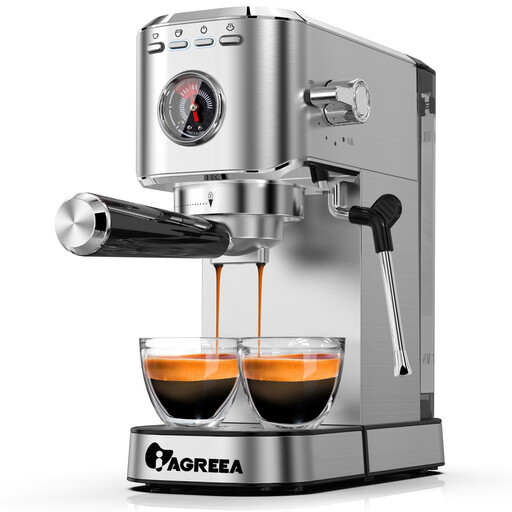
Key features : Perfect for moving on from pods and learning to control extraction without breaking the bank. Its compact, all-stainless-steel design will easily find a home in any modern kitchen.
The integrated pressure gauge allows you to look beyond the advertised "20 bars" and aim for the ideal extraction pressure. Its stainless steel frame ensures far better durability and thermal stability than plastic alternatives.
A complete starter package : a pressure gauge for control, a high-performance steam wand, and a cup warmer, all in a discreet, compact form factor.

Key features : For those who want to go further and master every variable. This semi-automatic coffee machine offers advanced settings to experiment and get the best out of every bean.
It goes beyond marketing claims with its programmable functions (temperature, pre-infusion time). Its 58 mm portafilter, a professional standard, ensures a much more even extraction.
Precise control over temperature and pre-infusion—features normally reserved for much more expensive professional machines.
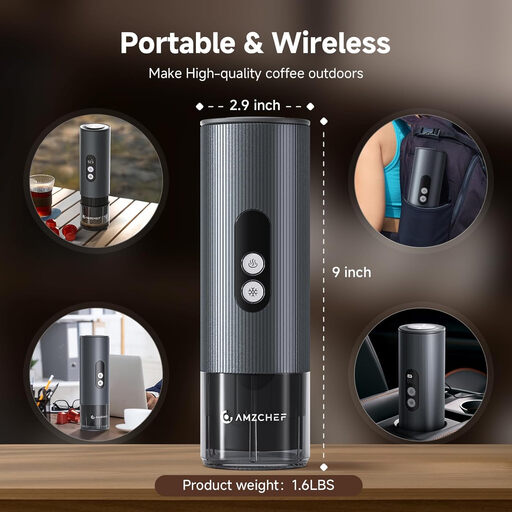
Key features : For those who refuse to sacrifice the quality of their espresso, whether traveling, camping, or at the office. Fully self-contained, its integrated battery heats the water and handles the extraction.
It doesn't try to replace a home machine. Its mission is portability, with a robust build and true 20-bar pressure for a quality espresso, wherever you are.
Its total autonomy : the 9000 mAh battery handles everything (heating and extraction), freeing you from the search for a power outlet or a kettle.
We have compiled a complete, up-to-date list of products that meet these strict selection criteria and safety standards.
Not necessarily. The pump's maximum pressure (15 or 20 bars) matters less than the machine's ability to maintain a stable and consistent pressure of around 9 bars at the group head. A pressure gauge will give you a much more reliable indication of the actual extraction performance than the large number printed on the box.
The longevity of a home coffee machine depends on its build quality and, most importantly, its maintenance. A model with a mostly metal frame, like a stainless steel coffee machine, will naturally be more durable. Regular descaling (every 2-3 months, depending on your water hardness) and cleaning the group head and steam wand after each use are essential to make it last for years.
A manual espresso machine requires a fine grind specifically calibrated for espresso. A grind that is too coarse will result in a weak, under-extracted coffee, while a grind that is too fine will clog the filter and prevent water from passing through. For a perfect result, the ideal approach is to grind your beans just before extraction with a quality coffee grinder.