
Livraison le jour même ou le lendemain

Qualité garantie

Débloquez vos offres de bienvenue: Livraison GRATUITE | Jusqu'à -80 % | 30 jours d'essai gratuits à JoyPlus
Téléchargez l'application
Tired of coffee pods or the same old drip coffee? Want to rediscover the intense flavour and rich crema of a true espresso, prepared the right way in your own home? Switching to a manual espresso machine is an essential step for any enthusiast looking to master their coffee, from bean to cup.
The only problem: the options are overwhelming, and it's easy to get lost. Don't worry, this guide is here to break down the key criteria and help you find the machine that will meet your expectations (and fit in your kitchen), all without the unnecessary marketing jargon.
Before diving into our selection, let's review the few technical points you need to know to make the right choice.
Pressure, measured in bars, is crucial for extracting all the aromas from the ground coffee. For a true espresso, a pressure of at least 9 bars is essential at the group head. Most quality home machines are equipped with a pump of at least 15 bars. This power ensures that hot water passes through the coffee grounds optimally to create the famous crema—that golden, creamy foam that signifies a successful espresso. A 15-bar espresso machine is therefore an excellent starting point. Some models go up to 20 bars, offering extra leeway for extraction purists.
A fan of cappuccinos, latte macchiatos, or flat whites? Then an espresso machine with a steam wand is a must-have. This accessory projects pressurised steam to heat milk and create a microfoam with a smooth, velvety texture. The simplest wands get the job done, but more sophisticated models (adjustable, with variable flow) offer much better control over the texture. It's the feature that turns your coffee corner into a barista's workshop and makes your appliance a true cappuccino machine.
Your counter space isn't infinite—that's a fact. Fortunately, many manufacturers offer ultra-compact models, some no wider than 15 cm. Also, consider the details that make life easier: a removable water tank for easy refilling, a cup warmer to prevent your espresso from cooling down on contact with the porcelain, or compatibility with E.S.E. (Easy Serving Espresso) pods, a convenient alternative to ground coffee for busy mornings.
Here are three models that caught our eye, each with its own strengths to win over lovers of great coffee.
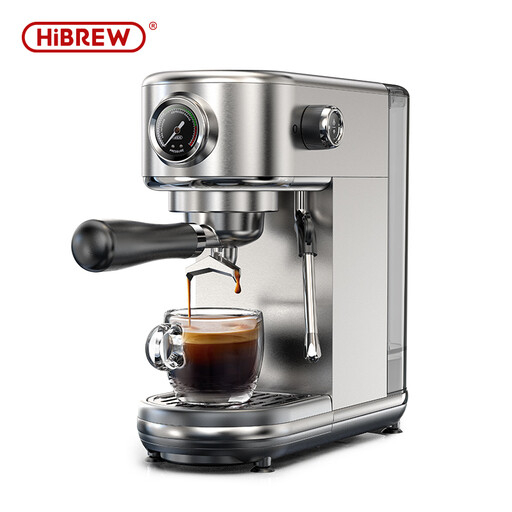
What sets it apart The HiBREW H10B stands out with its myriad of programming options. It allows you to adjust everything: coffee volume, extraction temperature, steam temperature, and even pre-infusion time. Its 20-bar pump and ultra-slim design make it a device that is both powerful and discreet.
Key features
Who is it for? For the coffee enthusiast who loves precision and wants to experiment with every parameter to craft a cup perfectly to their taste.
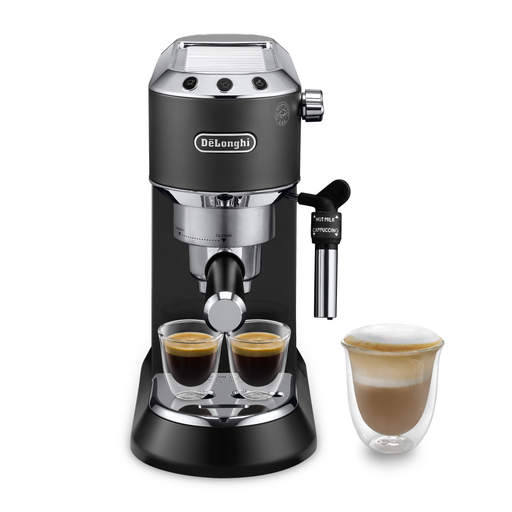
What sets it apart The De'Longhi Dedica is a true market star, the benchmark for anyone seeking a high-performance, ultra-compact machine. At just 14.9 cm wide, it fits in anywhere. Its stainless steel body and ease of use make it an ideal entry point into the world of manual espresso, without sacrificing style or in-cup quality.
Key features
Who is it for? The ideal choice for beginners or for small kitchens. A safe bet for anyone who wants an excellent, creamy espresso without any hassle.
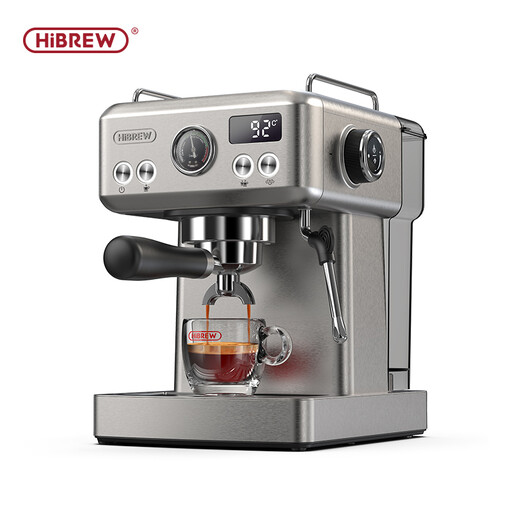
What sets it apart The HiBREW H10A takes things to the next level with its sturdy brushed steel body and, most importantly, its 58 mm portafilter. This is the standard diameter for professional machines, a guarantee of a more even extraction. Add to that advanced settings and a high-performance steam wand, and you have a complete tool for enthusiasts.
Key features
Who is it for? For the enthusiast who wants to get closer to the professional experience, with precise control over extraction and a robust machine built to last.
If the espresso ritual seems too complex, or if you simply prefer other brewing methods, the French press remains a timeless alternative. It delivers a coffee rich in body and aroma through a simple infusion process—a different, but equally rewarding, ritual.
Discover our selection of French presses
1. What's the difference between a 15-bar and a 20-bar machine? In theory, a pressure of 9 bars at the point of contact with the coffee is sufficient for a good extraction. Pumps rated for 15 or 20 bars are a guarantee that this minimum pressure will be reached and maintained, even with a very fine grind or an expert tamp. A 20-bar pump offers a greater "power reserve," but for typical home use, a well-designed 15-bar machine will already deliver excellent results.
2. Can I use E.S.E. pods with any manual espresso machine? No, this compatibility must be explicitly stated by the manufacturer. It requires a specific pressurised filter basket, which is usually included with the machine (as is the case with the De'Longhi Dedica, for example). It's a very convenient option for mornings when every second counts.
3. How do I maintain my manual espresso machine? Regular maintenance is simple but absolutely crucial. After each use, clean the portafilter and the steam wand. Remember to empty the drip tray frequently. Finally, periodic descaling with a suitable product (following the manufacturer's instructions) is essential to guarantee the performance and longevity of your machine.