
Livraison le jour même ou le lendemain

Qualité garantie

Débloquez vos offres de bienvenue: Livraison GRATUITE | Jusqu'à -80 % | 30 jours d'essai gratuits à JoyPlus
Téléchargez l'application
Nothing beats the aroma of freshly ground coffee, the promise of a rich and complex tasting experience. For any enthusiast, switching to whole bean coffee is the most crucial step in transforming their daily cup. Yet, the market for manual coffee grinders is a real jungle. Between marketing promises and technical jargon, it's easy to make the wrong choice. To avoid any disappointment, it's best to know the most common pitfalls before you pull out your credit card.
Here are the 3 most common mistakes when buying a manual grinder?:
To avoid these pitfalls, focus on a few key technical specifications that don't lie. These are what separate a mere gadget from a true precision tool.
The centrepiece of any manual coffee grinder is its burr set. High-performance models are almost always equipped with stainless steel conical burrs. Those that are CNC-machined (Computer Numerical Control) offer precise geometry and high hardness (often measured in HRC).
Unlike ceramic, steel allows for sharper, more durable edges capable of "slicing" the coffee bean rather than crushing it. This translates to?:
A good adjustable coffee grinder must offer total control over the grind size. The clicked adjustment system has become the standard, allowing you to save and replicate a setting with great reliability. Here, the crucial factor is the number of available clicks. A large number of clicks (over 20 across the entire range) indicates a capacity for micro-adjustment.
Some models offer an external adjustment, which is far more convenient than an internal one that requires disassembling part of the grinder to change the setting. For espresso lovers, this precision is non-negotiable.
The consistency of the grind depends directly on the stability of the burrs. A quality grinder always features a central axle supported by one or two ball bearings. This setup prevents the axle from wobbling during rotation, ensuring a constant gap between the burrs.
The choice of body material is just as critical. A unibody aluminium alloy body offers rigidity that is leagues beyond plastic, ensuring a perfect and lasting alignment of the internal components.
Choosing a grinder is, above all, about finding the right tool for your habits and standards. Here is a selection of models that meet our demanding criteria, each tailored to a specific user profile.
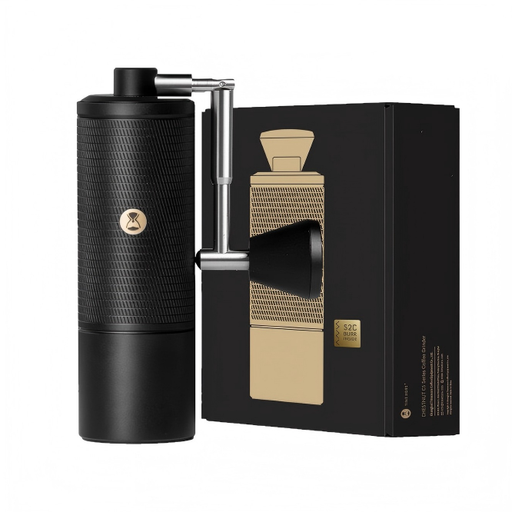
It offers a grind quality and robust construction often associated with much more expensive models. It's the smart choice for getting serious about specialty coffee (pour-over, French press...) without compromising on consistency.
Unlike entry-level models with vague settings, it features a precise click system that makes it easy to find your favourite settings and puts an end to the frustration of an inconsistent grind.
High-performance stainless steel burrs and a metal body for exemplary durability. Unbeatable value for money to access a high-fidelity grind.
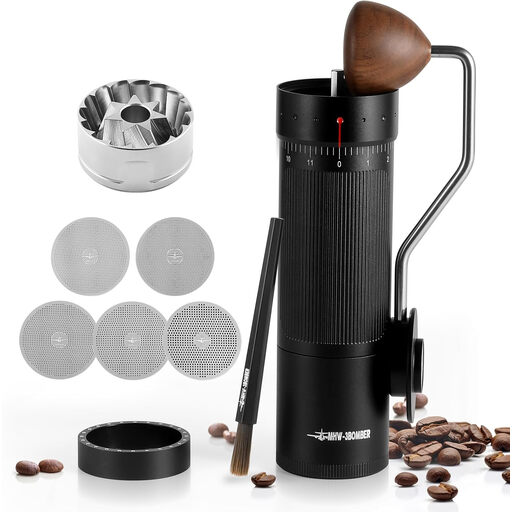
Designed for the user who leaves nothing to chance. Its ultra-fine external adjustment and optional sifters allow for near-scientific control over particle size, a key advantage for taming espresso extraction.
It demolishes the problem of imprecise settings with its 60 clicks per rotation, offering the micro-precision needed to dial in an espresso shot with pinpoint accuracy—a mission impossible with standard grinders.
Surgically precise external adjustment. Sifter set included for remarkable grind uniformity. Ultra-convenient magnetic catch cup.
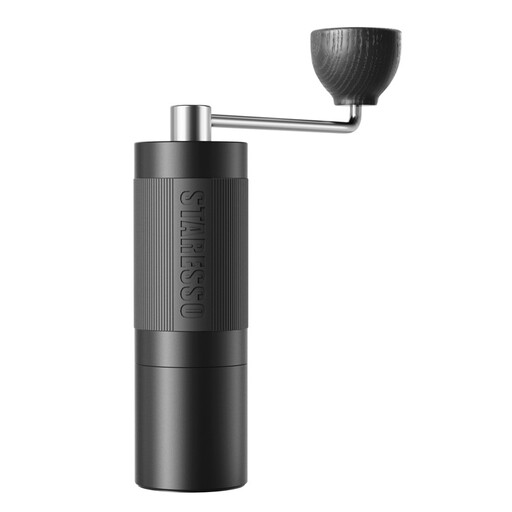
Compact, robust with its metal body, and impressively efficient thanks to its dual-bearing system, it's the ideal travel companion for excellent coffee on the road, at the office, or on a hike, without ever sacrificing grind quality.
It sidesteps the "false portability" trap by combining a pocket-sized form factor with a solid build and a stable axle. This guarantees a consistent grind, light-years ahead of the random performance of travel gadgets.
Dual-bearing system for smooth rotation and reduced effort. Fully disassemblable design for quick cleaning, even on the go.
We have selected a full range of products that meet our demanding criteria for performance and durability.
Regular cleaning is essential to preserve the flavours of your coffee. Most quality grinders are designed to be easily disassembled. Use the provided brush (or a stiff-bristled brush) to remove ground coffee residue from the burrs and grinding chamber. Absolutely avoid water on steel burrs, as it could cause them to rust. Make sure all parts are completely dry before reassembling the grinder.
The main difference lies in precision and durability. Steel burrs, especially CNC-machined ones, have sharper edges that slice the coffee bean cleanly, producing a more uniform grind. Being more robust, they are the gold standard for fine grinds (espresso). Ceramic burrs, which are cheaper to produce and rust-proof, are more fragile and struggle to provide a grind that is as fine and consistent.
The lifespan of the burrs depends on the material, their hardness, and the frequency of use. High-quality stainless steel burrs, like those in TIMEMORE or MHW-3BOMBER models, are designed to grind hundreds of kilograms of coffee before showing any signs of wear. For home use, this translates to many, many years of peace of mind.