
Livraison le jour même ou le lendemain

Qualité garantie

Débloquez vos offres de bienvenue: Livraison GRATUITE | Jusqu'à -80 % | 30 jours d'essai gratuits à JoyPlus
Téléchargez l'application
Drawing a manga requires less equipment than you might imagine. Yet the choice of tools directly affects your comfort, precision and the longevity of your illustrations. Between the ultra-complete kits, the manga pen sets and the promises of “professional” ink, it’s easy to buy accessories that aren’t well suited to your skill level or your paper.
Here are the main pitfalls to avoid, along with the criteria to check before choosing a manga drawing kit, manga fineliners or specialist paper.
A beginner manga kit packed with accessories might seem economical. In practice, some items often end up at the bottom of the box: unsuitable colours, redundant nibs or accessories of inconsistent quality. To get started, a few well-chosen tools are usually enough: a pencil, an eraser, two or three inking nibs and some sturdy paper.
A waterproof or water-resistant black ink doesn’t necessarily prevent bleeding. On paper that’s too porous, lines can widen and bleed through the sheet. Conversely, some very smooth papers slow down drying time. So you need to consider the pen-and-paper pairing, especially if you’re using alcohol markers or manga brush pens.
Claims like “archival”, “indelible” or “smudge-free” should be taken with a pinch of salt. The result depends on the surface, the drying time and the pressure you apply to the tool. Before starting a page, always test your materials on a scrap of the same paper.
Manga fineliners are perfect for precise outlines, facial details, textures and hatching. Several sizes allow you to prioritise your lines: a fine nib for details, a medium nib for outlines and a broader nib for borders or shadows.
A brush nib offers more variation depending on the pressure you apply. It works well for hair, clothing and more expressive outlines, but it does require a bit of skill. For a beginner, a set combining fine nibs and a brush nib will often be more versatile than a pack containing just one size.
Check whether the ink is pigment-based or dye-based, along with the properties stated: water resistance, drying time and lightfastness. A water-resistant ink is particularly useful if you plan to add wet colour later on.
The “waterproof” claim on some packaging doesn’t guarantee the same resistance on all papers. Let the line dry, then test it with a slightly damp brush. For children, also check the recommended age and any warnings about small parts or ingestion.
Manga Bristol paper is prized for its smooth surface, which makes it easier to achieve clean lines and make corrections. A weight of 250 g/m² offers better performance than a lightweight sheet, especially with ink, alcohol markers or repeated erasing.
An acid-free, pH-neutral paper is a wise choice for drawings you want to keep for a long time. A protective sheet placed under the page can limit ink transfer to the next one, but it doesn’t replace a prior test. For travel or quick sketches, an A5 manga sketchbook will be easier to carry than an A3 pad.
The following options cover several uses: guided learning, precise inking and intensive drawing on Bristol paper.
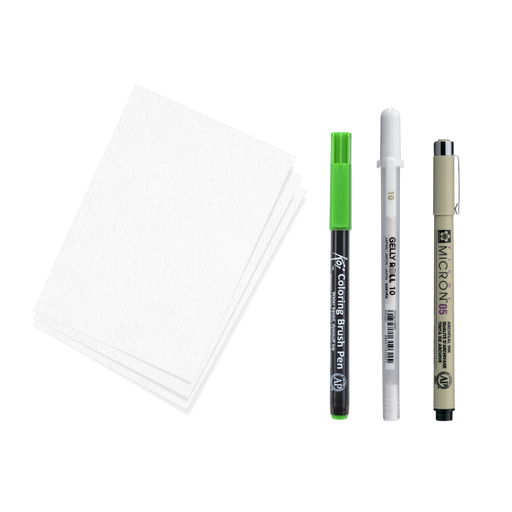
Why this choice suits this profile: This kit offers a simple, guided approach to discovering manga illustration without having to buy each tool separately.
The contents are clearly stated: one black Pigma Micron 05, a white gel pen, a Koi brush pen and three A6 sheets.
The video tutorial, accessible via QR code, guides you through your first project and stops you from buying unnecessary extras.
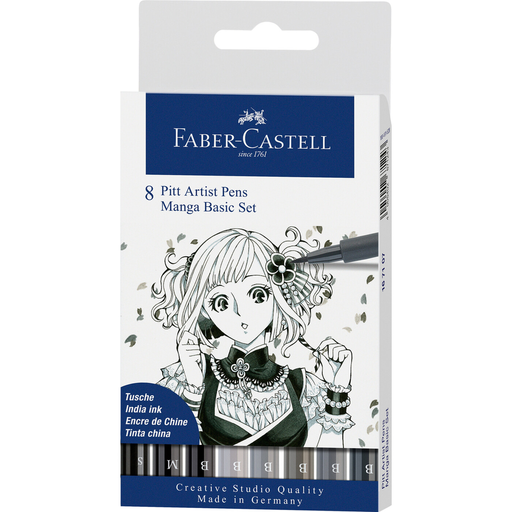
Why this choice suits this profile: Illustrators who ink regularly will appreciate this set of eight brush-tip pens, which allows you to vary line thickness.
The eight nibs are designed to respond to hand pressure; however, test the flow on your paper before committing to a final page.
A black India ink claimed to be water-resistant and lightfast, paired with brush nibs suited to expressive lines.
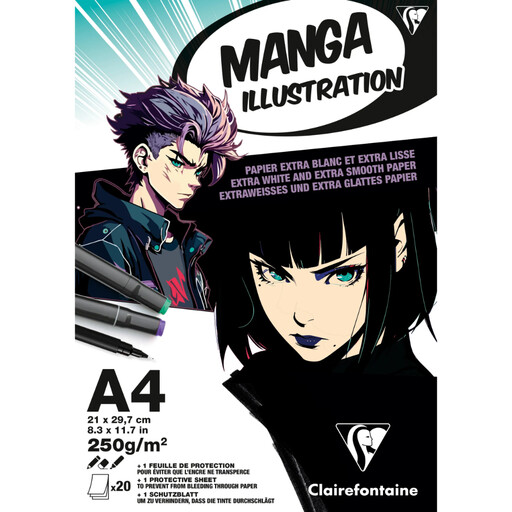
Why this choice suits this profile: This A4 pad is ideal for artists who switch between pencil, ink and markers and need a stable surface.
Its 250 g/m² weight and protective sheet reduce the risk of bleed-through with certain alcohol markers.
An extra-white, smooth Bristol surface, acid-free pH-neutral paper and claimed resistance to repeated erasing.
We’ve put together a comprehensive, real-time updated list of products that meet these demanding selection criteria and European safety regulations.
To draw in good conditions, separate the different stages:
Replace the caps after each use and store pens horizontally when the manufacturer recommends it. Keep paper pads flat, in a dry place, away from heat and direct sunlight.
A beginner manga kit can include a pencil, an eraser, two fineliners, a brush pen and paper that’s thick enough. A guided kit will make your first attempts easier, while buying separately will give you more control over your budget.
For ink lines and frequent corrections, look for a smooth Bristol paper of 200 to 250 g/m². A5 is good for tests and sketches that are easy to carry. A4 or A3 formats offer more space for pages and detailed illustrations.
Replace the cap immediately after use, avoid leaving pens near a radiator and follow the recommended storage method. If you use several nibs, identify them by size to reduce unnecessary handling and forgotten caps.