
Livraison le jour même ou le lendemain

Qualité garantie

Débloquez vos offres de bienvenue: Livraison GRATUITE | Jusqu'à -80 % | 30 jours d'essai gratuits à JoyPlus
Téléchargez l'application
You're surely familiar with the little Japanese cat that greets you with a wave of its paw. The Maneki Neko has become a decor staple and a highly appreciated symbolic gift. But be aware: behind its charming demeanor lies a world of specific codes and widely varying quality levels. With an overwhelming number of options available, it's easy to make the wrong choice and end up with an item that falls short of expectations, whether in terms of its finish or its symbolism.
To prevent your quest for a lucky charm from ending in disappointment, here are the three most common mistakes.
To guide you, we've broken down the essential criteria to review before choosing your Maneki Neko.
Understanding the fundamental characteristics of this Japanese lucky cat will help you select a model that is both durable and carries the message you wish to convey.
The language of the Maneki Neko is subtle but easy to decode. This is the starting point to ensure your lucky charm is perfectly aligned with your intentions.
The Raised Paw:
The Colours:
The longevity and finish of your lucky cat figurine depend directly on its material.
The Maneki Neko is no longer confined to the traditional figurine. It now comes in multiple forms to suit every lifestyle.
Here are a few options that cater to different needs and profiles, taking into account quality and symbolic criteria.
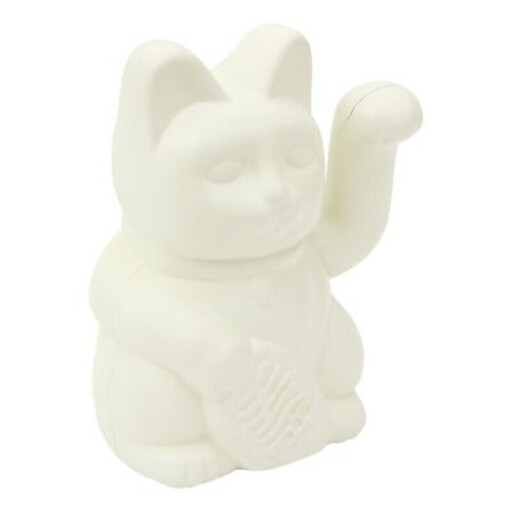
Why it's a great match: Perfect for those who want a classic decorative object with meaning. Its 15 cm size is ideal for a desk or entryway, and the different colours allow you to choose the symbol that corresponds to a specific wish (luck, prosperity, etc.).
Its ABS resin construction ensures greater durability than entry-level plastics. The choice of colours helps avoid symbolic errors by allowing you to select the appropriate message.
Its versatility: the different colours allow you to choose a specific message, and its compact size fits in anywhere.
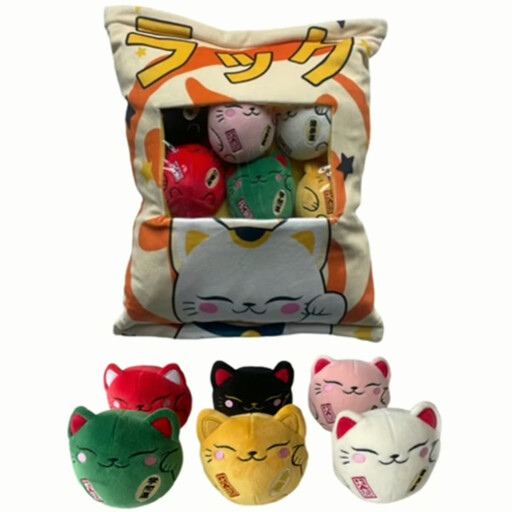
Why it's a great match: For those who love Japanese culture from its cutest angle. This set combines a decorative cushion with six collectible mini-plush toys, perfect for a bedroom or a sofa.
By opting for the Maneki Neko plush toy format, it completely eliminates the risk of breakage associated with fragile figurines. It is, above all, a fun and decorative object.
A 2-in-1 set that offers great playful and decorative value, ideal for an original and adorable gift.
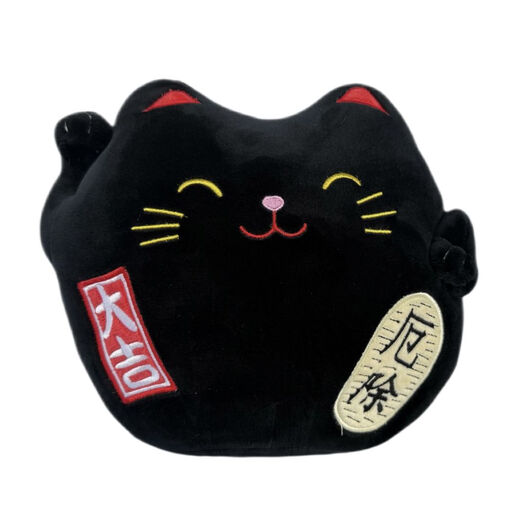
Why it's a great match: Ideal for giving a gift that is both meaningful and visually impactful. Its large 40 cm size makes it a centrepiece, and its black colour, symbolising protection, makes it a thoughtful gesture for a loved one.
The choice of a large plush toy is intentional here, avoiding the pitfall of an unsuitable size. The clear symbolism of the black colour (protection) makes the gift thoughtful and precise.
A large size for a guaranteed "wow" factor, combined with strong, positive symbolism.
If the Maneki Neko isn't quite what you're looking for, don't worry! We've compiled a treasure trove of gift ideas for every occasion.
The lifespan of your Maneki Neko depends primarily on its material and the care you give it. A ceramic model can last a lifetime if handled carefully and protected from knocks. A high-quality resin figurine is more resistant to falls, but it's advisable to keep it away from direct sunlight, as UV rays can dull the colours over time. For plush toys, spot cleaning according to the manufacturer's instructions will be enough to keep them in good condition.
It all depends on the model. Traditional figurines are stationary; their power is purely symbolic. Others, more modern, include a small mechanism that animates the paw. This movement can be powered by a battery (usually AA) or by a small solar panel located on the base. The effect is mainly visual and does not alter the object's symbolic meaning in any way.
Traditionally, its placement is strategic. For a business, it is placed near the entrance, facing the door, to welcome customers. At home, it is often placed in the living room, on a desk, or in a main living area. Some Feng Shui principles suggest placing it in the southeast corner of the house, which is associated with wealth. But ultimately, the most important thing is to place it where you will see it often, so it can serve as a daily reminder of its positive vibes.