
Livraison le jour même ou le lendemain

Qualité garantie

Débloquez vos offres de bienvenue: Livraison GRATUITE | Jusqu'à -80 % | 30 jours d'essai gratuits à JoyPlus
Téléchargez l'application
If you're already invested in the Makita 18V ecosystem, you've backed a reliable and high-performance battery standard. Expanding your toolkit with a Makita 18V-compatible impact wrench is a logical next step, whether you're a car mechanics enthusiast, a maintenance pro, or tackling ambitious construction projects. But be warned: the market is full of tempting yet often misleading claims.
Before you make a purchase, it's best to know the pitfalls to avoid. Too many users end up with a disappointing tool, despite a spec sheet that seemed too good to be true.
To choose wisely, focus on the features that truly make a difference. They are the real benchmark of your future cordless impact wrench's performance and longevity.
The power of an impact wrench is measured in newton-metres (N·m). It is crucial to distinguish between two values:
Always ensure the manufacturer clearly communicates both figures to avoid unpleasant surprises.
brushless ImperativeA brushless impact wrench is the standard today, period. Unlike older-generation brushed motors, a brushless motor is electronically controlled. The advantages are immediate:
1/2-Inch StandardFor versatile use, especially in auto mechanics, the 1/2-inch square drive anvil is the absolute standard. It ensures the widest compatibility with impact sockets on the market. It's the ideal format for an impact wrench for car wheels and the majority of work on chassis and suspensions. Also, consider the socket retention system (friction ring or detent pin) based on your preference.
No more endless lists. We've selected tools for specific uses to help you find the model that truly matches your projects, not just a spec sheet.
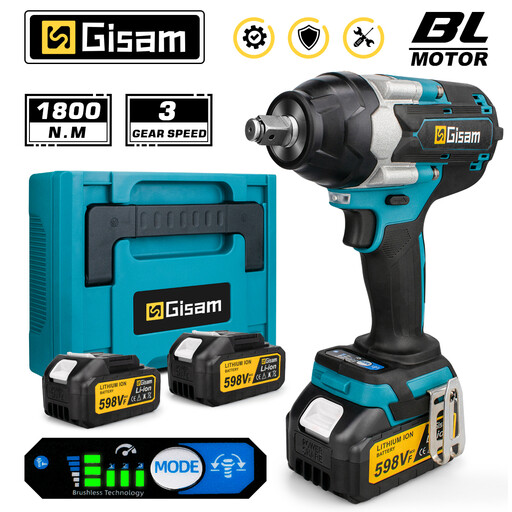
Why we chose it: Built for heavy-duty tasks, this powerful impact wrench is the go-to tool for mechanics and expert DIYers who regularly tackle seized suspension bolts or lug nuts on heavy vehicles. Its direct compatibility with Makita 18V batteries allows it to integrate seamlessly into your existing setup.
The spec sheet clearly distinguishes the maximum torque (1800 N·m) from the nominal torque (700 N·m), giving a realistic idea of its performance and sidestepping the "torque myth" trap.
It features a true brushless motor and a speed selector (3 forward, 2 reverse) with an auto-stop function, so you'll never lose a nut during removal again.
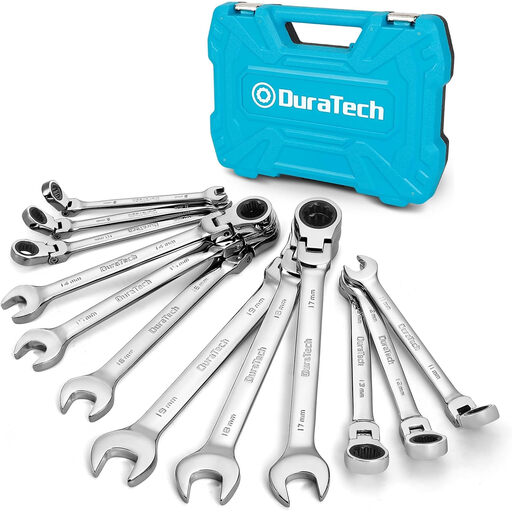
Why we chose it: An impact wrench is the king of brute force, but it's often useless in the tight corners of an engine bay. This spanner set is the essential companion for reaching starter, alternator, or manifold bolts, where access and precision take precedence over raw power.
This set avoids the "one-tool-fits-all" trap. It's a reminder that a good mechanic needs the right tool for each situation, not just the one with the most torque.
The 180° flex-head and 72-tooth mechanism (5° swing arc) allow you to work at angles impossible for a power tool, giving you total control over fastening torque.
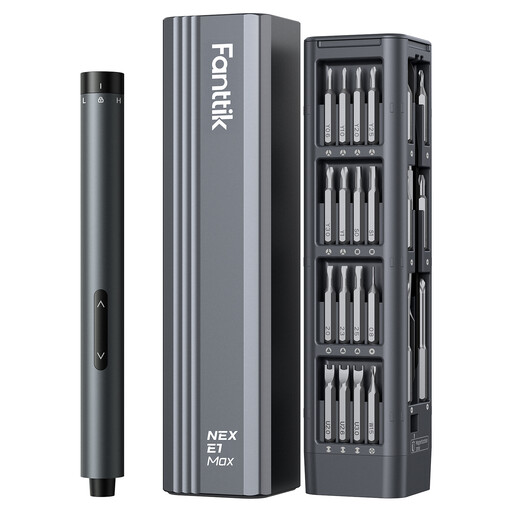
Why we chose it: For working on onboard electronics, interior trim, or ECU housings, an impact wrench is total overkill. This precision screwdriver provides controlled torque for delicate screws, preventing you from stripping a plastic thread or destroying a circuit board.
It debunks the idea that more power is always the answer. Using an oversized tool is a mistake that can be costly, and this precision screwdriver helps you avoid it for delicate jobs.
It offers dual torque settings (0.05 N·m and 0.2 N·m) and a manual torque of 3 N·m, providing total flexibility for risk-free electronic assembly and disassembly.
Discover our complete selection of products, all chosen for their quality, reliability, and adherence to safety standards.
Although both tools use a hammering mechanism, their applications are very different. The impact wrench is made for tightening and loosening large-diameter bolts and nuts. It delivers very high torque and has a square drive anvil (usually 1/2-inch). The impact driver, on the other hand, is designed for driving long screws into wood or metal, with lower torque and a 1/4-inch hex chuck.
No, and it's actually far too much for tightening. The recommended torque for passenger car wheels is between 110 and 140 N·m. The 1800 N·m refers to the breakaway torque, which is very useful for loosening nuts that are practically welded on by rust. For final tightening, you must use a torque wrench to apply the exact torque specified by the manufacturer. It's a matter of safety!
Absolutely not. The "Makita 18V-compatible" designation means the tool is designed to fit mechanically and electrically with official Makita LXT 18V batteries. Never try to use batteries from other brands or, even worse, knock-offs. You risk damaging the tool, the battery, and endangering yourself due to mismatched voltages or inadequate electronic protections.