
Livraison le jour même ou le lendemain

Qualité garantie

Débloquez vos offres de bienvenue: Livraison GRATUITE | Jusqu'à -80 % | 30 jours d'essai gratuits à JoyPlus
Téléchargez l'application
While MagSafe technology has simplified life for iPhone users, choosing the right car mount is still a daunting task. Faced with an overwhelming number of options, it's hard to know where to start. Yet, the wrong choice can quickly turn into a nightmare: a phone crashing to the floor at the first pothole, or a battery that drains faster than it charges while the GPS is running.
Before we present our top picks, let's review the 3 most common traps that turn a promising purchase into a costly hassle.
To avoid these disappointments, it's crucial to focus on a few technical specifications. These are the details that make all the difference between a reliable accessory and a frustrating gadget.
The choice of mounting system depends primarily on your car's interior layout and your personal preferences.
magnetic car phone mount can be placed on the dashboard or windscreen. Models with an adjustable arm offer maximum flexibility to adjust the screen to the perfect height and angle. Just make sure your dashboard surface is smooth enough to ensure a good grip. Note that extreme temperatures can compromise the suction cup's hold.If charging your phone while driving is a priority, then charging power is non-negotiable. A wireless charging car mount worthy of the name must deliver sufficient power.
The promise of MagSafe is simplicity: bring it close, and it clicks. The quality of the magnets is therefore paramount. A good iPhone car mount must grip the device firmly, even on a cobblestone road. For a perfect connection, using a MagSafe-certified (or at least compatible) case is almost essential. Standard cases, which are often too thick, dramatically weaken the magnetic bond.
Rather than a one-size-fits-all "ideal" product that doesn't exist, we've selected solutions tailored to specific needs, based on the criteria we've just defined.
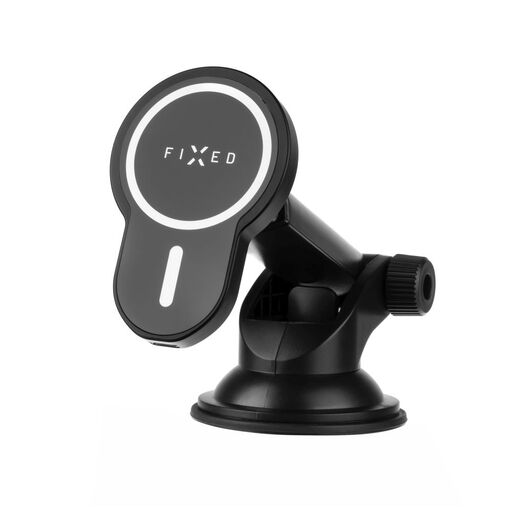
Why we chose it: The perfect ally for long journeys and road professionals who demand perfect screen visibility and flawless charging for GPS and calls.
Its high-performance suction cup and articulated arm eliminate any risk of falling. The charging coil (7.5W for iPhone, up to 15W) protects you from the slow-charging syndrome.
The extendable arm allows for custom positioning, so the screen is always in your line of sight without ever obstructing your view of the road.
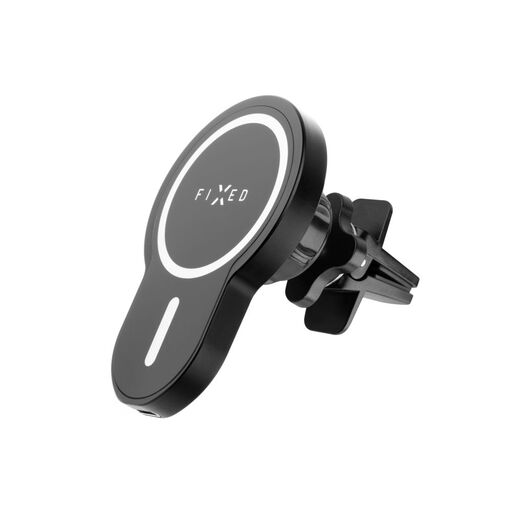
Why we chose it: Ideal for drivers who love a clean car interior and are looking for a mounting and charging solution that is as discreet as it is effective for daily commutes.
Despite its small size, it integrates powerful magnets and a robust mounting clip with a stabilising foot, ensuring a rock-solid hold.
Its compact design and air vent mount make it almost invisible. It preserves the dashboard's aesthetic while providing efficient wireless charging.
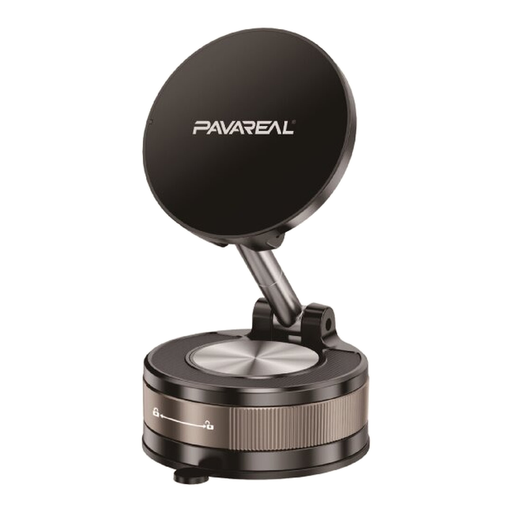
Why we chose it: For those who primarily want a stable and versatile magnetic mount, without the charging function, to keep their budget in check.
It gets straight to the point: mounting. Its aluminium alloy base and robust suction cup ensure a reliable hold, a far cry from multi-function gadgets that do everything, but poorly.
Its aluminium construction exudes durability, and its 360° ball joint allows for precise viewing angle adjustment. Excellent value for money.
We have compiled a complete selection of products that meet our strict selection criteria and safety standards.
Yes, but with a caveat. For an optimal and secure magnetic grip, it is essential to use either a bare iPhone or a case specifically designed for MagSafe. A standard case, even a thin one, will significantly weaken the magnet's force, and your phone will be at risk of falling at the first jolt.
Generally, no, if the mount is well-made and properly installed. Quality models have silicone-coated clips to avoid scratching the fins. However, it's best not to force it during installation. On older or fragile vents, repeated use may cause wear over time. Also, avoid attaching a heavy mount to a fin that seems flimsy.
To properly power a MagSafe car charger and achieve an efficient charge (7.5W for an iPhone), you'll need a USB-C cigarette lighter adapter with a minimum power of 15W, and ideally 20W. A less powerful charger will struggle, especially if you are simultaneously using power-hungry apps like Waze or Spotify.