
Livraison le jour même ou le lendemain

Qualité garantie

Débloquez vos offres de bienvenue: Livraison GRATUITE | Jusqu'à -80 % | 30 jours d'essai gratuits à JoyPlus
Téléchargez l'application
By the Joybuy Team, Your Product Experts
Bright sun in the morning, thick fog in the afternoon... Mountain weather changes in a flash. And trying to swap goggle lenses between runs, with frozen fingers, can be a real struggle. The risk? Losing your patience or, worse, scratching your brand-new lens. It's precisely to end this hassle that magnetic ski goggles have emerged as the go-to solution for thousands of skiers and snowboarders.
This guide breaks down the key points to check before you buy and presents our selection of the best models for the 2026 season. The goal: to help you focus on what really matters—the thrill of the ride.
Before you settle on a model, it's crucial to understand a few technical concepts. Here are the three key points to check to make the right choice.
VLT (Visible Light Transmission) is a percentage that measures the amount of light the lens allows to pass through. Choosing the right VLT is absolutely essential for optimal vision and safe skiing.
This is the main advantage of a magnetic interchangeable lens: the ability to swap between different VLTs in just a few seconds.
For prescription glasses wearers, OTG (Over-The-Glasses) is a non-negotiable feature. An OTG ski goggle has more interior volume and specific notches in the foam to accommodate your frames without creating uncomfortable pressure points on your nose or temples.
Overall comfort also depends on the quality of the foam (triple-density is a sign of quality) and the effectiveness of the ventilation system. Good airflow is your best defence against fogging, complementing the anti-fog coating applied to the lens.
All ski goggles worth their salt must provide full UV400 protection, which blocks 100% of UVA and UVB rays. This is a non-negotiable safety standard on the mountain, where the sun's reflection off the snow multiplies UV exposure.
The frame, typically made of TPU (thermoplastic polyurethane), must strike the right balance: flexible enough to conform to the shape of your face, yet sturdy enough to withstand impacts and freezing temperatures.
Here are a few models that have caught our eye for their performance and design, created for both skiers and snowboarders, men and women.
Why It Stands Out: This model features lenses developed in partnership with ZEISS, an undisputed leader in optics. The promise: enhanced contrast and clarity to perfectly read the terrain, no matter the light conditions. Its magnetic lens-change system is designed to be both ultra-fast and secure.
Key Features:
Who is it for? For intermediate to advanced skiers and snowboarders who demand top-tier optical performance and the versatility of a system that can adapt to the weather in a flash.

Why It Stands Out: The ULTRA goggle goes all-in on an extra-large field of view thanks to its toric lens. It features the MagKlick magnetic system, designed for a lens change in one second flat. A mark of performance? This model is the official supplier to the U.S. Ski & Snowboard Team.
Key Features:
Who is it for? Ideal for avid snowboard goggles and ski enthusiasts looking for a maximum field of view and flawless fog management, especially for freeride or freestyle.
Finding high-performance OTG ski goggles is one thing. But if visual comfort is your top priority, both on the slopes and in daily life, choosing the right prescription glasses frames is just as crucial.
For those looking to update their eyewear, discover our wide selection of frames for every style.
Discover our selection of glasses frames
Use only the provided microfibre pouch. Never rub the inner surface of the lens, as this can destroy the anti-fog coating. For the outer surface, gently dab it to remove snow or moisture. Then, let it air dry, away from any direct heat source (like a radiator or fireplace).
Absolutely. Modern magnetic systems are designed to be extremely secure. They combine powerful magnets with small locking latches to ensure the lens stays perfectly attached to the frame, even during a heavy fall. Yet, swapping them out is still a breeze.
VLT (Visible Light Transmission) indicates the percentage of light that reaches your eye through the lens. To put it simply:
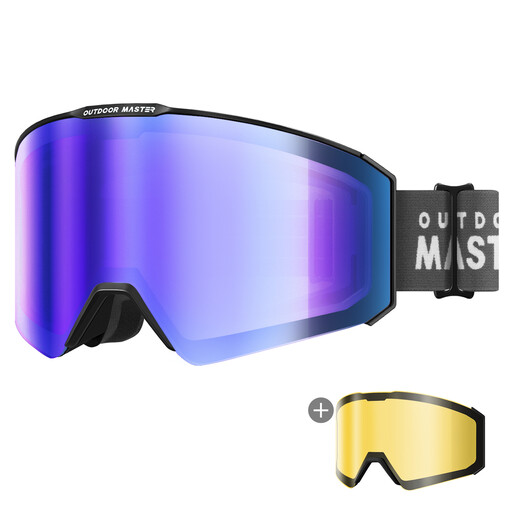
An OutdoorMaster ski goggle with a magnetic system allows you to have multiple lenses on hand to adapt in an instant.