
Livraison le jour même ou le lendemain

Qualité garantie

Débloquez vos offres de bienvenue: Livraison GRATUITE | Jusqu'à -80 % | 30 jours d'essai gratuits à JoyPlus
Téléchargez l'application
A magnetic building set for children can fill an afternoon, support a STEM activity or make an excellent educational gift. But colourful photos and promises of "powerful attraction" aren't enough to tell the good models apart. The size of the pieces, how the magnets are fixed and the exact contents of the box all directly affect the play experience.
Before buying educational magnetic blocks, families need to avoid three common pitfalls.
A large number of pieces doesn't guarantee a wide variety of constructions. You need to look at the shape of the pieces, their dimensions and whether any accessories are included. A 28-piece set with unusual faces plays completely differently from a box of 150 classic tiles.
Compatibility between brands is also worth checking. A difference in shape or size can limit what you can build, even when both products are marketed as magnetic tiles.
The advertised holding force doesn't necessarily tell you much about the strength of the casing. For a child, the key points are the permanent fixing of the magnets, the absence of sharp edges and the plastic's resistance to repeated handling.
A magnet that comes loose is a serious risk if swallowed. Parents should therefore inspect the pieces regularly and immediately remove any cracked, open or damaged piece that exposes a magnet.
A magnetic discovery set designed for first constructions needs to be easy to grip. Conversely, a 3D building set made up of small pieces or more complex shapes requires more independence and supervision.
The age stated on the packaging is a useful guide, but you also need to consider the child's ability to follow instructions, not put pieces in their mouth and tidy the box away after use.
ABS plastic is common in construction toys because it allows for rigid, lightweight pieces. However, this material alone isn't enough to judge a product's safety. Instead, check the following:
Any standards or declarations mentioned by a brand should be treated as documentary information. They don't replace a visual inspection of the product when it arrives.
Compact pieces are handy to take with you, but they can sometimes offer less stability for building a large structure. The Tokky 32-piece set features magnetic squares of 3.75 cm in a metal box designed for travel. The XINQIYUAN set, on the other hand, offers blocks of 5.5 cm with a diamond-shaped surface.
For a child aged 3 to 5, prioritise easy handling and low-level constructions. Between 6 and 12, varied shapes and a larger number of pieces can support more ambitious projects.
The quantity should match the intended use. A small box is suitable for solo discovery or for taking on trips. For playing together, building structures or organising a classroom activity, a larger set is usually more practical.
After each session, store the pieces in their box or bag. Wipe them with a soft, dry cloth, avoiding abrasive products and immersion in water. Also check the welds, corners and magnets before letting the child start a new build.
The options below are organised by specific use cases, rather than by a general promise of performance.

Why this choice suits this profile: its 32 square pieces of 3.75 cm and metal box are ideal for a first discovery at home, at the grandparents' house or on a journey.
The format and quantity are clearly stated, which reduces the risk of choosing a set that's too large for a first experience. The box also makes storage easy.
32 pieces, compact 3.75 cm format, metal box and ABS material stated on the product page.
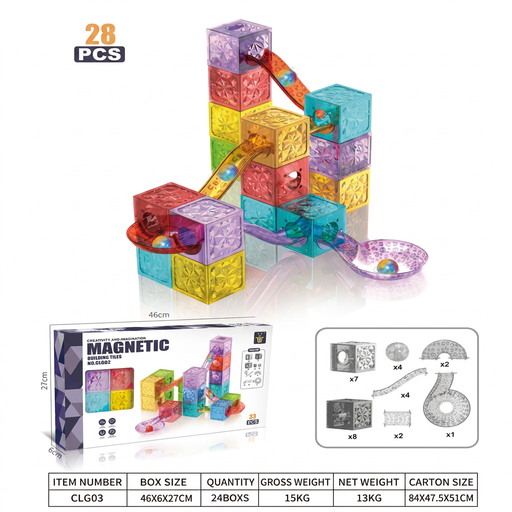
Why this choice suits this profile: its 5.5 cm blocks with a diamond-shaped surface are designed for children who want to explore 3D constructions with a different visual look.
The product page specifies the number of pieces, the size of each element, the storage bag and the warnings about magnets and small parts.
28 pieces of 5.5 cm, diamond-surface shapes, storage bag and magnets stated as integrated by ultrasonic welding.
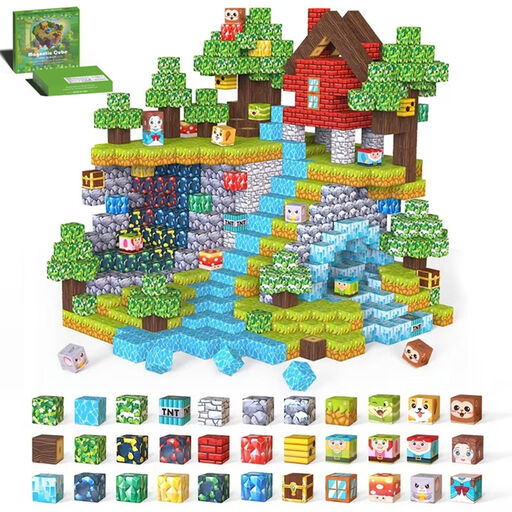
Why this choice suits this profile: a 150-piece set can work well for siblings, group workshops or children who regularly build large structures.
The stated volume makes it easier to compare this set with a small starter set. It's still essential to check the shapes included and the recommended age before ordering.
150 pieces stated, ABS construction and orientation towards STEM building activities.
We've put together a comprehensive list, updated in real time, of products that fully meet these strict selection criteria as well as European safety regulations.
There are sets designed for children aged 3 to 12, but the recommended age varies depending on the size of the pieces and the complexity of the builds. Before age 3, small parts and magnets should be avoided. With younger children, adult supervision is still recommended, even when the product is labelled for ages 3 and up.
The lifespan depends on how often it's used, how it's stored and the condition of the welds. Inspect the pieces after any impact, never let a child use a cracked piece and keep the set away from heat and moisture. A well-stored set can remain usable for a long time, but it's impossible to guarantee a precise lifespan for every household.
Magnetic blocks work without batteries or any power connection: their assembly relies on magnetic attraction. There are therefore no ongoing running costs, aside from the initial purchase and the possible replacement of a lost or damaged piece. Electronic STEM toys in the same category, such as a solar system projector, may however require batteries sold separately.