
Livraison le jour même ou le lendemain

Qualité garantie

Débloquez vos offres de bienvenue: Livraison GRATUITE | Jusqu'à -80 % | 30 jours d'essai gratuits à JoyPlus
Téléchargez l'application
A magnetic building set for children can keep the whole family entertained for hours, provided you pick a kit that suits the child's age, the space you have available and their attention span. However, parents and grandparents often fall into several traps: a misleading piece count, magnets that are tricky to handle, or accessories that end up gathering dust at the bottom of the box after just a few sessions.
Here are the criteria to consider before buying magnetic building blocks, magnetic tiles or any other STEM toy for children.
A set boasting 100 or 150 pieces doesn't necessarily offer a wide variety of constructions. Instead, look at the breakdown between squares, triangles, connectors, wheels and accessories. A kit made up mostly of small decorative elements can quickly limit the scale of what you can build.
Magnetic sets aimed at children aged 3 and over aren't automatically suitable for every child of that age. The presence of small parts or magnetic balls requires appropriate supervision. Magnets must remain completely sealed inside the pieces: if a piece is cracked or a magnet comes loose, remove the toy immediately.
Phrases like "powerful magnets", "STEM" or "Montessori" don't replace concrete information. Always check the recommended age, the material, any warnings, the dimensions of the pieces and the compliance details available on the product page.
For an educational toy from age 3, choose pieces that are easy to grip, with rounded edges and large enough to handle without frustration. Flat builds are a great way to start recognising colours and shapes. Three-dimensional models then introduce concepts of balance, symmetry and spatial awareness.
These activities can help develop fine motor skills, hand-eye coordination and movement planning. This benefit comes from the act of handling the pieces themselves and is in no way a medical claim.
The product page should state that the magnets are embedded or sealed inside the pieces. Some models mention ultrasonic welding, but that doesn't mean you shouldn't regularly inspect the set at home.
Remember:
Swallowing several magnets can cause a serious medical emergency. If you suspect ingestion, contact emergency services immediately.
A storage bag or box included with the set makes tidying easier and helps prevent pieces from getting lost. For regular use, also check how easy it is to clean: a soft, slightly damp cloth is usually fine for plastic surfaces. However, pieces should not be submerged if the product page advises against it.
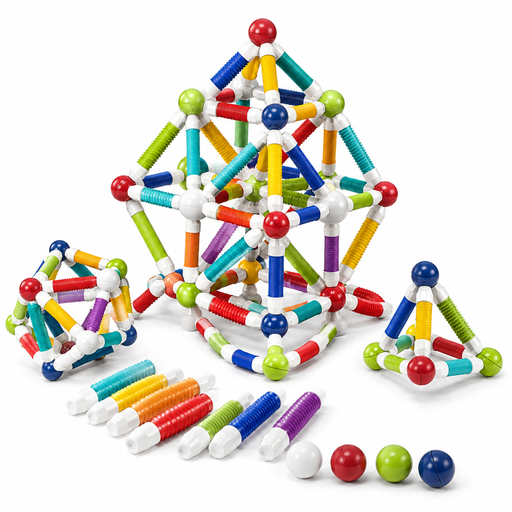
Why this choice suits this profile: With its 85 pieces and gift box, this set offers an accessible introduction to magnetic building, ideal for use at home or as a present.
The piece count is clearly stated and the set is presented as a complete kit, making it easy to compare with other options.
85 pieces, ABS plastic indicated in the product name and gift box included.
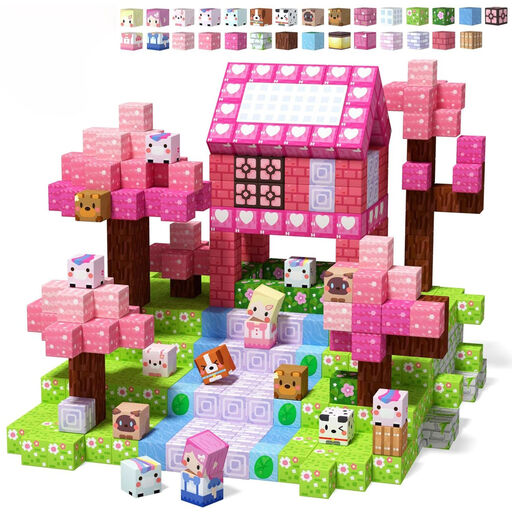
Why this choice suits this profile: Families looking for a themed universe and plenty of model ideas can turn to this 100-piece set, which is advertised with 29 models to build.
Having a theme and advertised models means you won't end up with a set whose pieces are hard to use without inspiration.
100 pieces, 29 advertised models and ABS material indicated in the name.
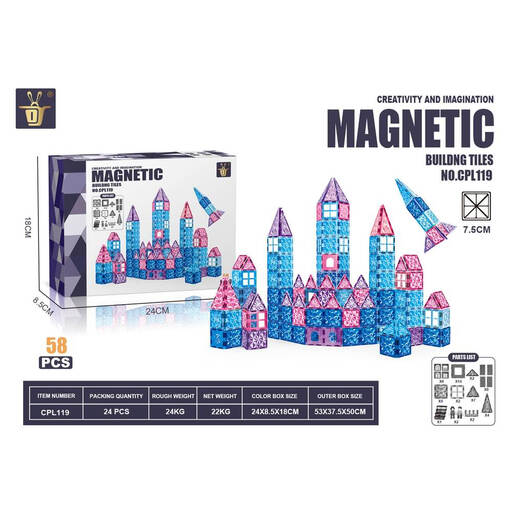
Why this choice suits this profile: Children who love building in 3D can explore 7.5 cm diamond-shaped panels and magnetic connectors, all with a storage bag included.
The size of the pieces and their detailed composition help you anticipate how they'll be used, rather than choosing based solely on a promise of "enhanced attraction".
58 pieces, 7.5 cm panels, magnetic balls included and carry bag.
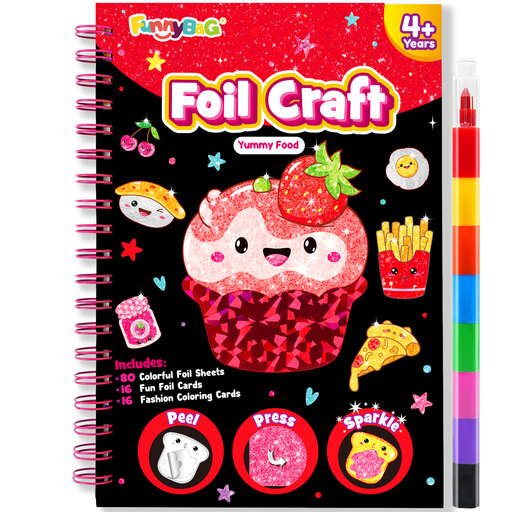
Why this choice suits this profile: For a child aged 4 to 10 who prefers creating to building, this craft activity offers pictures to decorate without glue or scissors, ideal for on the go.
The contents are clearly listed: 80 foil sheets, 16 backing boards, 16 colouring cards and an eight-colour pencil.
112 items advertised, no-glue no-scissors activity and compact format for travel.
We've put together a comprehensive, real-time updated list of products that meet these strict selection criteria and European safety regulations.
To keep a creative building toy interesting over the weeks, set progressive challenges: build a house, copy a shape, create a vehicle, then invent a story around the construction. Alternate between guided models and free play so the child doesn't just copy the examples from the box.
Sorting by colour or shape can also turn tidying up into a fun categorising activity. When choosing a gift for a child, finally check the available play surface, the noise level, the number of pieces and whether you can add to the set later.
Follow the age recommended by the manufacturer. Many sets are suggested from age 3, but some contain smaller pieces or magnetic balls and require extra vigilance. A child under 3 must not use a product marked as unsuitable for their age.
Wipe the pieces with a soft cloth, then dry them thoroughly. Avoid abrasive products and immersion when the product page advises against it. Regularly check for cracks, sharp edges and the condition of the magnets. Any damaged piece should be set aside.
A set of around 50 to 100 pieces is usually enough to begin with and build simple shapes. For playing with others or building larger structures, a 150-piece set or an expandable kit may be more suitable. The choice mainly depends on the child's age, the space available and their ability to tidy up their equipment.