
Livraison le jour même ou le lendemain

Qualité garantie

Débloquez vos offres de bienvenue: Livraison GRATUITE | Jusqu'à -80 % | 30 jours d'essai gratuits à JoyPlus
Téléchargez l'application
Magnetic building blocks for children have plenty to offer: quick assembly, attractive colours and almost endless creative possibilities. However, not all sets are created equal. A kit that is too small quickly limits what can be built, while fragile pieces risk ending up at the bottom of a drawer.
Before buying a magnetic construction set, there are three pitfalls that are particularly easy to avoid.
A 150-piece set doesn’t necessarily offer more possibilities than a more compact one. The variety of shapes matters just as much: squares, triangles, bases, wheels, decorative elements and connecting pieces. Also check whether the stated number includes accessories.
A strong connection makes building easier, but the magnets must remain completely enclosed inside the pieces. If a piece cracks or has a faulty seal, a magnetic element could become accessible. Warnings about swallowing magnets must be taken seriously, especially for children under 3 years old.
ABS magnetic blocks can usually be cleaned with a soft cloth, but instructions may vary between models. A set without a bag or storage box makes it easy to lose pieces, especially when they are small. Before choosing a gift for a boy or girl, consider the space available at home and how easy it will be to tidy away.
A creative toy from age 3 must be used in line with the manufacturer’s recommended age. Adult supervision is still necessary when pieces are small or contain strong magnets. For younger children, choose elements that are easy to grip, with rounded edges and no small detachable parts.
The size of the pieces also affects how easy they are to handle. Larger blocks are suitable for first constructions, while 3D magnetic cubes, which are more varied, allow children to gradually explore volumes and shapes.
ABS is a plastic commonly used in construction toys. Check for smooth edges, no burrs and strong joints. A mention of ultrasonic welding can give an indication of how the pieces are made, but it does not replace regular inspection by an adult.
For a purchase in France, look for compliance information applicable to toys, particularly the CE marking, warnings in French and, where stated, references to the EN 71 standard. Any certification mentioned on a product page should be verifiable. It does not, on its own, protect against wear and tear or misuse.
Flat magnetic tiles allow you to build houses, rockets and various geometric shapes. Rod-shaped pieces or articulated elements offer more freedom to create complex structures. Some sets add a light-up wheel, a vehicle or an animal theme to keep play scenarios fresh.
This variety can support the development of fine motor skills, spatial imagination and an understanding of geometric concepts. It is a learning-through-play tool, not a promise of academic results.
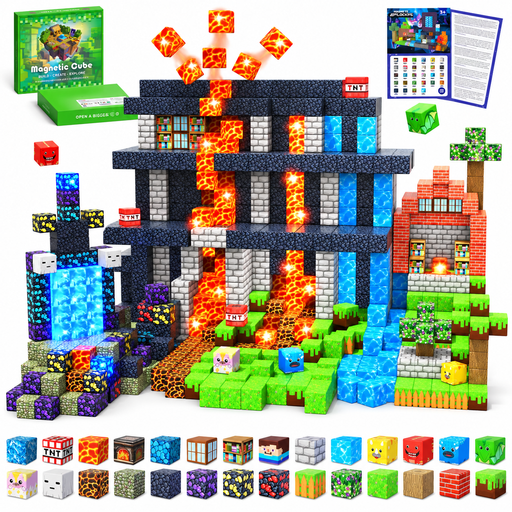
Why this choice suits this profile: with its 150 pieces, this set provides a versatile foundation for getting started. According to the product page, it is suitable for children from age 3 and avoids overcomplicating things with too many accessories from the outset.
The stated rounded edges and the number of pieces help avoid the limitations of a set that is too small or unpleasant to handle.
150 pieces, stated rounded edges and a focus on fine motor skills and 3D constructions.
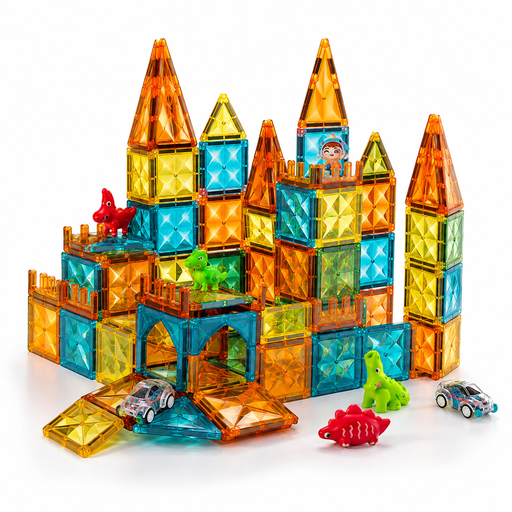
Why this choice suits this profile: the illuminated Ferris wheel adds a decorative feature and a real storytelling element to constructions. A great choice for children who enjoy switching between building and imaginative play.
The themed accessory extends the set’s appeal beyond simply assembling shapes.
Magnetic tiles, illuminated Ferris wheel and assembly described as being made using ultrasonic welding.
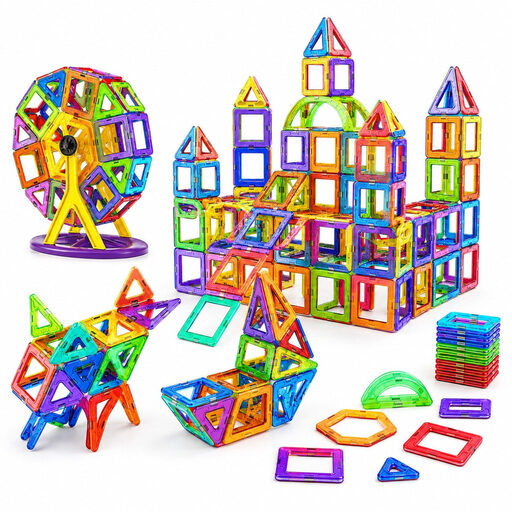
Why this choice suits this profile: this expansion set is aimed at families who already own a magnetic construction set and want to vary the models without replacing the whole kit.
The expansion format avoids buying duplicates and allows you to check compatibility with pieces you already have.
Spiral elements, magnets described as strong and a toy presented as washable.
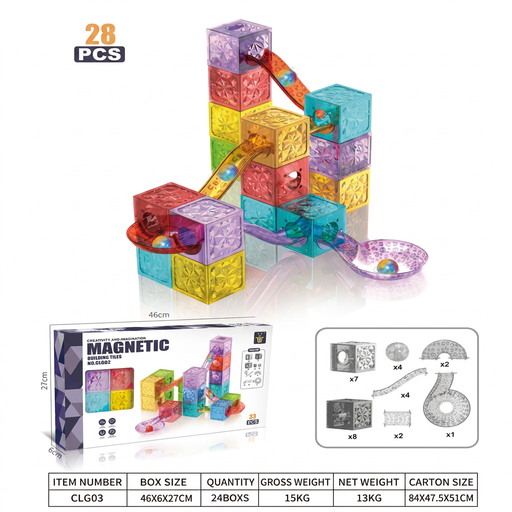
Why this choice suits this profile: their diamond surfaces and stated size of 5.5 cm offer an alternative to classic tiles, particularly for exploring volumes.
The stated dimensions and the included storage bag make handling easier and reduce the risk of losing pieces.
28 blocks, ABS plastic stated to be free from harmful substances and magnets integrated via ultrasonic welding, according to the product sheet provided.
We have put together a comprehensive, real-time updated selection of products that meet these demanding criteria and European safety regulations.
The lifespan of a set depends above all on how it is stored and used. To keep a Montessori toy or STEM game in good condition:
For classroom or group use, take an inventory after each session and adapt the models offered to the age of the group.
Some sets are labelled as suitable from age 3, but this does not remove the need for adult supervision. Check the size of the pieces, the warnings and the overall condition of the set. Extra care should be taken with children who still put toys in their mouths when magnets are involved.
A set of 50 to 100 pieces is enough to discover the concept and make simple shapes. A 150-piece set is better suited to building with others or for larger 3D projects. The variety of shapes also matters: don’t rely solely on the number stated.
Check the recommended age, warnings, CE marking, manufacturer information and the quality of the piece seals. Inspect the set before each use. If a magnet might have been swallowed, contact emergency medical services immediately: swallowing multiple magnets can cause serious complications.