Families preparing several lunchboxes
If you often use biscuits, look at both the total weight and how the pack is divided inside. A large pack split into individual sachets lets you take one portion without opening the others.


If you regularly prepare several lunchboxes, choose a family-size pack with individual inner packs, provided they contain the number you want to take with you. For a single lunchbox, a smaller pack divided into portions may be more convenient, but it contains less. In France, the DGCCRF says that Nutri-Score is voluntary. Compare the nutritional information per 100 g and check the allergens in the product you choose, rather than insisting on this logo.
If you often use biscuits, look at both the total weight and how the pack is divided inside. A large pack split into individual sachets lets you take one portion without opening the others.
A small sachet can go straight into a lunchbox. Check how many biscuits it contains, though: the total pack weight alone won’t tell you how much is in each portion.
Before choosing a recipe or pack size, read the ingredients and allergen information on the specific pack you plan to buy. The products mentioned here aren’t interchangeable when it comes to their ingredients.
For a secondary school lunchbox, start with how much you want to take, then compare the packaging, nutrition label and ingredients.
| Criteria | What to check | Who is it for? |
|---|---|---|
| Portioning | Count the inner sachets and biscuits in each one. St Michel lists 16 sachets of 5 in its 520 g pack; Auchan’s product page shows LU’s 150 g biscuits in 8 sachets of 3. | If you prepare one lunchbox at a time, you’ll want a portion that’s easy to take without opening the whole pack. Around 29% of consumers prioritise this kind of portioning. |
| Nutritional values | Compare the sugars, fat (including saturated fat) and salt per 100 g. A Nutri-Score, if shown, can help with this, but shouldn’t replace checking the figures. | When comparing two different-sized packs, you’ll want to check their nutritional values on the same basis. This is the main priority for around 29% of consumers. |
| Allergens | Check the ingredients, highlighted allergens and any “may contain” warnings on the exact pack, even if you’re switching to a different size. | If the lunchbox is for someone with an allergy, the ingredients matter more than the pack size. Around 24% of consumers prioritise this check. |
| Pack size | Compare the net weight, number of inner portions and storage instructions with how often you’ll use them. | If you prepare several lunchboxes during the week, you’ll want enough biscuits without buying more than you need. Pack size is the top priority for around 18% of consumers. |
The DGCCRF says Nutri-Score is voluntary in France, while the nutrition declaration on pre-packed foods provides the basis for comparing products per 100 g. Bio Village and Eco+ product pages from E.Leclerc also note that their Nutri-Scores were calculated using the previous system, which was in place before April 2025.
Compare the nutritional information on the pack you buy. If a Nutri-Score is shown, check which version of the packaging it refers to.
According to the brand, each of the 16 sachets in the St Michel family-size pack contains 5 biscuits. That may not be the amount you want to take in one go.
Check both the total weight and the contents of each sachet. Then decide whether you’ll take the whole sachet or portion the biscuits into a reusable container.
“All-butter” or “organic” doesn’t tell you everything that’s in a product. Depending on the specific product, the biscuits mentioned here may contain wheat, milk or eggs, or carry warnings about possible traces of other allergens.
Check the ingredients list and allergen information on the exact pack, even if you’re already familiar with the brand.
The number of sachets alone won’t tell you how much sugar, fat or salt is listed on the label.
Compare the values per 100 g across recipes, then choose a pack size that suits the amount you want to put in the lunchbox.
The details below apply to the specific products listed, not every biscuit made by each brand.
St Michel’s Galettes au bon beurre come in a 520 g family-size pack containing 16 sachets of 5.
Auchan’s product page for LU’s 150 g all-butter biscuits lists 8 sachets of 3 biscuits.
Carrefour’s Galettes fines pur beurre are sold in a 250 g pack.
Auchan’s all-butter Breton biscuits are listed as a 125 g pack containing 16 biscuits in individual sachets.
E.Leclerc’s product pages for Bio Village and Eco+ biscuits each feature a 125 g pack.
This selection features a 170 g pack to consider if you want to buy a smaller quantity. Before putting it in a lunchbox, check how it’s portioned inside rather than assuming it’s a family-size pack with individual sachets.
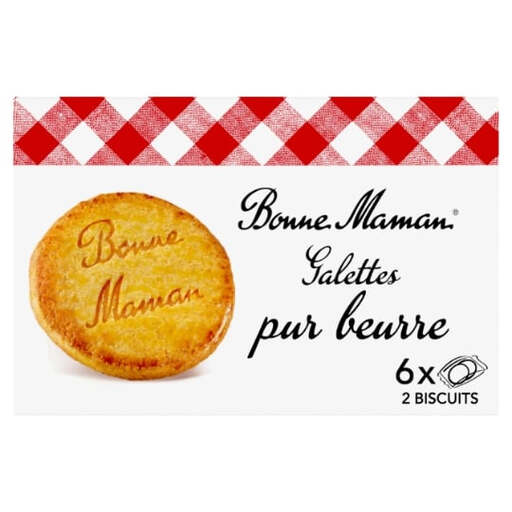 Image unavailable
This 170 g pack is a good option if you’re after a smaller quantity, rather than building up a large family-size supply. Before using it for a lunchbox, check the inner packaging, ingredients and allergen information on the pack.
No. The DGCCRF says Nutri-Score is voluntary in France. To compare pre-packed biscuits, check the nutrition declaration per 100 g, even if no Nutri-Score is shown.
Check the ingredients, highlighted allergens and any “may contain” warnings on the packaging of the specific product. Recipes and allergen information can vary between products and pack sizes; an individual sachet doesn’t change the ingredients in the biscuits.
Yes, if the pack actually contains separate inner sachets. St Michel lists 16 sachets of 5 biscuits in its 520 g pack. Check that this amount per sachet suits you, and follow the storage instructions on the pack.