
Livraison le jour même ou le lendemain

Qualité garantie

Débloquez vos offres de bienvenue: Livraison GRATUITE | Jusqu'à -80 % | 30 jours d'essai gratuits à JoyPlus
Téléchargez l'application
Between the commute from home to school, days at the office, picnics and meal prep, a lunch box needs to meet some very real requirements: enough capacity, a secure seal, easy cleaning and a material that's safe for food contact. Yet adverts sometimes highlight details that aren't actually the most important when it comes to making your choice.
A compartmentalised lunch box might look practical, but several sections aren't enough to stop liquid foods from mixing together. For a salad with dressing, a saucy dish or very juicy fruit, check for inner lids, seals or dividers designed to limit leaks and transfer.
A multi-compartment bento box is best suited to dry or semi-dry foods: rice, vegetables, sandwiches, chopped fruit and snacks. It won't necessarily replace a truly airtight container when you need to transport a liquid preparation.
This term can simply mean a closure that's splash-resistant, without guaranteeing the container can carry liquids in any position. Examine the system used: clips, latches, removable seal or press-on lid. Also check the manufacturer's recommendations, especially if the box shouldn't be turned upside down.
A lunch box intended to be carried in a bag needs a sufficiently reliable closure. For a child, the mechanism should also be easy to operate, while preventing accidental opening.
Stainless steel and glass are durable and reusable, but they're often heavier than plastic. A large glass container can be very practical for meal prep at home, but far less suited to a daily walk or public transport commute.
Also check whether the lid is dishwasher-safe, whether the seal can be removed and whether the different containers stack. These are the details that make a real difference day to day, especially after several weeks of use.
For a child, a capacity of 700 to 900 ml may be suitable, depending on their age and appetite. For an adult, choose according to your habits: a full meal, sandwich, salad or several small portions.
Large containers of 1.5 L are better suited to storage, sharing or bulky dishes. In a school or work bag, they can quickly become cumbersome.
Materials and accessories intended for food contact must comply with applicable European requirements, in particular those of Regulation (EC) No 1935/2004. This doesn't replace the need to check the precautions specific to each model.
A seal that's easy to remove limits the build-up of residue, provided you put it back correctly after cleaning. For a thermal food jar or 1.5 L insulated food flask, preparing the container can help maintain temperature. The Maxcook product sheet recommends preheating or pre-cooling it with water before filling.
According to the product sheets for the Maxcook MCTG0856 and MCTG0164 models, the stated thermal retention is 4 to 6 hours. However, this duration depends on several factors: initial temperature, volume filled, frequency of opening and external conditions.
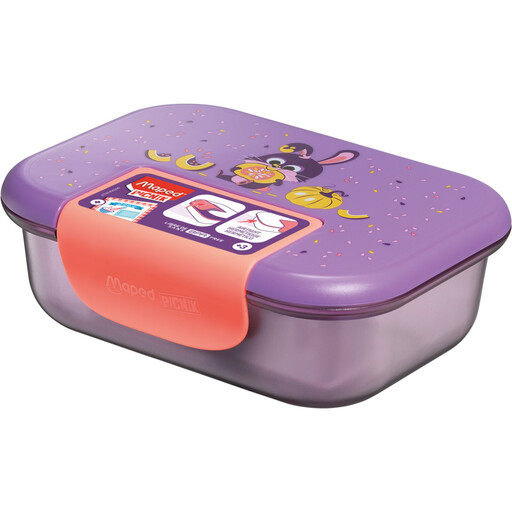
Why this choice suits this profile: Its 900 ml size and fluorescent clip are ideal for school meals and children learning to open their lunch box on their own.
The attached lid reduces the risk of losing a part, while the highly visible closure lets you quickly check the box is properly sealed before you leave.
Stainless steel, 900 ml capacity, attached lid and dishwasher compatibility as stated on the product sheet.

Why this choice suits this profile: The five 1,040 ml containers and five 370 ml sizes make it easy to organise meals and leftovers.
The different sizes prevent using a large container for a small portion and help reduce clutter in the fridge.
High-resistance borosilicate glass as stated, snap-lock lids and a ten-piece set.

Why this choice suits this profile: This large thermal food jar is designed for hot meals, soups and takeaways during long days or outings.
Its wide opening makes filling and cleaning easy. However, the product sheet recommends not tipping it over during transport.
316 stainless steel, vacuum insulation, 1.5 L capacity and lid with seal, according to the product description.

Why this choice suits this profile: The four identical containers make portioning, storing leftovers and organising prepared meals much easier.
The uniform size and stackable design make storage simpler and more predictable than with a mix of different sizes.
316L stainless steel, four 1,600 ml containers and stated compatibility with dishwasher and freezer.
We've put together a comprehensive, real-time updated selection of products that meet these demanding criteria and European safety regulations.
The Exeter Chicken Luncheon Meat 340 g is described as a ready-to-eat tinned halal chicken preparation. Its product sheet states a proportion of 80% mechanically separated chicken meat. It can accompany a sandwich, salad or a hastily prepared meal. The presence of wheat containing gluten is mentioned, as is the risk of traces of soya: always check the labelling before consuming the product.
After opening, the tin must be placed in the fridge, in a sealed container, at a temperature of 7 °C or below. It should then be consumed within two days, in line with the instructions provided. For practical and hygiene reasons, it's best to transfer the contents to a separate food container rather than keeping the opened tin itself.
Choose a capacity suited to the child's age, a closure that's easy to check and a size that fits comfortably in their bag. Stainless steel is impact-resistant, while a compartmentalised box can help separate different foods. For liquids, opt for a specifically airtight container.
Yes. It's often used to store several portions in the fridge or freezer, provided you follow the manufacturer's instructions. However, its weight and fragility should be taken into account if it's intended for daily transport.
Clean the container promptly after the meal, remove the seal if it's designed to be taken out and dry each part thoroughly before storing. Don't use metal containers in the microwave. Also replace any box that shows a crack, deformation or a closure that no longer holds properly.