When choosing a low-fat frozen dessert, start by checking the value per 100 g: under European Regulation (EC) No 1924/2006, a solid food can contain no more than 3 g of fat per 100 g to carry this claim. Sorbet may meet this criterion, but if you fancy something after dinner, compare the sugars and energy content too, then decide how much to serve.
Who are these criteria useful for?
People looking for a low-fat option
You want to check this in the nutrition information, rather than relying on the word ‘fruit’ or the size of the dessert. The apple sorbets listed by E.Leclerc and Auchan are below the threshold for the claim, but their sugar content is worth checking too.
People mindful of their portion after dinner
You want a chilled dessert without serving yourself straight from a large tub. Comparing the energy per 100 g, then deciding how much to serve, helps you distinguish the product’s nutritional profile from that of your portion.
People who prefer individual portions
You’d like a pre-portioned treat, while still checking its nutritional values. The mochi and ice cream bar examples listed by Picard show that a small format is not necessarily low in fat.
What should you check before buying?
For a frozen dessert after dinner, check the values per 100 g before choosing between a tub to portion out and an individually packaged treat.
| Criterion |
What to check |
Who is it for? |
| Fat |
Check the value per 100 g. For a solid food to carry the ‘low fat’ claim, European Regulation (EC) No 1924/2006 sets a maximum of 3 g per 100 g. |
I want to make sure the dessert I choose really meets my criteria, rather than relying on the flavour name alone. Around 42% of consumers would prioritise this check. |
| Sugars and energy |
Compare the sugars and energy per 100 g, then relate these values to the amount you plan to serve. |
After dinner, I want to take into account what’s in my portion, even if the sorbet is low in fat. This would be the main criterion for around 33% of consumers. |
| Format and storage |
Choose between an individual portion and a tub to portion out; check the weight and storage instructions on the packaging. |
I prefer a pre-portioned treat, or a tub that lets me serve the amount I want. This convenience would be the main consideration for around 25% of consumers. |
Common misconceptions to avoid
-
Assuming ‘fruit’ or ‘individual’ means low in fat
These words describe a recipe or format, not its nutritional value. Picard lists 11 g of fat per 100 g for its coconut ice cream mochi and 20 g for its Snickers ice cream bar.
Check the ‘fat’ value per 100 g before choosing a product presented as low in fat.
-
Assuming low-fat sorbet is low in sugar
The product information for E.Leclerc and Auchan apple sorbets lists 25 g and 23 g of sugars per 100 g respectively. Fat content alone does not tell you everything about a product’s nutritional values.
Compare the sugars and energy on the same per-100 g basis, then choose how much to serve.
-
Serving yourself straight from a large tub
A tub doesn’t define how much you eat; conversely, an individual portion defines the format but doesn’t guarantee a low fat content.
If you choose a tub, serve the sorbet in a bowl. For an individual dessert, always check the values per 100 g and the allergen information.
-
Overlooking storage on the way home
The product information checked at Carrefour and Picard recommends storage at −18 °C; Picard also says not to refreeze its products once thawed.
Plan how you’ll transport frozen food and follow the storage instructions on the packaging.
Brands to compare when checking labels
Carrefour
Carrefour Extra apple sorbet comes in a tub, making it easy to check a fruit-based option against its nutrition information.
- Carrefour describes this sorbet as ‘0% fat’ and lists 118 kcal per 100 g.
- The fat claim doesn’t mean you can skip checking the sugars or deciding how much to serve.
E.Leclerc / Eskiss
Eskiss apple sorbet made with whole fruit comes in a 650 g tub.
- E.Leclerc’s product information lists 0.5 g of fat and 116 kcal per 100 g.
- It also lists 25 g of sugars per 100 g, so check this separately from the fat content.
Auchan
Auchan apple sorbet with pieces comes in a 665 g tub.
- Its product information lists less than 0.5 g of fat and 117 kcal per 100 g.
- It also lists 23 g of sugars per 100 g; choosing a portion is a separate decision.
Picard
Picard’s individual frozen desserts show why it’s worth checking the recipe as well as the format.
- An individually wrapped treat makes it clear how much is in the pack.
- Picard lists 11 g of fat per 100 g for its coconut ice cream mochi and 20 g for its Snickers ice cream bar. Neither meets the threshold for the ‘low fat’ claim.
Sorbet sticks on Joybuy
This mango sorbet stick format is ideal if you’d rather choose an individual portion than serve yourself from a tub. Always check the product’s nutritional values against the portion you plan to have.
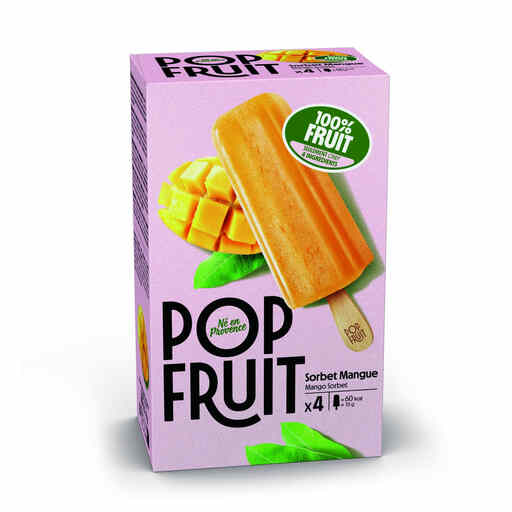 Image unavailable
POP FRUIT Sorbet Sticks 100% Mango, pack of 4 (280 g)
If you fancy sorbet in an individual portion rather than from a tub, this pack contains four sticks, with a total weight of 280 g.
Before choosing this format for an evening treat, compare the fat and sugars per 100 g on the label.
View on Joybuy
Frequently asked questions
How can I tell if a frozen dessert is low in fat?
For a solid food carrying this claim, check that the nutrition table lists no more than 3 g of fat per 100 g, in accordance with European Regulation (EC) No 1924/2006. The flavour name or the presence of fruit is no substitute for this value.
Is low-fat sorbet always low in sugar?
No. The E.Leclerc and Auchan product information for the apple sorbets mentioned above lists 25 g and 23 g of sugars per 100 g respectively. Compare the sugars separately from the fat, using the same per-100 g basis.
Is an individual portion enough to help me choose a low-fat dessert?
No. It defines the amount, but not the fat content. Picard’s product information lists 11 g of fat per 100 g for its coconut ice cream mochi and 20 g per 100 g for its Snickers ice cream bar.
What should I check if I’m having this dessert after dinner?
Check the fat, sugars and energy per 100 g, then consider how much you plan to eat. A low fat content alone doesn’t tell you everything about the portion as a whole.
How should I store a frozen dessert after buying it?
Follow the storage instructions on the packaging, including when transporting it and putting it in the freezer. The Carrefour and Picard product information checked recommends storage at −18 °C; Picard also says not to refreeze its products once thawed.


