People who put the sauce’s salt content first
For your homemade dinner, you want to compare the salt content of the products you’re considering. The value per 100 g matters more to your decision than a general description of the recipe.


To choose a lower-salt pasta sauce, compare the “salt” value per 100 g across products of the same type. Tomato purée lets you season the recipe yourself, while a ready-made sauce makes serving quicker. In either case, check the label of the specific product rather than judging its salt content by its name or Nutri-Score.
For your homemade dinner, you want to compare the salt content of the products you’re considering. The value per 100 g matters more to your decision than a general description of the recipe.
You’re happy to cook a tomato base so you can choose the herbs and vegetables, and control how much salt you add during preparation.
You’re looking for a sauce that’s ready to heat and a pack size that suits the number of guests, without assuming that the packaging or Nutri-Score alone tells you how much salt it contains.
First, decide whether you want to cook a tomato base or heat up a ready-made sauce. Then compare the salt per 100 g across products of the same type, and choose a pack size that suits the meal.
| What to consider | What to check | Who is this for? |
|---|---|---|
| Salt content | The “salt” value per 100 g on sauces of the same type, and the exact wording of any “no added salt” claim. | If I want to limit the salt in the sauce I serve, I need a comparable value rather than relying on an impression given by the name; around 42% of consumers would put salt content at the top of their list of criteria. |
| Seasoning | The difference between a tomato base and a ready-made sauce, as well as the ingredients list for the product you choose. | When I make the sauce, I want to choose the herbs myself and control how much salt I add; nearly 33% of consumers would make this freedom their main consideration. |
| Time and pack size | The net weight, how many packs you’ll need, and the preparation and storage instructions. | If I’m entertaining and want to keep preparation time down, I’m looking for an amount that suits the number of guests; around 25% of consumers would prioritise speed and packaging. |
These claims don’t tell you how much salt a sauce contains. Nutri-Score gives an overall nutritional profile, not just a rating for salt.
Check the “salt” value per 100 g, then read the ingredients and allergen information for the product you’re considering.
Carrefour’s listing for a Heinz sauce described as having “no added salt or sugar” says that this product is unavailable.
Check availability at your chosen shop or for your chosen click and collect service before planning a meal around a specific product.
Otherwise, you may need to spend time changing the recipe or choosing another sauce.
Auchan says that the ingredients in its cooked tomato sauce may vary depending on the store and the date of purchase.
Check the nutritional information and ingredients list for the product available locally, then check the label on the jar you receive.
Panzani offers both a cooked tomato sauce and a cooking base, Tomacouli Nature, for recipes you can customise.
Barilla’s cooked tomato sauce is a ready-made option to serve with pasta.
This range of cooked tomato sauces gives you two jar sizes to compare for a homemade meal.
Auchan’s cooked tomato sauce has a value worth checking when comparing ready-made sauces.
BARESA, a brand sold by Lidl, offers options including an onion tomato sauce, with a pack size to suit your needs.
These tomato purées are cooking bases for homemade pasta sauce. Compare pack sizes to suit your meal, and check the label if salt content is a factor in your choice.
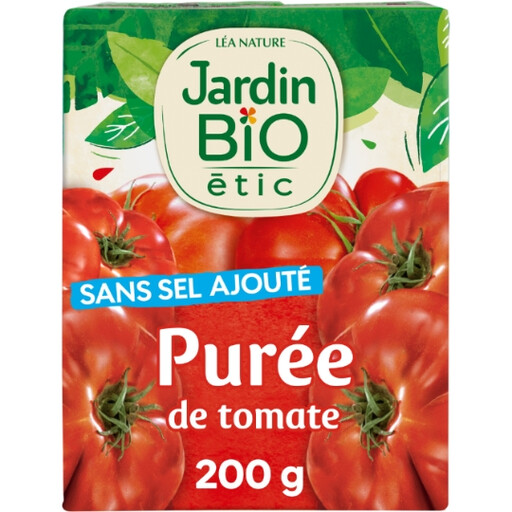 Image unavailable
This tomato purée makes a suitable base for a homemade pasta sauce that you can season yourself.
Pack size: 200 g. If you’re choosing this product based on its salt content, check the value per 100 g and the information on the packaging.
 Image unavailable
This tomato purée can be used as a base for making and seasoning pasta sauce.
Pack size: 500 g. To decide based on salt content, check the value per 100 g and the exact wording on the packaging.
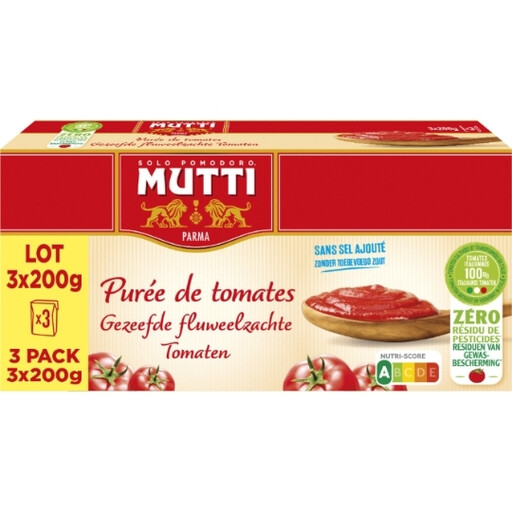 Image unavailable
This multipack of tomato purée can be used to make homemade sauce, with the containers kept separate.
Pack size: 3 × 200 g. Before choosing it to reduce salt, check the “salt” value and ingredients list on the packaging: the product listing gives conflicting information on this point.
No. Nutri-Score doesn’t replace the “salt” value in the nutritional information. To compare two sauces for the same use, check this value per 100 g on each product.
“No added salt” describes a feature of the recipe; it doesn’t necessarily mean the “salt” value is zero. If you’re choosing based on salt content, check the exact claim and the value per 100 g on the packaging, then compare products of the same type.
No. Carrefour’s listing for a Heinz sauce described as having “no added salt or sugar” says that this product is unavailable. Check your local store or click and collect service before planning dinner around it.
Choose tomato purée if you want to create your own seasoning and have time to prepare it; a cooked sauce is a good option if you’d prefer something quicker. In either case, compare the salt per 100 g on the products you’re considering and allow enough for your guests.