People keeping an eye on fat
You use stock cubes in soups, rice dishes, vegetables or sauces and want to compare their fat content based on the same preparation.


If you want to limit your fat intake, compare the nutritional values of stock cubes on a like-for-like basis, distinguishing between the dry product and the prepared stock. A ‘reduced fat’ label can help guide your choice, but it’s no substitute for checking the salt, ingredients and allergens. ‘No added salt’ addresses a different priority.
You use stock cubes in soups, rice dishes, vegetables or sauces and want to compare their fat content based on the same preparation.
You check the net weight and number of cubes to choose a pack suited to the amount of stock you make.
You also check the salt and ingredients list: a cube that meets your fat criteria may not suit your other dietary requirements.
Start by comparing fat content on a like-for-like nutritional basis, then check the salt and ingredients in the specific recipe. Pack size and flavour can help you choose between cubes that meet your criteria.
| Criteria | What to check | Who is it for? |
|---|---|---|
| Fat | The amount listed per 100 g of dry product or per 100 ml of prepared stock, as well as the dilution. | If I want to limit the fat in my cooking, I need to compare values calculated on the same basis. Around 36% of consumers concerned would make this their priority. |
| Salt and ingredients | Salt per serving or prepared volume, followed by the ingredients and allergens in the recipe. | If salt or a particular ingredient affects my choice, a ‘reduced fat’ label isn’t enough. Around 29% of consumers concerned would prioritise this check. |
| Pack size | The net weight and number of cubes in the pack. | If I make stock regularly, I want to know how many cubes are in the pack I choose. Nearly 21% of consumers concerned would prioritise this criterion. |
| Flavour and use | The recipe, such as vegetable, chicken, beef or pot-au-feu, and the preparation instructions. | For a soup or slow-cooked dish, I look for a suitable flavour once I’ve checked my other criteria. Around 14% of consumers concerned would put this preference first. |
These labels refer to different characteristics. Stock with no added salt should still be checked for its fat content, while reduced-fat cubes should also be checked for salt.
Compare fat and salt separately, using the same preparation basis for the products you’re comparing.
Net weight alone doesn’t tell you how many cubes are in a pack or how much stock you can make by following the instructions.
Check the number of cubes and recommended dilution, while keeping your nutritional criteria in mind.
Ingredients and allergen warnings vary between stocks. A fat content that suits you won’t tell you whether allergens are present.
Read the ingredients list and allergen information on the packaging of the product you choose.
The range includes KUB OR Dégraissé and reduced-fat stock cube varieties in beef, poultry and pot-au-feu flavours.
The Chicken Stock, described as low in fat, and the No Added Salt Vegetable Stock cater to different priorities.
Reduced-Fat Beef Stock is worth considering if you’re looking for this flavour in a cube labelled as having reduced fat.
The brand offers a reduced-fat pot-au-feu stock cube, intended for use in soups, rice, pasta and vegetables.
This vegetable stock cube is labelled as having less salt. If your priority is to limit fat, compare its nutritional information with that of reduced-fat stock cubes using the same preparation basis.
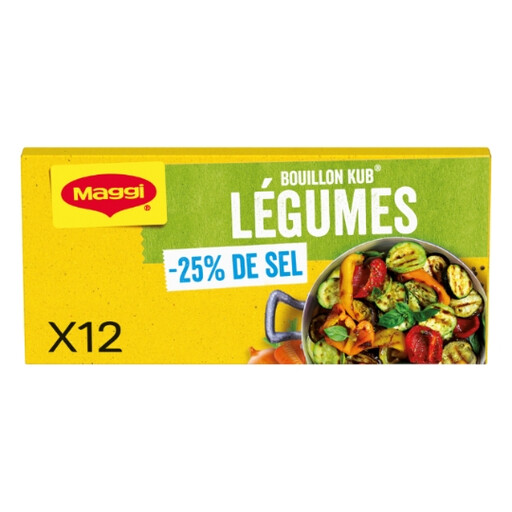 Image unavailable
For seasoning soup or vegetables, this cube may suit anyone comparing a vegetable stock recipe with reduced-fat options.
Pack size: 120 g. The ‘25% Less Salt’ claim refers to salt, not fat. Check the nutritional values for the prepared stock before choosing.
Compare values given on the same nutritional basis, such as per 100 ml of prepared stock at the stated dilution. A value for the dry cube can’t be compared directly with one for diluted stock.
No. The ‘no added salt’ claim doesn’t tell you how much fat the product contains. For its No Added Salt Vegetable Stock, Knorr France lists 0,02 g of salt and 1,3 g of fat per serving. Check both values separately.
Yes, because fat content doesn’t tell you how much salt a product contains. According to the brand, Knorr Chicken Stock contains 0,6 g of fat and 1,7 g of salt per serving. Check both figures for the recipe you’re considering.
Follow the instructions on your stock’s packaging. For its reduced-fat pot-au-feu stock cube, Auchan recommends transferring the tablets to an airtight container after opening, if possible, and keeping them away from heat and moisture.