Families comparing fat content
If you’re buying several pizzas for the same meal, compare their values per 100 g rather than assuming that a vegetable topping or thin crust means less fat. Check the saturated fat and salt too.


To choose lower-fat frozen pizzas for a large family, compare the fat content per 100 g of similar products, then check the saturated fat, salt and the amount you’ll actually serve. The topping or family-size format alone won’t tell you how much fat a pizza contains; where shown, the Nutri-Score is an additional guide.
If you’re buying several pizzas for the same meal, compare their values per 100 g rather than assuming that a vegetable topping or thin crust means less fat. Check the saturated fat and salt too.
Net weight and the portions you plan to serve matter just as much as the words “family size”. A larger pizza can make serving easier, but its size alone won’t tell you about its nutritional composition.
Check the ingredients and allergen information for each product you choose, even when you switch recipe or size. Wheat and milk are among the ingredients in several pizzas listed on Carrefour and Auchan product pages.
Start with the factor that matters most to your household, then compare the values per 100 g with the amount you’ll need for the meal.
| Criteria | What to check | Who this matters to |
|---|---|---|
| Fat | Compare the fat and saturated fat per 100 g in pizzas with similar recipes. | If I want to reduce the fat in the meal, I need to be able to compare products without relying on their topping names. Around 33% of consumers make this their priority. |
| How much to serve | Check the net weight and how many portions you plan to serve. | To feed the whole family, I want to know whether one large pizza will be enough or whether I’ll need several boxes; this is the priority for around 25% of consumers. |
| Overall nutritional values | Check the salt per 100 g too and, if shown, compare the Nutri-Score of pizzas in the same aisle. | A lower fat content doesn’t answer all my questions about a product’s composition. Around 25% of consumers prioritise this broader comparison. |
| Allergens and storage | Read the allergen information for the exact product and its storage instructions; check you have enough freezer space. | If a recipe needs to meet your household’s requirements and be stored properly after shopping, these checks come before other criteria for around 17% of consumers. |
These terms don’t tell you how much fat a pizza contains. For example, Carrefour product pages list 5.4 g of fat per 100 g for Carrefour Extra 4 Stagioni and 15 g per 100 g for Carrefour Extra 4 Cheese. These figures apply only to those two recipes.
Compare the nutritional information for the products you’re considering, especially fat, saturated fat and salt per 100 g.
A large pizza is only useful if there’s enough for the meal you have planned; its size doesn’t mean it contains less fat.
Check the net weight of each box and work out how many pizzas you’ll need to feed your household.
Ingredients vary from one recipe to another. The pizza examples listed by Carrefour and Auchan include products containing wheat or milk.
Check the ingredients, allergen information and any ‘may contain’ warnings on the packaging of the exact product.
Freezer space and the journey home matter when you’re buying in bulk. Anses points out that breaking the cold chain can encourage bacteria to grow.
Make room for the boxes and follow the storage instructions on their packaging.
These brands offer products worth looking at individually: the figures for one recipe don’t represent an entire range.
Carrefour Extra and Carrefour Bio pizza product pages let you compare different recipes and their nutritional values.
The Ristorante range includes a mozzarella pizza and a Grandissima 4 Cheese designed for sharing.
The Buitoni recipes listed include an Air Fryer Salami pizza and a La Grandiosa 4 Formaggi.
Auchan product pages feature products in different sizes, including a 200 g 4 Cheese pizza.
The E.Leclerc range includes family-size pizzas and multipacks under these brands.
These products offer different options for a family meal: a pizza to share, mini pizzas, individual pizzas and lahmacun, a pizza-like speciality. Compare their composition and how many boxes you’ll need for the portions you have planned. Their inclusion here doesn’t mean they carry a “reduced fat” claim.
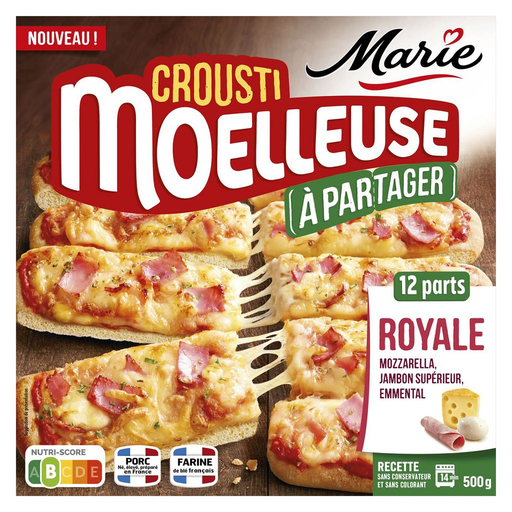 Image unavailable
This sharing-size pizza could work well if 500 g is enough for the portions you have planned.
Compare the nutritional values for the exact product and check its allergen information before buying.
 Image unavailable
Mini pizzas make it easy to share them out, but check how many 270 g packs you’ll need for the meal.
Check the fat per 100 g and the allergen information on the packaging you choose.
 Image unavailable
If you’re looking for a vegetable topping, compare this 385 g pizza with other recipes using the values per 100 g. Don’t assume its topping means it contains less fat.
Also check whether this weight gives you the portions you want, and read the allergen information on the box.
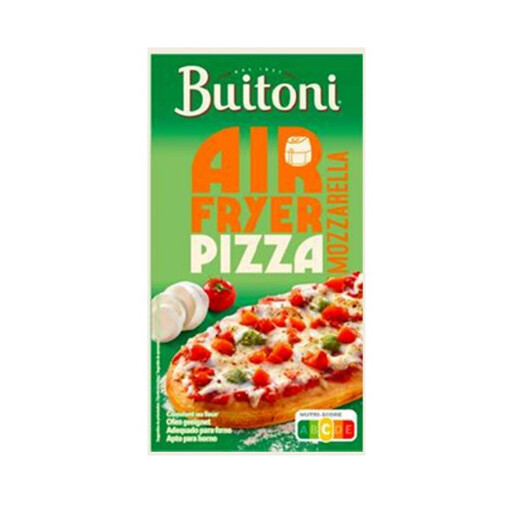 Image unavailable
At 195 g, you may need several boxes for a family meal, so check the portions before choosing.
Air Fryer refers to how it’s prepared, not its fat content. Follow the cooking instructions on the packaging.
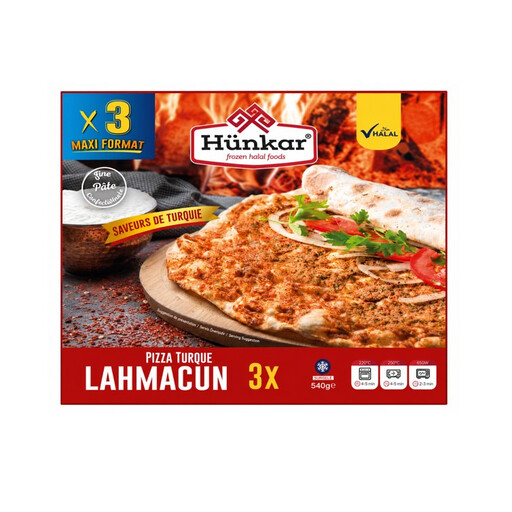 Image unavailable
These three lahmacuns weigh 540 g in total. They’re a pizza-like speciality rather than a classic pizza, so check they suit your household’s tastes and portion sizes.
Check the packaging for the ingredients, allergen information and any dietary features you’re looking for.
No. A difference between two recipes isn’t enough to establish that a pizza carries this claim. Manger Bouger points out that nutrition claims are regulated. To compare products, read their values per 100 g rather than inferring a claim from the topping name.
Compare fat, saturated fat and salt per 100 g across pizzas with similar recipes. If a Nutri-Score is shown, use it as an additional guide when comparing products in the same aisle, but don’t let it replace checking the nutritional information.
Check the ingredients, declared allergens and any ‘may contain’ warnings on every box, even if the pizzas are from the same brand. Recipes and ingredients can vary between products and sizes.
Follow the storage instructions on the packaging of the product you’ve bought, especially before considering refreezing it. Anses points out that breaking the cold chain can encourage bacteria to grow, so plan how you’ll transport the pizzas and make room in the freezer when buying several boxes.