What should you check before buying?
For your party, first check that the dessert meets your requirements for fat content. Then make sure its format and storage conditions suit how you plan to serve it.
| Criteria |
What to check |
Who it matters to |
| Fat content |
Compare the value per 100 g or 100 ml across similar products and read the exact nutrition claim. |
If I’m looking for a lower-fat dessert, I want to distinguish a like-for-like comparison from a mere impression that it’s light; around 36% of consumers would prioritise this check. |
| Portions |
Check the number of items or portions and the amount per serving before working out how many desserts you’ll need. |
When several children are waiting for dessert, I want to serve everyone without a lot of fiddly cutting; ease of serving would be a priority for around 29% of consumers. |
| Ingredients and allergens |
Check the ingredients list and allergen information for the exact product, including any warnings about possible traces. |
If a guest has a known allergy, I want to rule out an unsuitable recipe before serving; this would come first for around 21% of consumers. |
| Storage |
Check the temperature and instructions on the packaging, then plan transport and storage accordingly. |
If the journey or wait before the party makes storage difficult, I need to keep the dessert at the stated temperature; around 14% of consumers would prioritise this planning. |
Individual sorbet portions on Joybuy
These sorbet ice lollies are an individual-portion option for your party. Their format alone doesn’t prove that they’re lower in fat.
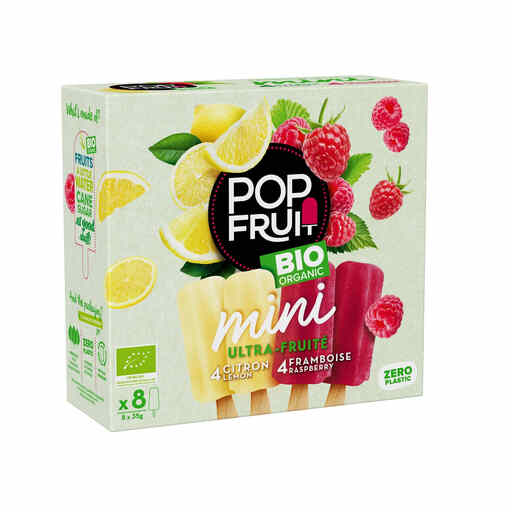 Image unavailable
POP FRUIT Mini, organic lemon and raspberry sorbet ice lollies, 8 x 280 g
The ice-lolly format can make serving easier, with no need to cut anything up. Check the packaging to see how many portions you can actually hand out.
To see whether this product suits your search for a lower-fat dessert, compare the fat content of the flavours in question and check the exact claim. If anyone has an allergy, read the ingredient and trace warnings. Follow the storage instructions and don’t refreeze the product once it has thawed.
View on Joybuy
Frequently asked questions
How do you compare the fat content of two frozen desserts?
Compare the ‘fat’ value per 100 g or 100 ml, using the same unit and similar products. The DGCCRF says that this format for nutrition information makes comparisons easier. Check any claim on each product’s packaging separately.
Is a water ice always lower in fat?
No: the product name is no substitute for its nutritional values. Check the fat content of the exact product, and look at its sugars and ingredients too before choosing it for the party.
Does ‘no added sugars’ mean ‘lower in fat’?
No, these claims relate to different characteristics. An Auchan product listing for ‘no added sugars’ strawberry sorbet includes vegetable oils and sweeteners, so check the fat, sugars and ingredients separately.
How should you store frozen dessert until the birthday party?
Follow the temperature and instructions on the packaging, from transport through to serving. Pick up frozen food at the end of your shop and keep it out of the freezer for as little time as possible. The DGCCRF points out that a rise in temperature can increase food safety risks.
Should you check the allergens in sorbet for children?
Yes, if a guest has a known allergy or other dietary restriction. Check the ingredients and allergen information for the exact product, including any warnings about possible traces. Don’t assume you know what it contains just because it’s called ‘sorbet’.


