People who compare fat content first
You’re looking for a sweet breakfast option with a lower fat content than the other biscuits you’re considering. Values per 100 g make this comparison possible; saturated fat and sugars are also worth checking.


To choose a lower-fat cake or biscuit for breakfast, first compare the fat and saturated fat per 100 g in products intended for the same purpose. Then check the sugars, fibre and allergens: a lower fat content alone does not tell you everything about a recipe.
You’re looking for a sweet breakfast option with a lower fat content than the other biscuits you’re considering. Values per 100 g make this comparison possible; saturated fat and sugars are also worth checking.
You want to check sugars and fibre as well as fat, and look at the Nutri-Score if it appears on the product. One figure alone doesn’t describe the full composition of a biscuit.
You need to check the ingredients and allergen information for the exact recipe, or you prefer packaging that makes it easier to see how much you’re serving. The pack format doesn’t change the nutritional values per 100 g.
When comparing biscuits for a sweet breakfast, start with the values per 100 g, then check the ingredients and pack format according to what matters most to you. The Directorate General for Competition Policy, Consumer Affairs and Fraud Control explains that presenting values per 100 g makes it easier to compare foods.
| Criteria | What to check | Who it matters to |
|---|---|---|
| Fat | Compare the fat and saturated fat per 100 g in recipes intended for the same purpose. | I want to reduce my fat intake without relying on the name of the biscuit or where it’s sold. Around 37% of consumers would prioritise this criterion. |
| Overall nutritional values | Also check the sugars, fibre and salt per 100 g; look at the Nutri-Score if one is displayed. | A lower-fat biscuit isn’t enough for me if its sugar content doesn’t match what I’m looking for. Around 27% of consumers would put this balance first. |
| Ingredients and allergens | Check the ingredients list, declared allergens and any ‘may contain’ warnings for the exact flavour and pack format. | If I have a dietary requirement, I need to check the composition of the pack I’ve chosen before looking at other criteria. Around 18% of consumers would put this check first. |
| Portion size and packaging | Check the pack weight and, where stated, the quantity that makes up one portion. | For breakfast, I prefer to be able to see easily how many biscuits I’m serving. Portion size and pack format would be priorities for around 18% of consumers. |
A difference between two recipes isn’t enough, by itself, to describe either one as low-fat. E.Leclerc and St Michel product listings each show 16 g of fat per 100 g for Grainea Multi Céréales and Petites Galettes, compared with 26 g for Roudor, according to St Michel.
Compare the values per 100 g, then look at the other nutritional information before choosing a recipe.
Values can vary from one recipe to another: Auchan lists 18 g of fat and 16 g of sugars per 100 g for Gerblé Matin Noisette; E.Leclerc lists 16 g and 21.4 g respectively for Grainea Multi Céréales.
Compare the figures in the nutrition declaration rather than making assumptions based on the product name.
Auchan’s listing for Gerblé Matin Noisette biscuits mentions wheat, hazelnuts, oats and soya, among other ingredients used in the production facility.
Before buying, check the ingredients, allergens and any ‘may contain’ warnings on the packaging of the exact product.
Recipes can vary within the same brand, so compare specific products rather than choosing based on the manufacturer’s name alone.
The Matin Noisette breakfast range gives you several nutritional values to compare on a single product listing.
Multi Céréales breakfast biscuits provide a point of comparison for fat and sugars.
The all-butter galettes help you distinguish between choosing a smaller portion and choosing a lower-fat recipe.
Carrefour lists LU’s Belvita biscuits among its breakfast biscuits.
Carrefour’s breakfast biscuit range includes its own-brand products alongside other brands.
These two Gerblé biscuits are suitable for a sweet breakfast. To decide whether either fits your search for a lower-fat recipe, compare its nutrition declaration with those of the other biscuits you’re considering and check the ingredients on the pack you choose.
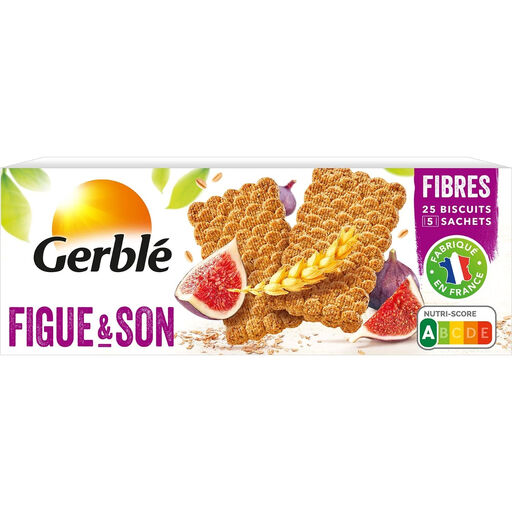 Image unavailable
Worth considering if you’re looking for a biscuit to enjoy as part of a sweet breakfast. Compare its nutritional values per 100 g and check the ingredients and allergens on the packaging.
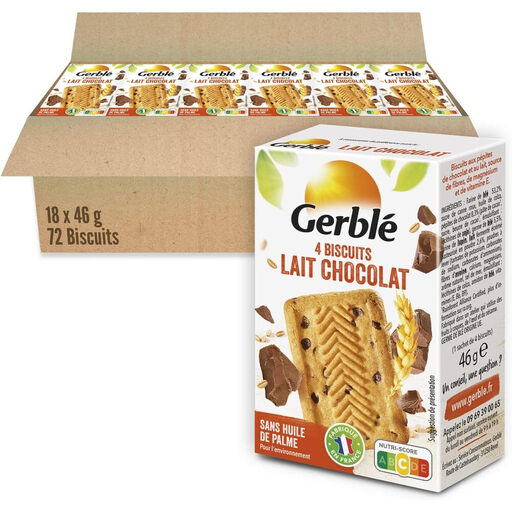 Image unavailable
Worth considering if pack size is important when choosing breakfast biscuits. Compare its composition per 100 g with other recipes and check the allergens on the packaging.
Compare their fat and saturated fat per 100 g, rather than looking only at the values per portion. The Directorate General for Competition Policy, Consumer Affairs and Fraud Control explains that nutrition information presented per 100 g makes foods easier to compare. Then check the sugars and any other values that matter to you.
No. A lower fat content doesn’t tell you about sugars, fibre or salt on its own. If a Nutri-Score is displayed, it gives an indication of overall nutritional quality; check the nutrition values too when comparing the recipes you’re interested in.
No, the presence of cereals doesn’t prove that a biscuit contains less fat. E.Leclerc lists 16 g of fat per 100 g for Grainea Multi Céréales, while Auchan lists 18 g for Gerblé Matin Noisette. Compare the specific recipe and its other nutritional values.
Before buying, check the ingredients, declared allergens and any ‘may contain’ warnings for the exact recipe. For example, Auchan’s listing for Gerblé Matin Noisette mentions wheat, hazelnuts, oats and soya, among other ingredients. This composition shouldn’t be assumed to apply to all Gerblé biscuits.