Families comparing calories per serving
If you want to know how many calories are in the amount you serve, start with the kcal per 100 g and the weight of each portion. Compare similar recipes rather than relying on the word ‘light’ alone.


For a large family, choose between a ready meal to share and individual portions based on how you plan to serve dinner. You could also build the meal around frozen vegetables, though these are not a complete meal on their own. Compare the kcal per 100 g of similar products, then factor in the amount you’ll actually serve: neither the pack size nor the recipe name alone tells you how many calories will be on your plate.
If you want to know how many calories are in the amount you serve, start with the kcal per 100 g and the weight of each portion. Compare similar recipes rather than relying on the word ‘light’ alone.
A meal designed for sharing lets you serve everyone at the table. The number of servings shown on the pack is a useful guide for planning, but according to Manger Bouger, a child’s portion should be adjusted to their age, among other factors.
Individual portions make it easier to work out how much is in each tray when mealtimes vary. However, you’ll still need to compare the ingredients and energy values of different recipes.
First decide whether you want a complete ready meal or ingredients to put together yourself. For a ready meal, choose a format that suits your plans, then check the nutritional information for the specific product.
| Criterion | What to check | Who it matters to |
|---|---|---|
| Calories per serving | Compare the kcal per 100 g of similar products, then take the amount you’ll actually serve into account. | If I’m sharing a family meal, I want to know the calories on my plate rather than in a theoretical serving. Around 33% of consumers would make this calculation their priority. |
| Family-size pack | Check the net weight and, if shown, the number of servings; plan how to divide it between those eating. | For a meal eaten together, I’m looking for an amount to share without assuming everyone will eat the same portion. A pack to share would be the priority for around 27% of consumers. |
| Nutritional content | Check the salt and fat content too, and look at the Nutri-Score if it appears on the pack. | I don’t want to choose a recipe based on calories alone if other nutritional information matters to my comparison. Around 20% of consumers would look at this broader set of information first. |
| Meal planning | Check the cooking instructions, storage requirements and whether it’s designed to be served or reheated. | When people in the household eat at different times, I’m mainly looking for a meal that’s easy to prepare and portion out. Around 20% of consumers would put ease of planning first. |
A recipe name or the serving size shown on the pack won’t, on its own, tell you the energy value of the amount you’ll serve.
Check the kcal per 100 g and the weight you’re serving before comparing two meals.
Anses lists ready meals among the foods that contribute to salt intake. So if two recipes look similar, it’s worth taking a closer look at their labels.
Compare the salt and fat content too, as well as the Nutri-Score if one is shown.
The number of servings helps you plan your shopping, but it doesn’t mean that everyone in the family should have the same amount. Manger Bouger says children’s portions should be adjusted to their age.
Divide the meal between the people at the table, rather than treating the pack as a guide to each person’s portion.
Getting your frozen food home and putting it away are part of choosing a convenient product. The DGCCRF recommends keeping transport time to a minimum and using an insulated bag where possible.
Pick up frozen food last, carry it in an insulated bag and follow the storage instructions on the pack.
These retailers offer ways to compare different formats and recipes. Their inclusion here doesn’t guarantee the nutritional details of a specific product or its availability when you shop.
Carrefour’s frozen ready meal range separates individual meals from dishes designed for sharing.
Picard offers individual meals and recipes to share, including a 900 g bag labelled as serving 3 to 4 people.
E.Leclerc DRIVE’s frozen food range includes ready meals and other products you can add to a family shop.
Lidl France lists frozen ready meals in a selection that may change.
This frozen vegetable mix can be served as a side to share at a family meal. On its own, it isn’t a complete ready meal.
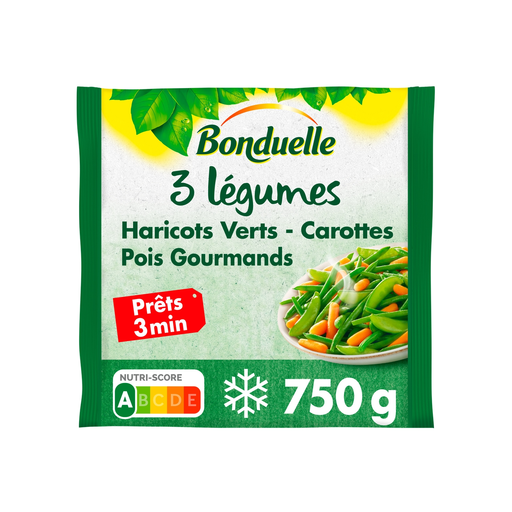 Image unavailable
Serve as a side dish to share at a family meal, and plan the other parts of the meal separately.
Pack size: 750 g. To work out the calories in each serving, check the nutritional information on the pack and weigh the amount you serve.
No. The calories per serving also depend on how much you serve. For a recipe you’re interested in, start with the kcal per 100 g shown on the pack, then factor in the weight of your portion.
No. According to Manger Bouger, the Nutri-Score is calculated per 100 g or 100 ml; it doesn’t tell you how many calories are in the portion you’ll serve. Check the energy value and the portion weight separately.
No, sharing a meal doesn’t mean everyone has to have the same portion. Manger Bouger says children’s portions should be adjusted to their age, so divide up the meal according to who’s eating rather than treating the number of servings on the pack as an instruction for everyone.
Where possible, carry them in an insulated bag and keep the time between buying them and putting them away at home to a minimum, as recommended by the DGCCRF. Then follow the storage instructions on each pack.
No. A recipe’s name alone doesn’t tell you what it contains. In its survey of 150 fresh and frozen ready meals, CLCV found nutritional differences between meals in the same category. Compare the nutritional information for the specific products you’re considering.