To control the ingredients in a cake with less sugar, start with a recipe designed around the ingredients you’ve chosen; its name alone won’t tell you how much sugar it contains. For a packaged cake, distinguish between the claim ‘sugar-free’ and a relative reduction. Under Regulation (EC) No 1924/2006, published on EUR-Lex, ‘sugar-free’ means no more than 0.5 g of sugars per 100 g, while a product with reduced sugars may still contain sugar.
Who are these options for?
People who bake cakes at home
You’d rather choose the ingredients and quantities yourself than guess how much sugar a recipe contains from its name. If you’re using ingredients such as fruit purée or chocolate, check the specific ingredients you’ve chosen too.
People looking for a ‘sugar-free’ claim
You’re looking for a packaged cake that meets this specific claim and want to check the ‘of which sugars’ line, ingredients and allergens before buying.
Families looking to reduce their sugar intake
You’re looking for a ready-to-eat cake advertised as having reduced sugars, without requiring it to carry the ‘sugar-free’ claim. The reference used for comparison and the nutritional values are still important when making your choice.
What should you look for first?
For a homemade recipe, start with the ingredients and quantities. For a packaged cake, check the exact claim before comparing the nutritional values.
| What to check |
Points to consider |
Who it matters to |
| Claim on the packaging |
Compare the exact claim with the ‘of which sugars’ line per 100 g. Under Regulation (EC) No 1924/2006, published on EUR-Lex, ‘sugar-free’ means no more than 0.5 g of sugars per 100 g. Anses points out that ‘no added sugars’ does not rule out naturally occurring sugars. |
If I’m mainly looking for a ‘sugar-free’ claim, a relative reduction alone doesn’t meet my criteria. Around 42% of consumers put this distinction first. |
| Homemade recipe |
Choose a recipe that lists its ingredients and quantities. Before using a sweetener, check that it’s suitable for baking and follow the recommended amount. |
When I bake a cake, I want to control what I add without assuming that removing table sugar gets rid of all sugars. This is the main priority for around 33% of consumers. |
| Ready-to-eat option |
Check the number of portions and the nutritional values, then distinguish between a reduced-sugar claim and ‘sugar-free’. |
For breakfast or a snack with no preparation, I’d choose a packaged cake whose advertised reduction matches what I’m looking for. Convenience comes first for around 25% of consumers. |
Which misunderstandings should you avoid?
-
Confusing ‘no added sugars’ with ‘sugar-free’
Anses explains that a product with no added sugars may still contain sugars that occur naturally in its ingredients, particularly fruit.
If the amount of sugar matters to you, read the ‘of which sugars’ line per 100 g rather than relying on the claim on the front of the pack.
-
Taking a reduction to mean there are no sugars
St Michel says its chocolate-coated Doonuts contain ‘30% less sugar than the market average’, while listing sugar and invert sugar syrup among the ingredients. This comparison doesn’t mean ‘sugar-free’.
Look for a relative reduction if your aim is to reduce sugar. If you’re looking for a ‘sugar-free’ claim, check for it separately on the product.
-
Swapping sugar for a sweetener at random
An intense sweetener chosen for its sweet taste won’t necessarily suit your recipe or the amount you plan to use. Anses does not present using one as a guarantee of nutritional benefit.
Follow a recipe designed for your chosen ingredient, and check its packaging for baking suitability and recommended quantities.
Brands and retailers to know
St Michel
An option if you’re looking for a packaged cake advertised as having reduced sugars, rather than being ‘sugar-free’.
- St Michel says its chocolate-coated Doonuts contain 30% less sugar than the market average and come in a pack of six.
- The ingredients include sugar, milk chocolate containing sugar and invert sugar syrup.
Carrefour
Its baking and sweetener range lets you explore different products before choosing a recipe.
- The Carrefour catalogue includes, among other things, sucralose and stevia tablets.
- A sweetener being stocked in this range doesn’t necessarily mean it’s suitable for baking. Check the product information or packaging for the one you choose.
Auchan
A retailer where you can browse biscuit and cake ranges if you’d prefer a packaged product.
- Auchan’s selection includes biscuits and cakes labelled ‘sugar-free’ and ‘no added sugars’.
- These claims don’t mean the same thing. Check the claim on the product you choose as well as its nutritional values.
Lidl
A recipe option for people who prefer to bake their own cake and check every ingredient.
- Lidl offers a fondant cake recipe titled ‘without sugar or butter’, using ingredients including dark chocolate, apple purée and ground almonds.
- The recipe title doesn’t prove that it contains no sugars. Check the exact ingredients you’ll be using, particularly the chocolate and apple purée.
Packaged cakes to consider on Joybuy
This packaged pineapple cake is an option if you’re looking for a ready-to-eat product advertised as having reduced sugars. It’s not a homemade recipe or a product carrying the ‘sugar-free’ claim.
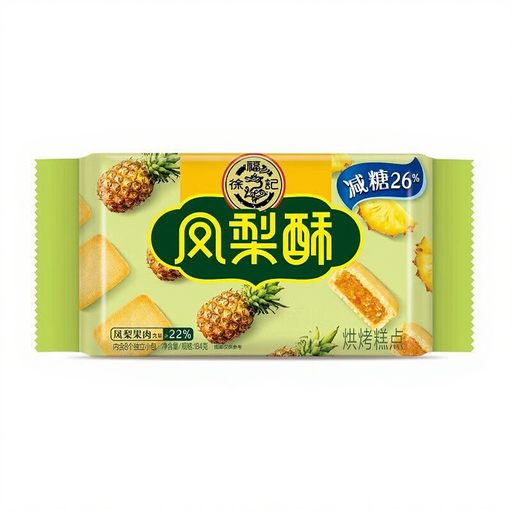 Image unavailable
HSU FU CHI Pineapple Cake (Reduced Sugar), 184 g, 8 sachets
This pineapple cake is a good option if you’d rather buy a packaged cake than bake one at home.
The 184 g pack contains 8 individual sachets.
The ‘Reduced Sugar’ claim doesn’t mean ‘sugar-free’. If the distinction matters to you, check the ‘of which sugars’ line and the ingredients list.
View on Joybuy
Frequently asked questions
Do ‘sugar-free’ and ‘no added sugars’ mean the same thing?
No. Under Regulation (EC) No 1924/2006, published on EUR-Lex, ‘sugar-free’ means no more than 0.5 g of sugars per 100 g. Anses points out that ‘no added sugars’ does not rule out sugars that occur naturally in the ingredients. For a packaged cake, check the ‘of which sugars’ line too.
Can I use any sweetener in a homemade cake?
Don’t assume that a sweetener can replace sugar in every recipe. Check that it’s suitable for baking and follow the recommended amount for the product you’ve chosen. It’s better to use a recipe designed for that ingredient than to improvise a like-for-like swap.
Does a cake with reduced sugars meet the requirements for a ‘sugar-free’ product?
No. A relative reduction alone doesn’t meet the ‘sugar-free’ claim. St Michel says its chocolate-coated Doonuts contain 30% less sugar than the market average, but their ingredients include sugar. If you’re looking for a ‘sugar-free’ claim, check for it and read the value per 100 g for the product you choose.
Does an intense sweetener automatically provide a nutritional benefit?
No. In its assessment published in January 2015, Anses found no evidence of a benefit that would justify encouraging people to replace sugar with intense sweeteners in food. When choosing ingredients for your cake, follow the recipe and the product instructions rather than assuming that a sweetener offers a nutritional benefit simply because it’s included.


