People keeping an eye on their salt intake
You want to compare the salt content per 100 g and choose the seasoning yourself. Anses lists sauces and condiments among dietary sources of sodium.


If you want to control the seasoning in your pasta, start with tomato purée or chopped tomatoes with no added salt, then check the ingredients and allergens of the product you choose. A ready-made sauce takes less preparation, but the claim ‘no added salt’ doesn’t guarantee that it’s dairy-free. Compare the salt content per 100 g too.
You want to compare the salt content per 100 g and choose the seasoning yourself. Anses lists sauces and condiments among dietary sources of sodium.
You check the exact recipe rather than relying on a claim about salt. Tomato sauce can contain milk or cheese, even when it’s listed among meat-free sauces.
You’re happy to season a tomato base and choose the ingredients for your sauce. Chopped tomatoes or tomato purée take more preparation than a ready-made sauce.
Choose this if: you want to season a tomato base yourself.
Bear in mind: you’ll need to prepare the sauce before serving it with your pasta.
Choose this if: you’d prefer a sauce that’s already been prepared, after checking the label for the specific recipe.
The downside: the seasoning is already set, and a claim about salt doesn’t tell you whether the sauce contains milk.
| What to check | What to look for | Who is this useful for? |
|---|---|---|
| Salt content | Look for the claim ‘no added salt’, then compare the salt content per 100 g of products intended for the same use. The DGCCRF explains that displaying this information per 100 g makes it easier to compare products. | I want to choose my own seasoning rather than rely on a claim on the front of the pack. Around 42% of consumers would put controlling salt intake first. |
| Dairy ingredients | Read the ingredients and any highlighted allergens for the variant you’re buying. Avoid recipes that list milk or cheese if you need to steer clear of them. | For lactose-free pasta, I need to check every recipe, even if it says ‘no added salt’. Checking for dairy ingredients would be a priority for around 33% of consumers. |
| Preparation and format | Choose between a ready-made sauce and a base you can season yourself. Also check the storage instructions after opening. | I want to prepare pasta quickly without losing the option to adapt the recipe. Ease of use would come first for around 25% of consumers. |
The Heinz Garlic & Onion sauce listed by Carrefour with a no-added-salt claim declares a flavouring that contains milk. So you need to check both criteria separately.
Check the ingredients and any highlighted allergens on the pack for the exact recipe.
The claim ‘no added salt’ doesn’t tell you how much salt the product contains. The nutrition declaration shows the salt content on a comparable per-100 g basis.
Compare the salt content of the products you’re considering before choosing a sauce or tomato base.
How long a product keeps after opening depends on the specific item. For the Jardin BiO étic chopped tomatoes listed by Auchan, the advice is to keep them chilled and use them within three days.
Choose a size that suits your meals and follow the storage instructions on the pack you buy.
You may end up wasting some of a large carton if you don’t plan to use it within the stated time.
Availability may depend on the retailer, seller or store. E.Leclerc, for example, advises customers to check with their local centre for certain products.
Check the product, pack size and seller when you put together your basket.
Panzani offers tomato bases, including Tomacouli Nature, as well as ready-made sauces.
Barilla’s tomato sauce range includes recipes with different ingredients.
Carrefour stocks tomato sauces from other brands, including a Prosain sauce with no added salt.
E.Leclerc offers sauces and tomato bases, including products under the Turini and Notre Jardin brands.
Auchan offers tomato bases with no added salt, including Jardin BiO étic chopped tomatoes and Mutti tomato purée.
Lidl lists a Baresa tomato sauce on its French website.
These three products are tomato purées to use as a base for pasta sauce, rather than pre-seasoned sauces. Check the ingredients, allergens and salt content of the variant you choose. For the MUTTI 3x200g multipack, pay particular attention to the salt information on the pack.
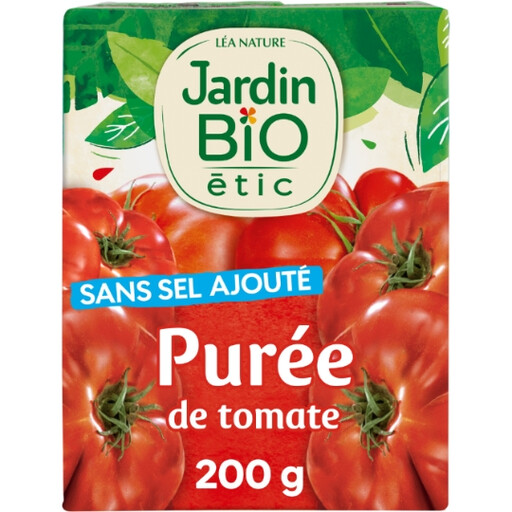 Image unavailable
This purée is a good choice if you’d like to season a tomato base for pasta yourself. Joybuy’s listing for this product says ‘no added salt’. Check the ingredients and allergens on the pack to make sure it suits your lactose-free requirements.
 Image unavailable
This 500 g size can be used as the base for a sauce that you season yourself. Before choosing it for lower-salt, lactose-free pasta, check the salt content, ingredients and allergens for this variant on the pack.
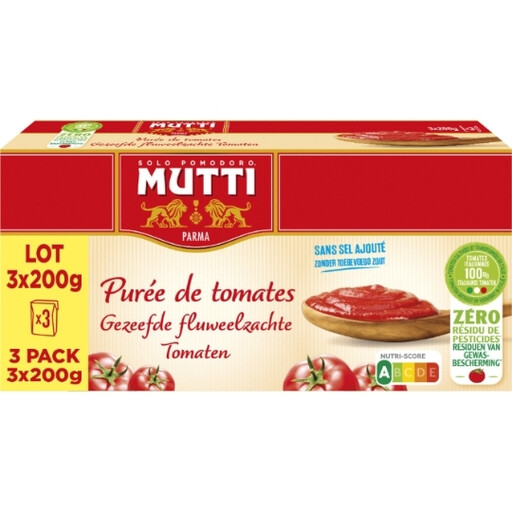 Image unavailable
This pack of three cartons can be used to make pasta sauce over several meals. The salt information in the product descriptions is inconsistent. Before deciding whether it’s right for your basket, check the pack for any added salt, the salt content and allergens.
No, these claims answer two different questions. The Heinz Garlic & Onion sauce listed by Carrefour with a claim about salt declares a flavouring that contains milk. Always read the ingredients and allergens for the recipe you choose.
Compare the salt content per 100 g in the nutrition declaration for products intended for the same use. The DGCCRF explains that values per 100 g or 100 ml make comparisons easier. Then take account of how much you’ll serve.
Tomato purée can be used as a base for pasta sauce, but you’ll need to season it to suit the recipe you have in mind. Auchan suggests adding herbs and spices to Mutti tomato purée with no added salt to make a sauce.
Follow the storage time shown on the pack of the product you buy. For the Jardin BiO étic chopped tomatoes listed by Auchan, the advice is to keep them chilled after opening and use them within three days.