People looking for a low-fat option
If the word ‘light’ isn’t enough for you, compare the fat content per 100 g. For a solid food, EU Regulation (EC) No 1924/2006 sets a maximum of 3 g of fat per 100 g for a ‘low fat’ claim.


If you’re looking for a low-fat frozen dessert in a tub that’s easy to chew, start by comparing the fat content per 100 g, then check the ingredients for any pieces. A sorbet whose ingredients list doesn’t mention any inclusions could be a good starting point, but that doesn’t guarantee a texture suitable for someone with swallowing difficulties.
If the word ‘light’ isn’t enough for you, compare the fat content per 100 g. For a solid food, EU Regulation (EC) No 1924/2006 sets a maximum of 3 g of fat per 100 g for a ‘low fat’ claim.
If pieces of fruit, nuts, biscuits or chocolate chips make chewing difficult, check the ingredients list for the specific flavour. The word ‘sorbet’ alone doesn’t tell you whether it contains inclusions.
You can’t assume that a shop-bought ice cream or sorbet is suitable just from its category or appearance. The International Dysphagia Diet Standardisation Initiative (IDDSI) says that texture should be assessed under the intended serving conditions, including at the temperature at which the product will be eaten.
When choosing a tub of frozen dessert, check the nutritional information for the flavour you’re considering, then look at the ingredients and the texture required when serving.
| Criteria | What to check | Who is it for? |
|---|---|---|
| Fat | The amount per 100 g. For a ‘low fat’ claim on a solid food, EU Regulation (EC) No 1924/2006 sets a maximum of 3 g per 100 g. | I want to choose based on a specific figure rather than the impression created by the flavour or packaging. Around 50% of consumers rank this check as their top priority. |
| Pieces and inclusions | The ingredients list and any mention of fruit pieces, shards or other inclusions. | I want to avoid pieces that take extra effort to chew, even in a low-fat sorbet. For around 30% of consumers, avoiding inclusions comes first. |
| Allergens or prescribed texture | The allergens listed on the packaging. If a particular texture has been prescribed, check that it’s suitable at the actual serving temperature with the relevant healthcare professional. | I need to take an allergy or individual texture guidance into account before choosing a product. This check comes first for around 20% of consumers. |
A product’s category doesn’t replace its nutritional information. The threshold for a ‘low fat’ claim is based on the amount measured per 100 g, in accordance with EU Regulation (EC) No 1924/2006.
Compare the ‘fat’ row in the nutrition table for the flavour and size you intend to buy.
Carrefour Extra apple sorbet is described as containing 0% fat, but Carrefour also lists apple pieces making up 5.4% of the product. So the fat content doesn’t tell you how much effort it takes to chew the inclusions.
If you need to avoid pieces, look for mentions of fruit pieces, shards or chips in the ingredients list.
A frozen product’s appearance isn’t enough to establish whether it’s suitable for someone with swallowing difficulties. According to the IDDSI, texture should be assessed under the intended serving conditions.
If a specific texture has been prescribed, follow the individual guidance given by the healthcare professional supporting the person concerned.
A low fat content doesn’t mean a product is low in sugar. Auchan lists less than 0.5 g of fat and 23 g of sugar per 100 g for its organic mango sorbet.
If sugar content matters to you too, compare the amount per 100 g and the portion you plan to serve.
These products show how fat content, pieces and packaging information can vary by flavour, so it’s worth checking each one.
Auchan offers a 586 g tub of organic mango sorbet.
The Carrefour Extra products considered here include an apple sorbet and a tub of vanilla ice cream, with different characteristics.
Häagen-Dazs Vanilla is an ice cream whose recipe includes cream, milk and eggs.
This tub gives you a chance to compare the stated fat content per 100 g against your criteria. Also check the pack size and texture when serving.
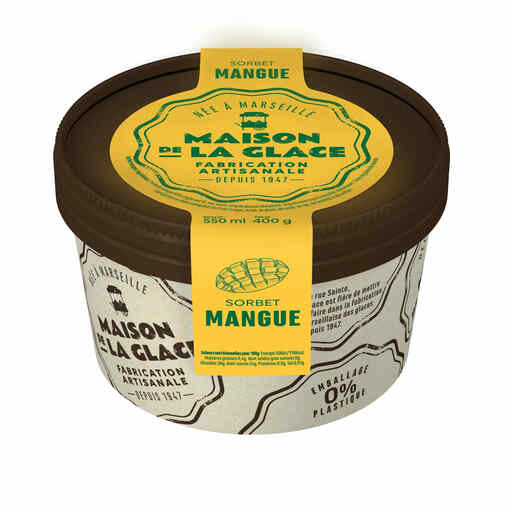 Image unavailable
This tub of sorbet may appeal to people looking for a low-fat option with ingredients that don’t mention any inclusions.
The product information lists 0.36 g of fat and 24 g of sugar per 100 g, and describes the texture as smooth and creamy. The title states 380 g, while the description states 400 g, so check the net weight on the packaging.
This description of the texture doesn’t confirm that the product is suitable for someone with swallowing difficulties.
For a solid food, EU Regulation (EC) No 1924/2006 allows this claim if the product contains no more than 3 g of fat per 100 g. Check the figure for the flavour and size you’ve chosen: ‘sorbet’ or ‘fruity’ is no substitute for the nutrition table.
No. Carrefour lists apple pieces making up 5.4% of its Carrefour Extra apple sorbet. If pieces are difficult to chew, check the ingredients for the specific product rather than relying on the ‘sorbet’ category alone.
You can’t tell from its name, appearance or fat content alone. The IDDSI says that texture should be assessed under the intended serving conditions. If a specific texture has been prescribed, follow the advice of the healthcare professional supporting the person.
No. Auchan lists less than 0.5 g of fat in its organic mango sorbet, but 23 g of sugar per 100 g. If both matter to your choice, compare these two figures separately in the nutrition information.