Anyone looking for the ‘low in fat’ threshold
You want to apply this specific criterion to the drink you use for crêpes, rather than assume its fat content from terms such as ‘plant-based’ or ‘light’. Compare the figure given per 100 ml.


If by ‘low fat’ you mean ‘low in fat’ as defined by the nutrition claim, choose a drink containing no more than 1.5 g of fat per 100 ml. Auchan and Carrefour product listings give figures of 1.3 g/100 ml for Bjorg Soja léger bio and 1.5 g/100 ml for Carrefour Sensation, respectively. When making crêpe batter, compare the ingredients and sugars too: meeting this threshold doesn’t mean a drink is plain or unsweetened.
You want to apply this specific criterion to the drink you use for crêpes, rather than assume its fat content from terms such as ‘plant-based’ or ‘light’. Compare the figure given per 100 ml.
You’d prefer a plain soya drink, perhaps organic or with no added sugars, so you can decide how much sugar or vanilla to add. This may lead you to choose a drink that doesn’t meet the strict fat threshold.
You check the protein, calcium or vitamins listed on the label. Compare these figures separately from the fat content: a fortified product won’t necessarily meet your original criterion.
When choosing a drink for crêpes, first decide whether your priority is the fat threshold or a plain ingredient list. Then check the other nutritional information and which product is available in your shop. Under the consolidated version of Regulation (EC) No 1924/2006, published by the European Union on 13 December 2014, the ‘low in fat’ claim for liquids requires a maximum of 1.5 g of fat per 100 ml.
| Criterion | What to check | Who is it for? |
|---|---|---|
| Fat | Check the figure per 100 ml: the threshold for the ‘low in fat’ claim for a liquid is 1.5 g/100 ml. | If I’m looking specifically for a drink that meets this threshold for my crêpes, I start with this line on the label. Around 40% of consumers would put fat content at the top of their list. |
| Ingredients and taste | Compare the ingredients list and, for sugar, the ‘of which sugars’ line in the nutritional information. | If I want to decide how much sugar and flavouring to add to the batter, a plain ingredient list takes priority, even if the drink exceeds the fat threshold. This would be the main criterion for around 30% of consumers. |
| Protein and added nutrients | Check protein separately, along with whether calcium or vitamins have been added. Don’t confuse these with fat content. | If I’m comparing the nutritional values shown for different drinks, I want to distinguish them from my ‘low fat’ criterion. Around 20% of consumers would prioritise protein or added nutrients. |
| Availability in store | Check the product and its label at the retailer you shop with, as well as the pack size you need for your recipe. | I want to find a suitable pack where I do my shopping, then check the product I actually buy. For around 10% of consumers, this practical consideration would come first. |
These terms describe different characteristics. The E.Leclerc product listing gives Bio Village Soja Nature Sans Sucres Ajoutés a fat content of 1.8 g/100 ml, above the 1.5 g/100 ml threshold for the claim on liquids.
If meeting this threshold is your priority, check the fat content per 100 ml before comparing other claims.
The Auchan listing for Bjorg Soja léger bio includes cane sugar, inulin, natural flavouring and stabilisers. Carrefour Sensation’s listing mentions fruit juice concentrates. These ingredients may matter if you’re looking for a plain base for your batter.
Compare the ingredients and the ‘of which sugars’ line, then adjust the additions in your recipe to suit your taste.
Carrefour and Auchan listings state that calcium and vitamins have been added to Alpro Soja, and that calcium has been added to Auchan’s soya drink. These details alone don’t tell you the fat content per 100 ml needed to check whether it meets the threshold.
Check each nutritional value separately for the product you choose.
The listing for Auchan’s soya drink states that it must not be used as the sole source of food for infants under 12 months, unless advised by a paediatrician. Choosing a drink for family crêpes is not the same as choosing infant food.
If you have questions about feeding an infant, don’t apply the criteria for this recipe; ask a health professional for advice.
The Auchan listing for Bjorg Soja léger bio gives a fat content of 1.3 g/100 ml, below the 1.5 g/100 ml threshold for liquids.
The Carrefour Sensation listing gives a fat content of 1.5 g/100 ml, exactly at the threshold. Carrefour Bio Soja Nature’s listing gives 2.1 g/100 g: to check this product against the threshold for liquids, look for its figure per 100 ml.
According to the E.Leclerc listing, Bio Village Soja Nature Sans Sucres Ajoutés contains organic soya juice and has a fat content of 1.8 g/100 ml.
The Carrefour listing for Alpro Soja states that calcium and vitamins D2, B2 and B12 have been added, and gives a fat content of 2.8 g/100 g.
The listing for Auchan’s plant-based soya drink states that calcium has been added, and gives figures of 3.2 g of protein/100 ml and 1.9 g of fat/100 ml.
This soya drink, sold in 250 ml cartons, is worth considering for crêpe batter. If fat content is your top priority, check the figure per 100 ml on the product you buy.
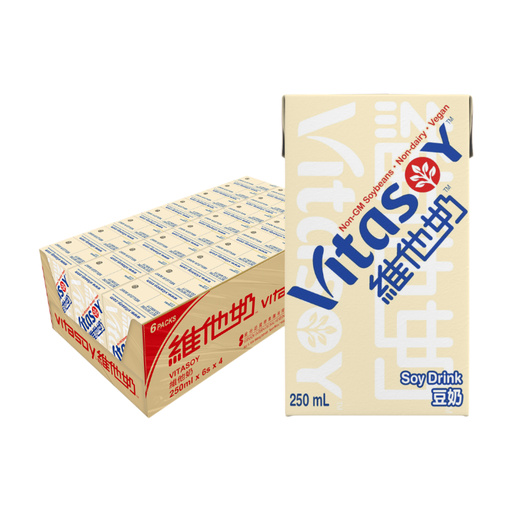 Image unavailable
When making crêpe batter with a soya drink, check the fat content per 100 ml and the sugars on the label of the product you buy.
Pack size: 24 cartons of 250 ml.
For a liquid, the claim means a maximum of 1.5 g of fat per 100 ml, under the consolidated version of Regulation (EC) No 1924/2006 published by the European Union on 13 December 2014. You can still use a drink above this threshold in a crêpe recipe; it simply doesn’t meet this specific criterion.
No: these claims don’t tell you the fat content. The E.Leclerc listing for Bio Village Soja Nature Sans Sucres Ajoutés gives a figure of 1.8 g/100 ml, above the 1.5 g/100 ml threshold for the ‘low in fat’ claim on liquids.
No. Don’t choose a soya drink intended for cooking as an infant’s sole source of food. The listing for Auchan’s soya drink carries this warning for infants under 12 months, unless advised by a paediatrician. Ask a health professional for advice about feeding an infant.
Follow the storage instructions for the product you buy. The Auchan listing for Bjorg Soja léger bio says to consume within 4 days of opening, while the listing for Auchan’s soya drink says 5 days in the fridge at between 0 °C and +6 °C. These storage times don’t automatically apply to other drinks.