People keeping an eye on fat
You compare values per 100 ml and don’t want to confuse “no added sugars” with a low fat content.


When choosing a low-fat oat drink before the October half-term break, start by checking the value per 100 ml. Regulation (EC) No 1924/2006 sets the maximum for a “low fat” claim on a drink at 1.5 g of fat per 100 ml. Product information from Alpro France, Carrefour and Auchan gives values of 1.5 g for Alpro Oat No Sugars and 1.2 g for the Carrefour Bio and Auchan Bio products mentioned here. Then compare the sugars, intended use and storage instructions for the carton you choose: “no added sugars” does not mean “low fat”.
You compare values per 100 ml and don’t want to confuse “no added sugars” with a low fat content.
You’re buying cartons for breakfasts and cooking, while taking into account how they need to be stored before and after opening.
You’re looking for a drink that froths in coffee, without assuming that a Barista version also meets your fat-content criteria.
For your October half-term shopping, check the fat per 100 ml first, then compare products by their sugar content, storage requirements and intended use.
| Criterion | What to check | Who it matters to |
|---|---|---|
| Fat | Check the value per 100 ml. Under Regulation (EC) No 1924/2006, a “low fat” claim on a drink requires a maximum of 1.5 g per 100 ml. | If my main aim is to choose a low-fat drink, I want to be able to judge this from the label rather than a claim on the front. Around 36% of consumers would put this need first. |
| Sugars | Compare the “sugars” line and distinguish “sugar-free” from “no added sugars”; check the fat content separately. | When choosing a drink that is sugar-free or has no added sugars, I need to check the exact wording rather than assume its composition based on another criterion. This would be the priority for around 29% of consumers. |
| Storage | Read the storage instructions for before opening, then check the temperature and time limit given for after opening. | When I shop before setting off, I want to be able to put the cartons away and avoid opening more than I need during the trip. Storage would come first for around 21% of consumers. |
| Coffee and cooking | Check whether the drink is recommended for coffee or recipes, then look at the nutrition table if low fat is still important to you. | If I mainly make coffee drinks or recipes, how I’ll use the carton matters more to me than its name alone. Around 14% of consumers would put this use first. |
These claims refer to two different characteristics. For a drink, Regulation (EC) No 1924/2006 sets the maximum for a “low fat” claim at 1.5 g of fat per 100 ml.
Compare the “fat” and “sugars” values per 100 ml separately on the carton you’re buying.
Oatly describes its Barista Edition as a drink that creates microfoam for coffee. This intended use doesn’t mean it’s low in fat.
If froth is your priority, look at the version made for coffee. If fat content is important, check its value per 100 ml too.
Storage requirements change after opening. For the Bio oat drink mentioned here, Auchan says to keep it refrigerated at a maximum of +6 °C and consume it within five days.
Open cartons as you need them and follow the instructions for each product.
A dated offer doesn’t guarantee that a product will be available when you shop. Lidl’s page for Vemondo featured an offer dated 30 September 2026.
Check the product and its availability at the shop where you plan to buy it.
The 1 L Oat No Sugars product lets you compare sugars and fat separately.
The range mentioned includes an Original oat drink, a No Sugars version and a Barista Edition.
Carrefour lists a 1 L organic oat drink carrying the claim “no added sugars”.
E.Leclerc lists a 1 L carton of Bio Village organic oat drink with no added sugars.
Auchan lists a 1 L organic oat drink with no added sugars.
Lidl featured an organic oat drink under its Vemondo brand in an offer dated 30 September 2026.
These two 1 L NATRUE drinks suit different needs during your trip: one is Oat Drink 0%, the other Chai Latte. Their names don’t replace checking the nutritional values and storage instructions on the packaging.
 Image unavailable
If you’re planning to buy an oat drink for your trip, this product comes in a 1 L carton.
The “0%” in its name doesn’t replace the “fat” value per 100 ml. Also check the carton for storage instructions after opening.
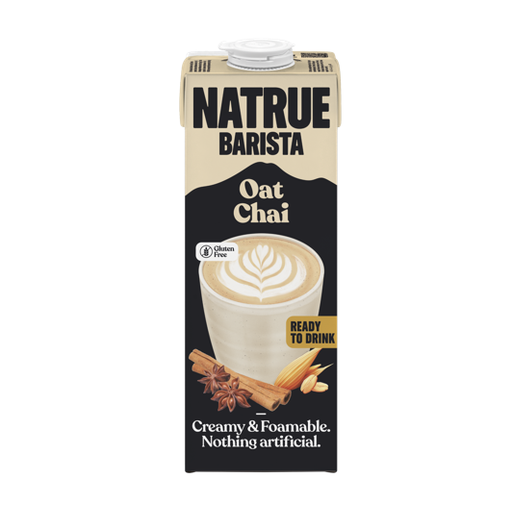 Image unavailable
If you’d like to bring an oat-based chai latte drink for your trip, this version comes in a 1 L carton.
If fat or sugars are important to your choice, compare their values per 100 ml and read the ingredients list on the packaging.
Under Regulation (EC) No 1924/2006, this claim, or wording with the same meaning, requires a drink to contain no more than 1.5 g of fat per 100 ml. Compare the value per 100 ml on the packaging of the product you buy.
No. These claims and the fat content refer to different characteristics. Check the sugar claim, the “sugars” line and the “fat” line separately on the carton.
Yes, provided the product you choose can be stored unopened in the conditions you have available. Once opened, follow its instructions: for the Bio oat drink mentioned here, Auchan says to keep it refrigerated at a maximum of +6 °C and consume it within five days.
No. A recommendation for use in coffee doesn’t tell you how much fat the drink contains. Oatly describes its Barista Edition as creating microfoam. If low fat matters to you too, check the value per 100 ml for this variant.
No, not for a baby under one year old. The French Agency for Food, Environmental and Occupational Health & Safety (Anses) warns that replacing breast milk or breast-milk substitutes with a drink not designed for this purpose may pose nutritional risks.